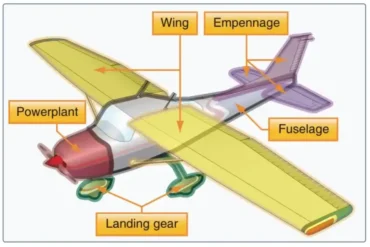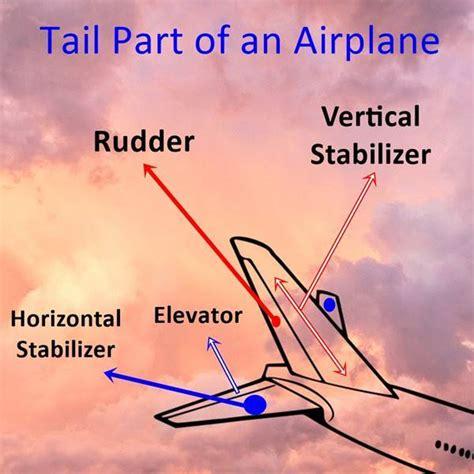
The empennage, often called the tail or tail assembly, is a crucial part of an airplane located at its rear. It includes the vertical stabilizer, horizontal stabilizers, and control surfaces, providing stability and control during flight. The most common type, known as the regular tail, can be found in aircraft like the Boeing 737, A320 family, and Cessna 172. This design consists of a vertical stabilizer attached to the rear fuselage, two horizontal stabilizers also connected to the fuselage, a rudder on the vertical stabilizer, elevators on the horizontal stabilizers, and trim tabs on both the rudder and elevators.
Stability, or the ability to fly straight, is achieved through these stabilizers. They act like wings, creating lift and countering any unintended pitch or yaw movements. When a random movement occurs, it increases drag at the tail, producing an opposing force that helps correct the plane’s path. Because the empennage is positioned far from the center of gravity (CG), smaller surfaces can effectively manage these forces.
Control is provided by the rudder and elevators, which function similarly to flaps and ailerons. For instance, deflecting the rudder to the right generates airflow that pushes the vertical stabilizer left, causing the airplane’s nose to yaw right. Likewise, when the elevator is moved down, it raises the effective angle of attack of the horizontal stabilizer, increasing lift and pitching the nose downward. Again, being further from the CG allows these small surfaces to exert significant influence.
While the regular tail design is widely used, alternative configurations exist. One example is the T-tail, where the horizontal stabilizer sits atop the vertical stabilizer, enhancing airflow and stability, as seen in the MD82. Another design is the V-tail, which uses two slanted surfaces for stability and control through a ruddervator, as found in the CM-175 Zephyr. There’s also the H-tail, featuring two vertical stabilizers at the ends of the horizontal stabilizer, like in the Antonov An-22.
Additionally, stability and control can be achieved through other innovative designs. The canard configuration places the horizontal stabilizer in front of the wing, as seen in the Saab Viggen. Lastly, some aircraft have a tail-less design that relies on the wing for stabilization, often incorporating a vertical stabilizer, like the Dassault Mirage 2000.