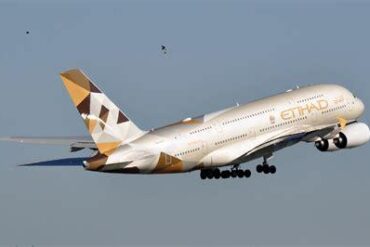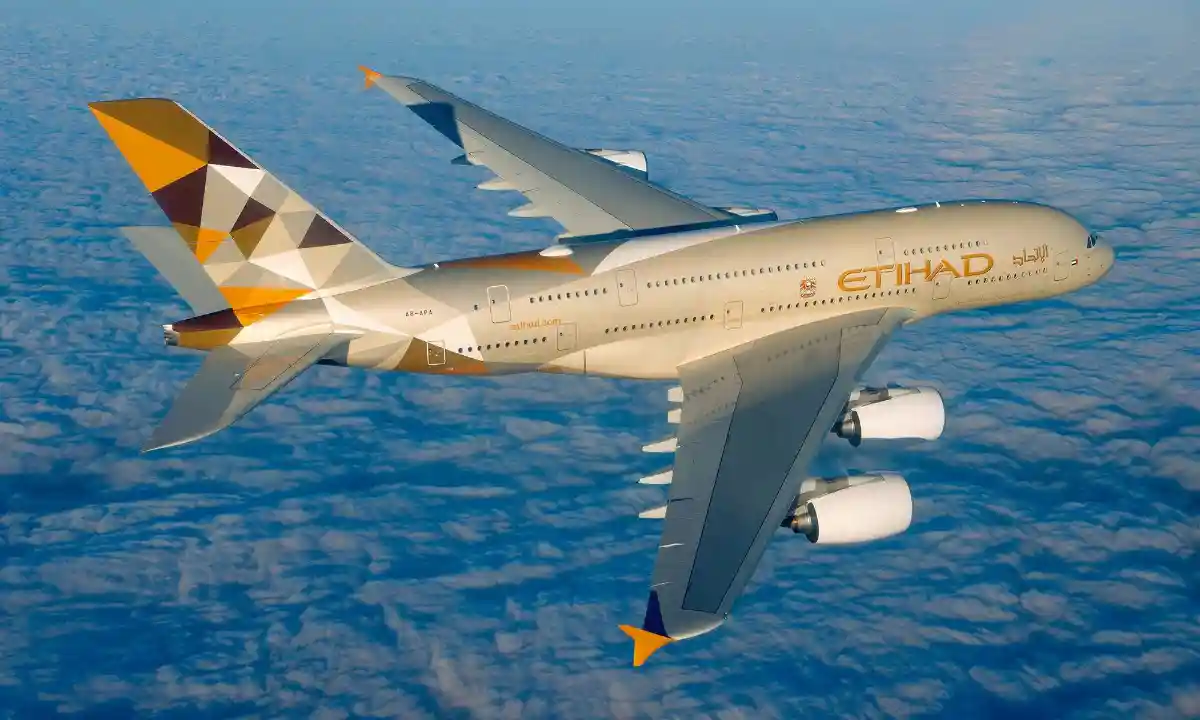
Etihad Airways is making a temporary adjustment to its Abu Dhabi–Singapore route, keeping the Boeing 787-9 on the service for longer than previously scheduled instead of introducing the Airbus A380 at the beginning of the winter timetable. The change means passengers traveling between Abu Dhabi International Airport (AUH) and Singapore Changi Airport (SIN) will continue to see the smaller widebody through December 14, with the superjumbo now scheduled to return on December 15.
The decision does not represent a withdrawal from Singapore. Etihad continues to operate the route daily, but the airline is changing the aircraft assigned to it during a portion of the winter season. The adjustment also illustrates how Etihad is moving its largest aircraft between Asian markets as it responds to expected demand and seeks to deploy its limited A380 fleet where the additional capacity can be used most effectively.
Etihad originally introduced the Airbus A380 on the Abu Dhabi–Singapore route in February 2025, giving the service a substantial capacity increase. At the time, the introduction of the double-decker was part of the carrier’s broader expansion across Asia. The aircraft’s arrival represented a significant change for travelers on the route because the A380 provides more than twice the seats available on the Boeing 787-9 currently scheduled to operate during the temporary period.
Etihad Airbus A380 Flights to Singapore Delayed Until December 15
According to recent schedule change data from aviation analytics company Cirium, Etihad has removed the planned A380 operation from November through mid-December. The original schedule called for the aircraft to replace the Boeing 787-9 at the beginning of November, coinciding with the start of the IATA winter schedule.
That plan has now changed. Instead of moving immediately to the A380, Etihad will retain the Boeing 787-9 Dreamliner on its daily Abu Dhabi–Singapore service until December 14. The Airbus A380 is scheduled to return on December 15, meaning the change is temporary rather than a permanent reduction in service or a restructuring of the route.
For passengers, the most obvious difference is capacity. The 787-9 configuration used on the route provides approximately 235 seats per flight, while Etihad’s A380 offers 496 seats. Maintaining the Dreamliner therefore removes a considerable amount of available capacity compared with the previously planned winter operation.
The change could give Etihad greater flexibility during a period when demand may not justify operating its largest aircraft every day. Widebody aircraft assignments can be adjusted according to seasonal demand, fleet availability, network requirements and the economics of operating a particular aircraft on a particular route.
Why the A380 Capacity Is Moving to Tokyo
The most significant part of the change is what happens to the aircraft that had been scheduled for Singapore. Rather than simply reducing A380 flying elsewhere, Etihad is redeploying superjumbo capacity to another Asian market.
Tokyo Narita Airport (NRT) is the beneficiary. Etihad currently operates the A380 to Narita, but its previous winter schedule called for the aircraft to be replaced by the Airbus A350-1000 in November. Under the revised plan, the A380 will remain on the Tokyo route until December 14, giving the Japanese market additional superjumbo capacity for roughly another month and a half.
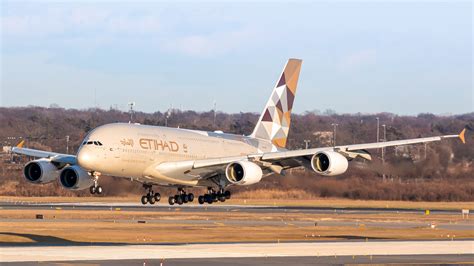
This is an important detail because Etihad is not simply reducing the use of the A380 across its network. Instead, the carrier is effectively shifting capacity between destinations. Singapore receives the 235-seat 787-9 for longer, while Tokyo retains the 496-seat A380 for longer.
Once the A350-1000 eventually takes over the Narita service, the aircraft will provide 371 seats, including 44 lie-flat business-class seats and 327 economy seats. That is substantially below the A380’s 496-seat capacity but still represents a large widebody operation.
Etihad’s 496-Seat Airbus A380 Configuration
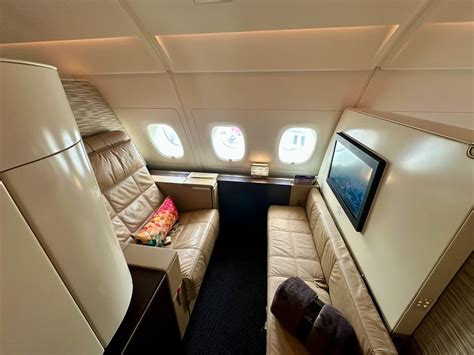
Etihad’s A380 remains one of the most distinctive aircraft in its fleet because its cabin includes the airline’s premium flagship products alongside a large economy cabin. According to the configuration data referenced in the schedule information, the aircraft has 496 seats in total.
| Cabin | Seats |
|---|---|
| First Class | 11 |
| Business Class | 70 |
| Economy Class | 415 |
| Total | 496 |
The First Class cabin is particularly notable because it includes The Residence, Etihad’s private three-room-style premium accommodation aboard selected A380 aircraft. The upper deck also accommodates the Business Class cabin, while the large Economy Class section accounts for the majority of the aircraft’s seating capacity.
For a route such as Singapore, the A380’s appeal is therefore not limited to the number of seats. Its cabin mix allows Etihad to combine substantial economy capacity with premium products that can generate additional revenue on long-haul international services.
Etihad’s Small A380 Fleet Shapes Winter Scheduling
Etihad’s ability to move the A380 between markets is naturally constrained by the size of its fleet. Current fleet data cited from ch-aviation indicates that the airline has nine Airbus A380s, compared with ten aircraft it had operated previously. Eight of the nine aircraft are listed as active, while one is in storage.
The aircraft are also relatively mature compared with Etihad’s newest-generation fleet. Their average age is approximately 11 years, compared with an overall fleet average of about 9.8 years. Maintaining a small fleet of older four-engine aircraft requires careful scheduling because each aircraft represents a significant amount of capacity concentrated in a single airframe.
This helps explain why aircraft assignments can change even after schedules have been published. A380 operations are most useful when there is sufficient demand to absorb the aircraft’s large capacity, while newer twin-engine aircraft such as the 787-9 and A350-1000 can provide more flexibility across different markets.
Etihad’s Other Airbus A380 Routes This Winter
Singapore and Tokyo are only part of Etihad’s wider A380 strategy. In November, the airline plans to operate six daily return flights using the Airbus A380-800, connecting Abu Dhabi with several major international destinations.
Beyond Tokyo, the superjumbo is scheduled to serve Bangkok and Toronto with daily flights, while London Heathrow remains Etihad’s largest A380 destination by frequency. Three daily A380 flights each way are planned between Abu Dhabi and Heathrow during November.
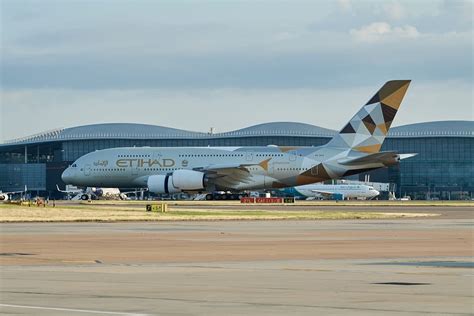
London is also a major A380 market for fellow UAE carrier Emirates. The concentration of superjumbo services between the Gulf and London reflects the enormous passenger flows between the regions and the ability of high-capacity aircraft to serve major international hubs efficiently.
For Etihad, however, the temporary Singapore adjustment demonstrates that its A380 strategy is not simply about putting the aircraft on the longest or most prominent routes. The airline is continuing to shift its largest aircraft toward markets where it sees stronger capacity requirements, while retaining smaller and more flexible widebodies elsewhere.
The result for Singapore passengers is straightforward: the Boeing 787-9 will remain on the Abu Dhabi–Singapore route until December 14, rather than giving way to the A380 in early November. The Airbus A380 is then scheduled to return on December 15, restoring the route’s higher-capacity operation while allowing Etihad to keep additional superjumbo capacity in Tokyo during the preceding weeks.