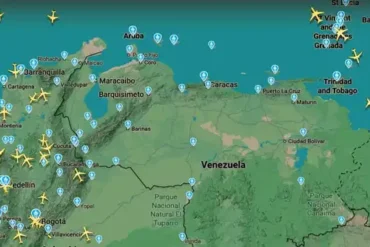
The Federal Aviation Administration (FAA) has issued a sharp and urgent advisory to U.S. carriers, warning of a ‘potentially hazardous situation’ in Venezuelan airspace, prompting several airlines to immediately reroute or cancel operations that would normally traverse the region. The move follows a significant deterioration in the regional security climate, exacerbated by a visible increase in both military activity and electronic interference.
Heightened Military Presence Raises Alarm
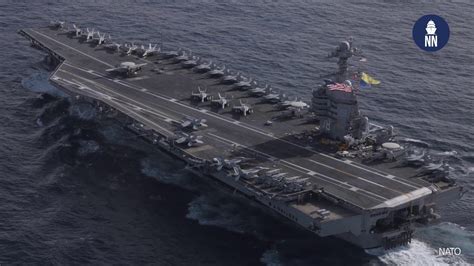
In recent weeks, the United States has escalated its military footprint near Venezuelan borders. A formidable assembly of nine warships, including the USS Gerald R. Ford, the world’s largest aircraft carrier, has been deployed alongside F-35 fighter jets, creating an imposing naval presence in the region. The USS Gerald R. Ford, with its expansive 1,106-foot length, 25 decks, and 256-foot-wide flight deck, functions as a floating fortress and airbase — a potent signal of American readiness amid geopolitical instability.
This military build-up comes against the backdrop of rising electronic warfare signals. Since September, the FAA has observed increasing interference with the Global Navigation Satellite System (GNSS) within Venezuelan territory. This interference presents a growing risk to commercial aviation safety, with disrupted navigation and surveillance systems jeopardizing aircraft control — particularly concerning given Venezuela’s advanced military radar and missile capabilities.
Airlines Take Preemptive Measures
Though direct U.S.-Venezuela flights have been suspended since 2019, many airlines that operate to South America continue to rely on airways over Venezuelan airspace. The FAA has not banned overflights outright but now requires airlines to notify the agency 72 hours in advance if any flights are scheduled to transit this airspace.
Major U.S. carriers such as American Airlines and Delta Air Lines have responded swiftly by halting routes that intersect Venezuelan skies. United Airlines has yet to provide a public statement. The FAA’s directive has prompted a domino effect throughout Latin America and Europe.
Regional Carriers Suspend Venezuela Routes
The impact of the FAA warning has rippled across the aviation industry. Prominent international carriers have suspended services to Caracas and other Venezuelan destinations:
- GOL Linhas Aéreas Inteligentes (GOL) of Brazil has ceased operations citing risk assessment.
- Avianca, the Colombian flag carrier, announced cancellations amid escalating instability.
- TAP Air Portugal and Iberia followed suit, with Iberia cancelling its upcoming direct flight from Madrid to Caracas, delaying future flights indefinitely.
Meanwhile, LATAM Airlines cancelled its Bogota-Caracas service on Sunday. Copa Airlines and Wingo, however, have maintained their operational schedules, though this could change depending on developments.
No Official Threat To Civil Aviation, But Risks Remain
While the Venezuelan military has not issued any direct threats to civil aviation, its recent maneuvers — including the mobilization of thousands of troops and military exercises involving long-range anti-aircraft systems — raise significant red flags. The FAA’s concerns are grounded in the dual threat of military escalation and technological interference, both of which increase the vulnerability of aircraft flying over or near Venezuelan territory.
The FAA continues to monitor the region closely, stressing that any aircraft at any altitude may be affected. The potential for misidentification, targeting errors, or accidental escalation underscores the fragility of the current situation.
Geopolitical Undercurrents and Aviation Safety
The convergence of geopolitical tension, advanced military readiness, and airspace sovereignty disputes has turned Venezuelan skies into a potential flashpoint. While the FAA stops short of a full airspace ban, its advisory functions as a de facto warning: proceed at your own risk. Airlines and travelers alike are left weighing the balance between operational necessity and safety in an increasingly volatile environment.
With the Caribbean and northern South America becoming entangled in broader power dynamics, the FAA’s alert may mark the beginning of a prolonged phase of airspace instability, demanding real-time strategic decisions from global aviation stakeholders.