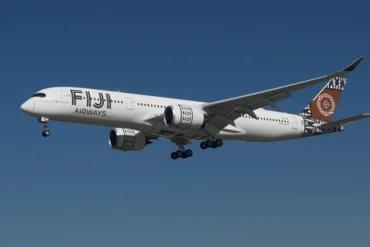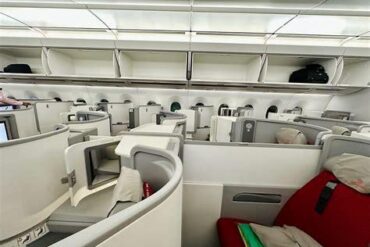
As Fiji Airways pushes forward in its ambitious transformation, the carrier has positioned itself as a compelling alternative for travelers navigating the busy transpacific corridor. With its Airbus A350-900 fleet, aggressive fare structure, and unique stopover incentives, Fiji Airways is building a strong case for those traveling between North America and Australia or New Zealand. Our journey from Vancouver (YVR) to Nadi (NAN) offered a deep look at what this carrier has achieved—and what it’s still perfecting.
Strategic Ambitions and Fare Disruption
Fiji Airways is capitalizing on a strategy employed successfully by Gulf and Asian carriers: connecting long-haul passengers through an exotic midpoint. In this case, it’s the South Pacific paradise of Fiji. Rather than match the non-stop fares of Air Canada, Qantas, or Air New Zealand, Fiji Airways undercuts them dramatically. Business class return fares from Vancouver to Australia or New Zealand via Nadi routinely hover around CAD $6,000–7,000, compared to CAD $12,000–15,000 on direct competitors. In economy, the story is similar, with Fiji offering seats for around CAD $1,500, undercutting others by $800–1,000.
This price advantage is amplified by Fiji Airways’ stopover program, which entices travelers to pause for several days in Fiji at no extra cost. While we didn’t book directly through that program, we still enjoyed a stunning multi-day stay to celebrate our anniversary—a clever tourism hook that delivers real value.
Booking Made Easy with Mileage Partners
Fiji Airways is a Oneworld alliance member, giving travelers a wide range of redemption options. The standout here is Alaska Mileage Plan, which offers exceptional value on Fiji redemptions. We secured our business class seats from Vancouver to Nadi for 55,000 Alaska miles and $50.51 USD per person. While continuing to Australia would have cost just slightly more in taxes, limited award availability meant we had to purchase a separate Virgin Australia cash fare from Nadi to Melbourne.
Booking through Alaska’s online portal was seamless, and we later adjusted dates easily via the excellent chat-based customer service. This flexibility added a layer of reassurance rarely matched by other airlines.
Check-In and Airport Experience
All North American flights to Fiji depart late at night, crossing the International Date Line and arriving two calendar days later at sunrise. We arrived at YVR about two hours before our 9:45 PM departure, and encountered one important nuance: online check-in is not available, as all documents must be verified in person. This includes hotel confirmations in Fiji, onward flight bookings, and even return tickets to Canada.
The Business Class priority line saved us from the chaos of the general queue, which looked like a 30-minute wait. Within minutes, we were checked in and enjoying the serene elegance of Vancouver’s International terminal, a space celebrated for its integration of First Nations art and sculpture.

Lounge Access and Preflight Experience
Business class passengers are granted entry to the SkyTeam Lounge at YVR. Although access via Priority Pass was restricted due to peak evening hours, our ticket ensured entry. The lounge is designed with an open-air concept, modern seating, and quiet nooks for light work.
Catering was unremarkable but adequate—siu mai dumplings and a glass of Prosecco made for a light preflight snack. For those with longer layovers, the lounge offers a comfortable retreat, though it doesn’t rival elite experiences like the Air Canada Signature Suite.

Organized Boarding and Cabin Welcome
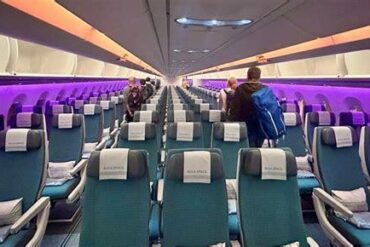
Boarding was sharply managed, segmented into 10 orderly groups, critical for a widebody aircraft with 334 passengers (33 in J, 301 in Y). We boarded efficiently in Group A through a single jetway and were immediately welcomed into one of the more visually distinctive cabins in the Pacific market.
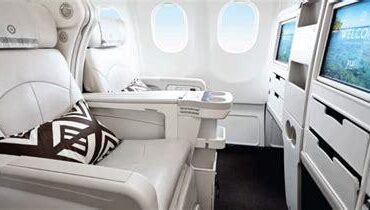
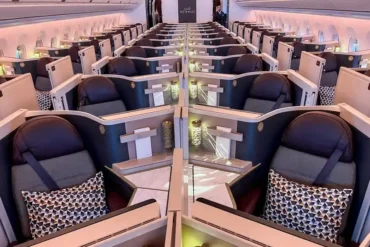
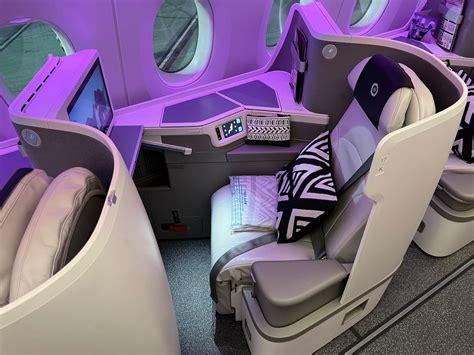
The A350’s business class cabin is nothing short of elegant. Styled in a crisp monochromatic palette accented by indigenous Fijian patterns, the aesthetic is understated yet deeply rooted in place.
Business Class Cabin and Comfort
Fiji Airways has selected the Collins Aerospace Super Diamond reverse herringbone seats in a 1-2-1 layout, giving each passenger direct aisle access. These seats are well-known from carriers like Qatar Airways, American Airlines, and British Airways, and Fiji’s execution is tasteful, with cream leather upholstery and black trim.
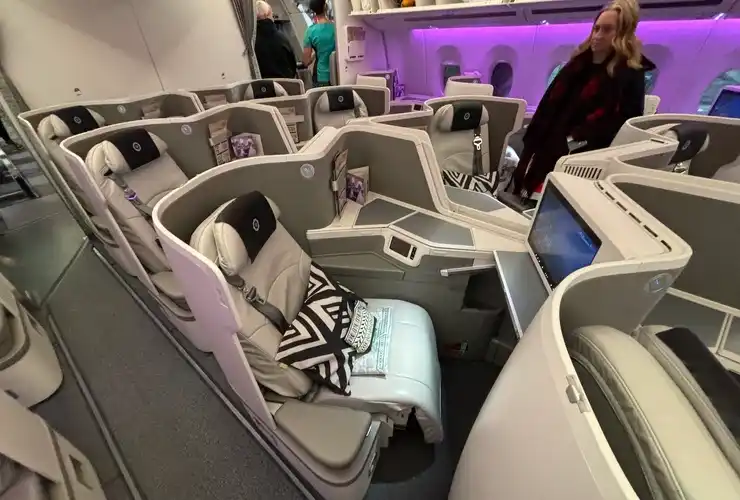
Storage is sufficient but could be improved. An odd design choice sees the aisle-side cubby used exclusively for water bottles, where other airlines allow shoe or bag storage. Additionally, the seat’s lumbar support is fixed, which may frustrate taller passengers needing more precise adjustments.
Still, privacy is excellent, even without sliding doors. Couples can choose the middle D+G seats, where a retractable privacy divider allows for conversation or separation.
A Business Class Designed for Newcomers
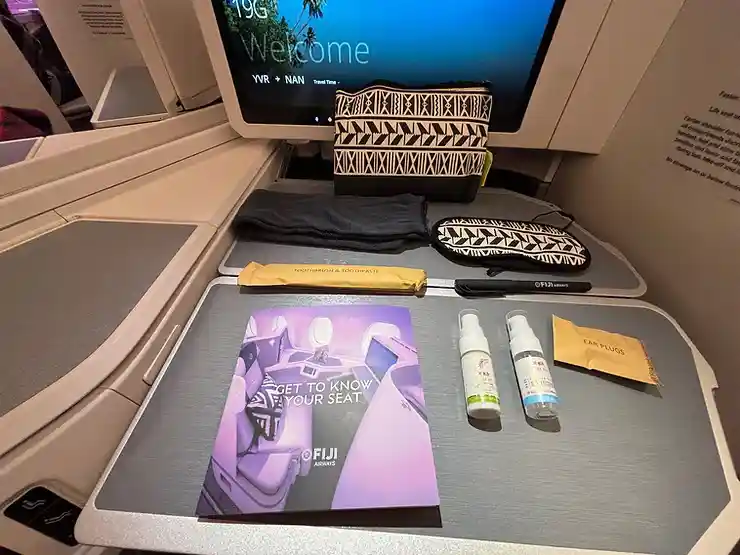
Fiji Airways seems to understand that its aggressive pricing attracts first-time business class flyers. We observed a high number of passengers unfamiliar with premium cabin conventions. Rather than leaving them adrift, Fiji anticipates the learning curve with printed guides explaining seat functions and IFE controls, ensuring all guests feel confident navigating the experience.
This thoughtful touch aligns with Fiji’s broader hospitality culture and its intent to cultivate long-term premium loyalty.
In-Flight Dining and Service Nuances
Service throughout the flight was warm, but inconsistently delivered. While one flight attendant was attentive and proactive, another was hesitant and reactive, affecting the rhythm of service depending on seat location.
Before departure, we received Cattier Brut Icône champagne or sparkling water, along with a bottle of Fiji Water. Orders for dinner and breakfast were taken promptly.

The meal offerings impressed, blending Western and Fijian influences. Highlights included:
- A creamy, flavorful mushroom soup
- A beautifully plated salmon and scallop appetizer
- A richly spiced prawn curry, one of the best inflight meals we’ve had
Dinner was served approximately two hours after takeoff, which suited those staying up to work or relax, but could frustrate passengers trying to sleep immediately after the 11PM departure.

Breakfast service was less polished. Passengers on one side of the cabin were served long before others, and drink requests made at boarding were missed entirely. In our case, the tray was cleared mid-meal without warning, then later returned with pastries and a drink—likely due to an inexperienced crew member.

In-Flight Entertainment, Connectivity, and Amenities
The entertainment system features a high-definition touchscreen and remote, with a rich selection of global films, TV series, and documentaries. Although personal preference leans toward the moving map and personal playlists, the system performed flawlessly.
A notable letdown was the Wi-Fi system, which was attractively priced at $19.95 for 11 hours of streaming, but completely inoperative during the flight. The crew appeared unconcerned, and no announcements were made.
The amenity kit featured a charming Fijian-designed pouch, including:
- Socks and eye mask
- Earplugs and dental kit
- Lightly scented hand lotion and sanitizer
- A branded pen for arrival documents
Sleep Experience at 36,000 Feet
The Super Diamond seat excels for back sleepers, with a medium-firm foam mattress pad that outperforms the air-cushioned models found on Air Canada’s Dreamliners and 777s, which often fluctuate mid-sleep.
While side sleepers may find the fixed tray table a bit restrictive, the duvet and pillow quality is outstanding. We achieved nearly five hours of uninterrupted rest, thanks in part to cooler-than-average cabin temperatures—a decision we wholeheartedly applaud.
That said, seat 1G and its neighbors suffer from an unusual design flaw: the forward lavatory opens directly into the cabin, resulting in unwanted light and sound throughout the night.
Arrival in Nadi: Seamless and Serene
Arriving at Nadi International Airport shortly after sunrise, we were among the first long-haul arrivals of the morning. Immigration and customs clearance were lightning-fast, and our luggage was already waiting by the time we reached the carousel. It was one of the smoothest international arrivals we’ve experienced in recent memory.
Conclusion: A Bold Competitor in the Pacific Skies
Fiji Airways has crafted a product that delivers tremendous value, especially for price-sensitive travelers looking to experience business class comfort or make the most of a South Pacific layover. The hardware is world-class, the cabin design stunning, and the food memorable. While service consistency requires refinement, this is a solvable issue in an otherwise strong offering.
We would not hesitate to recommend Fiji Airways for future transpacific journeys, especially when connecting to Australia or New Zealand. If the airline continues investing in staff training and sustaining competitive pricing, it will undoubtedly earn its seat among the elite players on the global stage.