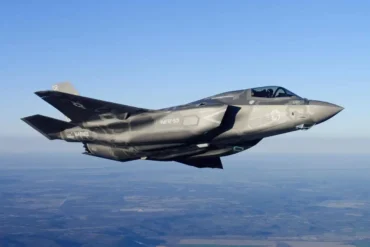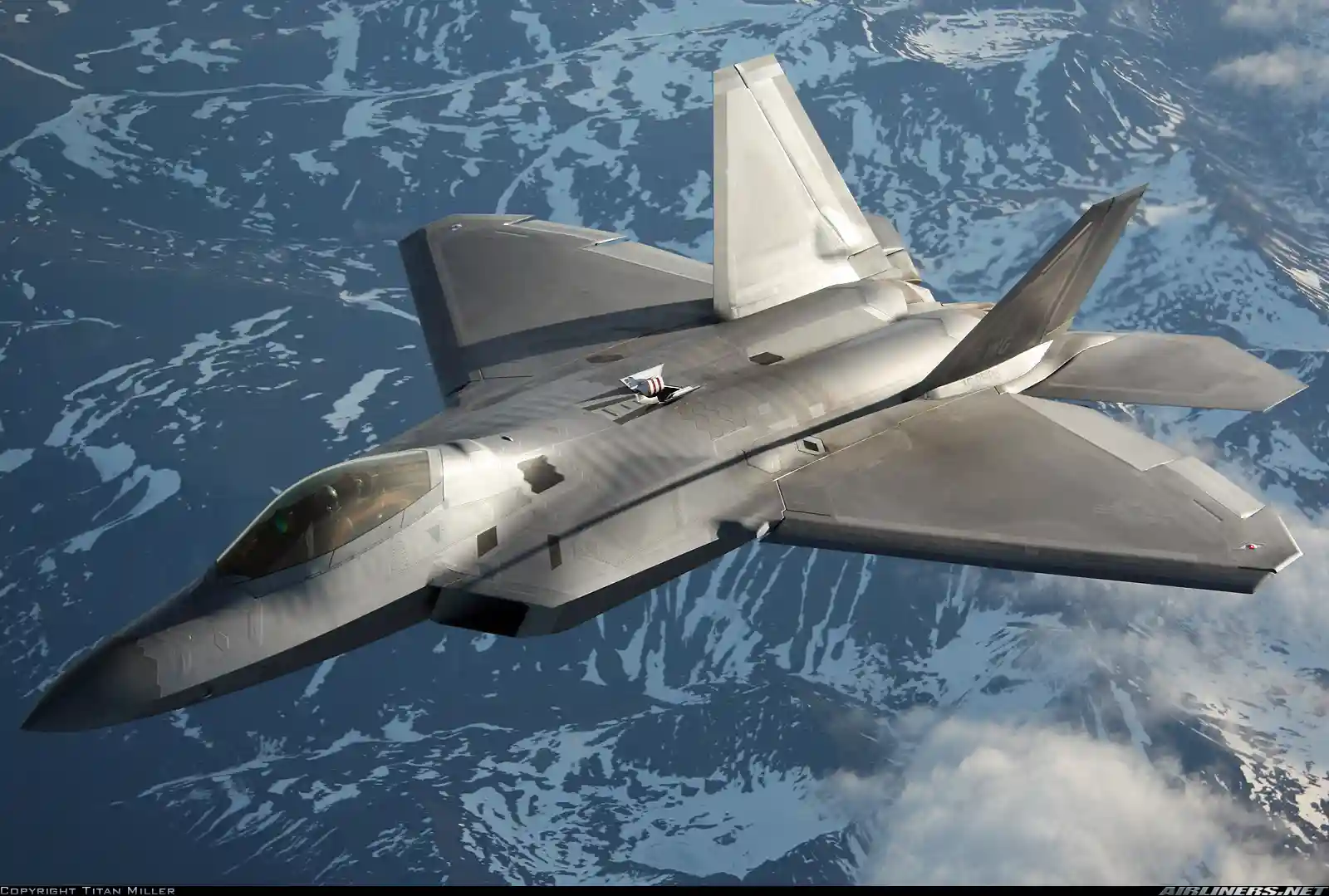
The F-22 Raptor stands as a symbol of cutting-edge aviation technology, crafted for air dominance in every sense. Developed by Lockheed Martin, this stealth fighter has captivated aviation enthusiasts and military strategists alike since its inception. Despite being more than two decades old, the F-22 continues to maintain its position as one of the most formidable air superiority fighters ever built. Below are some fascinating facts that showcase the F-22’s exceptional capabilities and its unique place in the world of military aviation.
1. Supercruise: A Game-Changing Feature
The F-22 Raptor is designed to fly at supersonic speeds without the need for afterburners, a capability known as supercruise. This advanced technology allows the Raptor to exceed Mach 1 without using afterburners, making it significantly more fuel-efficient and stealthy. While other fighters require afterburners to reach supersonic speeds, the F-22’s ability to fly faster and farther without consuming excessive fuel gives it a crucial operational advantage. Supercruise extends the aircraft’s range and operational envelope, allowing it to cover vast distances at high speeds while remaining undetected.
2. The F-22 Raptor Can Reach Mach 2 with Afterburners
Even though the F-22 is known for its supercruise, its true top speed is even more impressive. With the use of afterburners, the F-22 can achieve speeds exceeding Mach 2, which is over 1,500 mph (2,400 km/h). This extreme speed, combined with its superior stealth and maneuverability, makes it one of the most dominant fighters in the skies.
3. Vertical Speed Like No Other: It Can Accelerate to Mach 1 Vertically
One of the most jaw-dropping abilities of the F-22 Raptor is its vertical acceleration. This air superiority fighter can go from zero to Mach 1 in a matter of seconds, purely on vertical thrust. The F-22’s two Pratt & Whitney F119-PW-100 turbofan engines, combined with thrust vectoring nozzles, allow it to climb at insane speeds, something that very few aircraft in the world can replicate.
4. Stealth and Radar-Evasion Technology
The F-22 Raptor was built with one goal in mind: to remain invisible to enemy radar systems. Its stealth capabilities are achieved through a combination of its aerodynamic shape, the use of radar-absorbent materials, and its advanced radar-evading coatings. The AN/AGP-77 AESA radar is one of the most sophisticated systems on board, allowing the F-22 to detect enemy aircraft long before it is detected. This “first-look, first-shot” advantage ensures that the F-22 can engage adversaries from a position of stealth and surprise.
5. The Raptor Is Not for Sale
Unlike many other modern military aircraft, the F-22 Raptor is not available for export to foreign nations. The U.S. Congress imposed a ban on its sale to protect its advanced technologies, including its stealth systems, radar, and avionics. The U.S. Air Force had originally planned to procure 750 units, but this was reduced to just 187 aircraft in the end. The restriction on sales has been a controversial decision, especially since several countries, including Japan, expressed interest in purchasing the aircraft.
6. Internal Weapon Bays for Stealth
The F-22 is designed to carry its weapons in internal bays to maintain its low-observable characteristics. The aircraft’s clean configuration means that all armament is stored internally, with no external stores or pylons, which could create radar signatures. These internal bays are capable of carrying up to six AIM-120 radar-guided missiles or two 1,000-pound GBU-32 JDAMs in air-to-ground configuration. Additionally, the F-22 is equipped with an M61A2 20mm cannon, making it a versatile and formidable fighter in both air-to-air and air-to-ground combat.
7. Thrust Vectoring for Enhanced Maneuverability
The F-22 is not just fast—it’s incredibly maneuverable as well. The aircraft is equipped with two-dimensional thrust vectoring nozzles that allow for superior control in the air. These nozzles enable the Raptor to perform extreme maneuvers that would be impossible for most other fighter jets. The result is super maneuverability, allowing the F-22 to excel in dogfights and quickly change direction, even in extreme conditions.
8. The Raptor Is One of the Best in Dogfights
While the F-22 Raptor may not have seen much action in real-world aerial combat, it is widely regarded as one of the most capable dogfighters ever built. Thanks to its superior avionics, stealth capabilities, and aerodynamics, the F-22 can outmaneuver and engage enemy aircraft in close-range combat with ease. In fact, the F-22’s ability to detect and track targets before being detected allows it to engage enemies from positions of strength, often scoring first hits in combat.
9. A Legacy of Training and Exercises
Although the F-22 Raptor has yet to engage in a real dogfight with enemy forces, it has participated in numerous training exercises. In these simulated combat scenarios, the F-22 has proven itself to be an overwhelming force, often dominating its opponents in aerial combat exercises. Even in training, the F-22 is a force to be reckoned with, and it remains the gold standard for air superiority fighters.
10. The F-22’s Canopy: An Engineering Marvel
The F-22 Raptor’s canopy is one of the most advanced and costly components of the aircraft. The replacement cost for the canopy was estimated to be around $182,205 in 2006. This might seem high, but it’s well worth the price considering the canopy’s advanced materials and technology. It consists of two sheets of polycarbonate, sandwiched between two layers of optical glass, and coated with a thin layer of indium-tin-oxide to reflect radar waves. The result is a golden tint and the ability to withstand extreme conditions while ensuring the pilot’s safety and visibility.
11. Unseen in Action: F-22’s Stealthy Nature
The stealth capabilities of the F-22 are so advanced that the aircraft can often track and engage enemy targets without ever being seen. Even if an enemy aircraft is able to detect the F-22 on radar, it is already too late. The Raptor’s radar can “see” the enemy first and lock onto them before the target has any chance of responding. Additionally, the F-22 can share target data with other Raptors in the vicinity, allowing for coordinated, radar-silent attacks.
12. A Remarkable Engineering Feat
The F-22 Raptor is a result of years of research, testing, and engineering. It incorporates the latest advancements in avionics, materials, propulsion, and stealth technology, making it one of the most sophisticated fighters ever built. Despite being over 20 years old, the F-22 Raptor continues to be a benchmark of air superiority, with its superior stealth, maneuverability, and speed ensuring that it remains a relevant and essential component of the U.S. Air Force’s arsenal.
Conclusion: A Fighter That Redefines Air Superiority
The F-22 Raptor is a fighter jet that pushes the boundaries of what is possible in terms of speed, stealth, and maneuverability. Its supercruise capability, advanced radar systems, and stealthy design make it a formidable opponent in any air conflict. While its service life may eventually be surpassed by newer technologies, the F-22 Raptor’s legacy as one of the greatest air superiority fighters in history will remain undiminished.
With its incredible engineering, unmatched capabilities, and continued relevance in modern combat, the F-22 Raptor will remain a symbol of military aviation excellence for years to come.