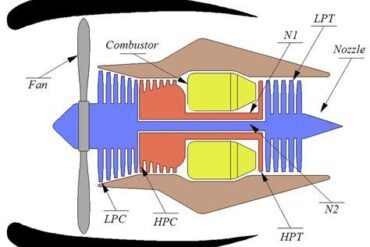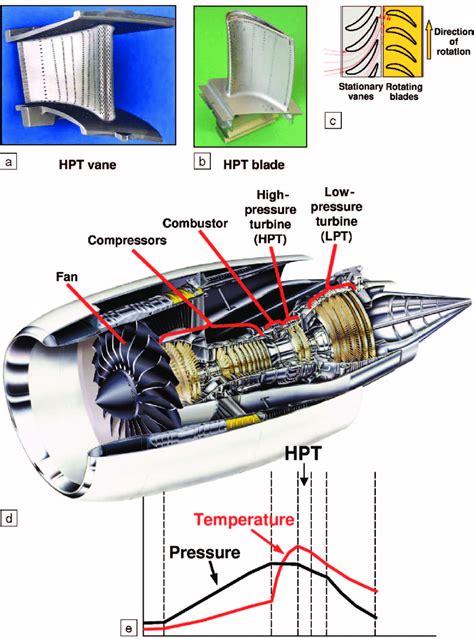
The high-pressure turbine (HPT) is a key part of a twin-spool jet engine. It plays a crucial role by taking energy from the exhaust stream to turn the engine shaft and rotate the high-pressure compressor.
A typical jet engine has four main sections: intake, compressor, combustion, and exhaust. As exhaust air flows over the turbines, it creates the spinning motion needed to turn the engine shaft. The compressor blades at the front squeeze the incoming air to the right level before it enters the combustion section. Here, the air mixes with fuel and ignites. The resulting hot exhaust air exits the rear of the engine at a much higher pressure than the incoming air, providing propulsion. This process follows Sir Isaac Newton’s principle that “for every action, there is an equal and opposite reaction.”
The twin-spool design enhances the efficiency of the basic jet engine. In this setup, two sets of compressors and turbines spin around a central shaft. The low-pressure compressor first receives the intake air and compresses it. The air then moves into the high-pressure compressor for further compression. After this, the compressed air flows over the high-pressure turbine, where energy is extracted from the hot gases to spin the high-pressure compressor. Likewise, the exhaust air flowing over the low-pressure turbine generates energy to turn the low-pressure compressor. This self-sustaining process continues until the fuel or air supply is cut off.