Air traffic control (ATC) is a vital part of aviation that ensures safe and efficient air travel. This article offers a clear overview of how ATC operates, catering to professionals, aviation enthusiasts, and trainee controllers alike.
Communication in Air Traffic Control
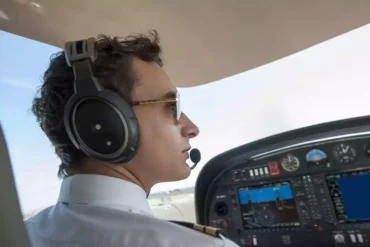
Effective communication is key in ATC. This involves air-ground communication, which is essential for aircraft safety. Controllers use specific callsigns to identify themselves and communicate with pilots. Additionally, they may employ light signals or pyrotechnic signals when necessary. Language diversity is also accommodated in ATC operations, ensuring instructions are understood by all.
The Role of Air Traffic Control
Air Traffic Management (ATM) encompasses various services, including:
-
Air Traffic Control (ATC): The primary service ensuring safe aircraft movement. It includes different areas:
-
Aerodrome Control: Managing aircraft on the ground and in the nearby airspace.
-
Approach Control: Assisting aircraft during their climb, descent, and approach phases.
-
Area Control: Overseeing flights during the cruising phase.
-
Flight Information Service (FIS): Offering information in uncontrolled airspace.
-
Alerting Service: Notifying Search and Rescue (SAR) teams about distressed aircraft.
-
Air Traffic Flow Management (ATFM): Organizing traffic to prevent congestion and reduce controller workload.
-
Airspace Management (ASM): Structuring airspace to meet user needs effectively.
Types of Air Traffic Controllers
There are three main types of air traffic controllers:
-
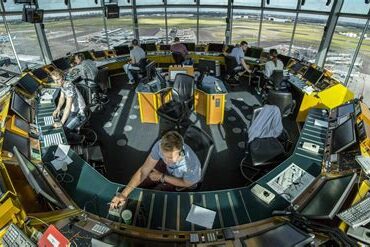
Tower Controller: Manages aircraft at and around an aerodrome.
-
Approach Controller: Connects tower operations with area control, focusing on incoming and outgoing flights.
-
Area Controller: Oversees flights during their cruising stage.
Other positions related to ATC include:
-
FIS Officer: Provides flight information services.
-
Assistant: Supports controllers with routine tasks.
-
Supervisor: Manages the ATS unit during shifts.
Training and Competency for Controllers
Before becoming an air traffic controller, individuals must undergo thorough training and meet competency standards. This includes initial training, refresher courses, and meeting English language proficiency requirements.
Surveillance Tools
Surveillance tools enhance controllers’ situational awareness, allowing them to manage traffic more safely. Key tools include:
-
Primary Surveillance Radar (PSR)
-
Secondary Surveillance Radar (SSR)
-
Automated Dependent Surveillance-Broadcast (ADS-B)
-
Surface Movement Radar
These tools significantly improve capacity and safety in air traffic management.
Automated Systems and Support Tools
Automation in ATM systems combines data from various sources, further enhancing situational awareness for controllers. This leads to improved capacity and safer handling of multiple flights.
ATC Clearances
Controllers issue clearances and instructions to maintain safe separation between aircraft. This includes immediate takeoff clearances and conditional clearances, ensuring efficient traffic flow.
Separation Standards
One of the main responsibilities of controllers is to ensure adequate separation between aircraft, preventing collisions. This involves detecting potential conflicts and taking necessary actions to resolve them.
Coordination in Air Traffic Control
Coordination is crucial for effective ATC operations. Controllers must work together within their units and with neighboring sectors to manage air traffic smoothly. This includes transferring communication and control between controllers as needed.