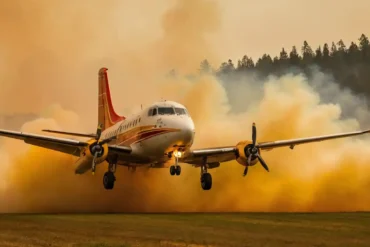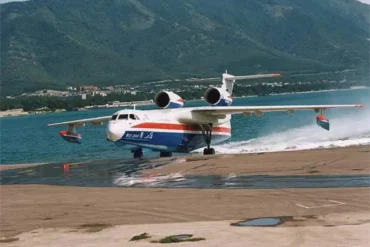
We explore the remarkable mechanics, engineering, and tactical value behind the firefighting aircraft known worldwide as Super Scoopers, machines that turn lakes and coastlines into fast-acting lifelines during destructive wildfire seasons. Their ability to reload in moments allows continuous attack cycles that no other aerial firefighting asset can match. This unique capability has transformed wildfire operations in regions like California, Southern Europe, and Australia, where fast-moving blazes demand rapid, repeated water delivery without the delays of returning to an airbase.
Super Scoopers are purpose-built amphibious firefighting planes, most famously represented by the De Havilland CL-415. Although their silhouette may remind casual observers of recreational seaplanes, the resemblance ends at the waterline. These aircraft are engineered from the keel up to withstand the punishing forces of repeated water landings, turbulent surface conditions, and low-altitude flight through hot, smoke-choked air.
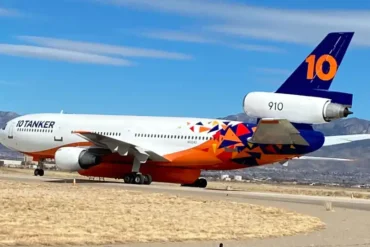
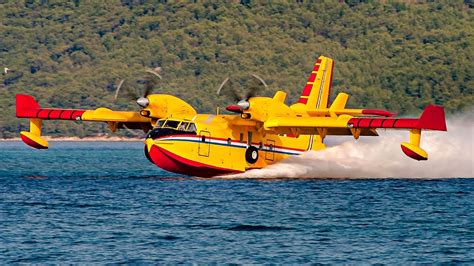
Unlike traditional air tankers that rely on airport-based reload stations, Super Scoopers transform any adequately sized body of water into a refill point. Their reinforced hulls allow them to skim across lakes or oceans at high speed while drawing water into their tanks. This creates a dramatically shorter mission cycle. A typical heavy tanker might require 20–40 minutes to land, reload, and climb back into the firefight. A Super Scooper can complete the entire loop in just a few minutes when water sources sit near the fire line.
The Ingenious High-Speed Scooping Process
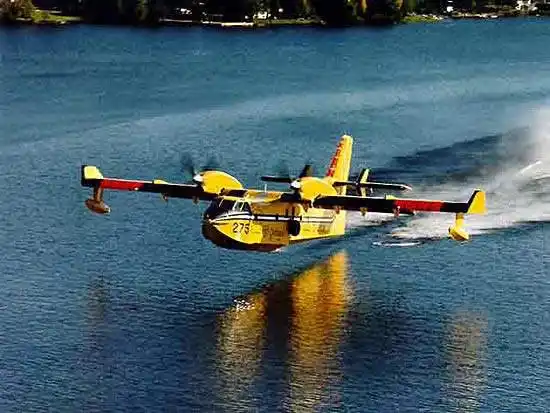
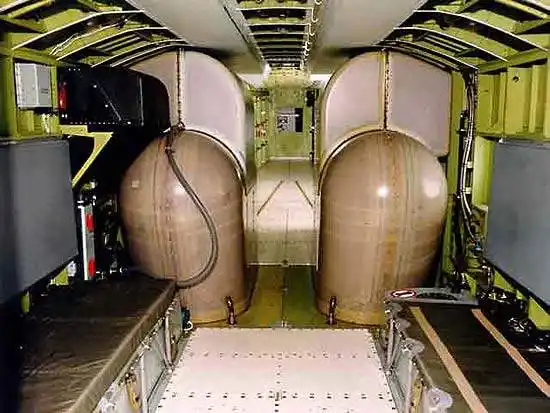
The refilling process is deceptively simple from the outside but involves coordinated forces and split-second timing. As the aircraft descends toward the water, its pilots execute what amounts to a controlled landing without fully settling into displacement mode. As the hull kisses the surface, the aircraft levels into a low-drag posture and extends a pair of retractable intake probes. These narrow scoops channel water into the internal tank using nothing but the aircraft’s forward motion.
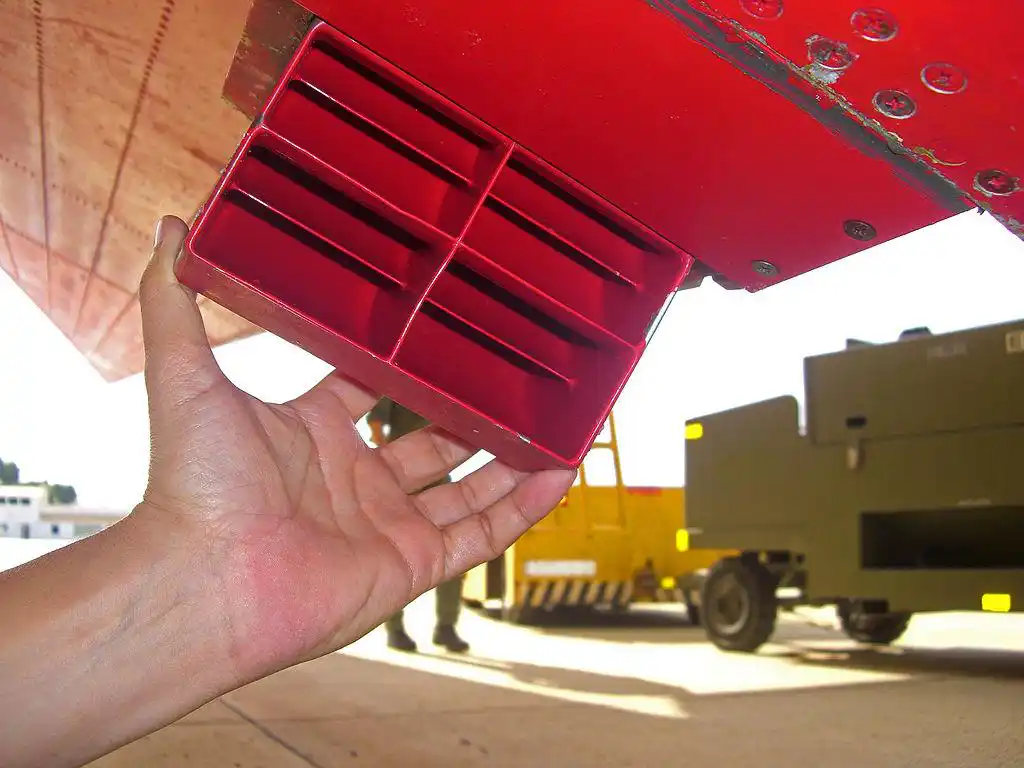
Within roughly 12 seconds, the tank swells with about 1,600 gallons of water. During that brief interval, the aircraft experiences rapid changes in weight and drag, requiring continuous adjustments on the control surfaces. Once the tank reaches capacity, the probes retract automatically, the engines surge, and the plane accelerates back into takeoff attitude. Every part of this choreography is optimized to keep the aircraft skimming smoothly without losing too much speed or risking instability.
Operational Performance That Turns Water Into Precision Strikes
A scooped load of water is only the beginning of the Super Scooper’s value. The aircraft’s powerful turboprop engines and oversized control surfaces allow tight maneuvering in rugged terrain—an essential trait when fires burn in canyons, foothills, or forested valleys. Pilots describe the job as a blend of maritime navigation and mountain flying.
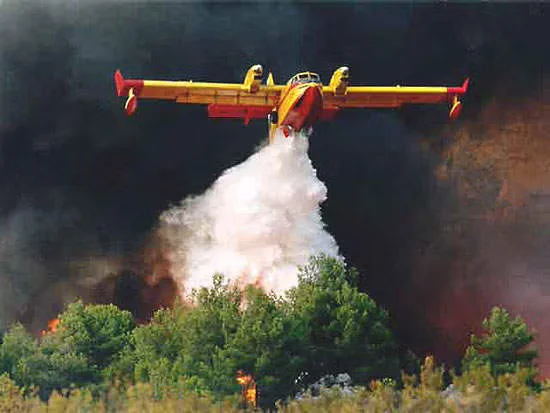
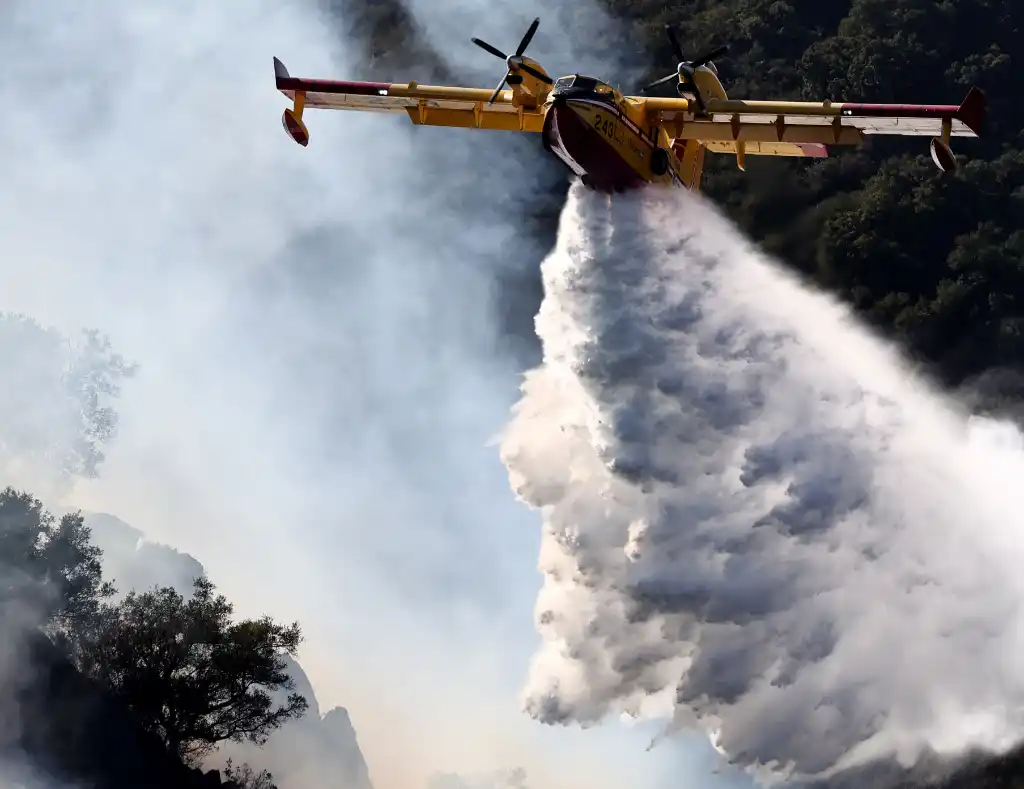
These planes routinely drop water from altitudes as low as 100 feet, a proximity that produces tighter drop patterns and enhanced impact on active fire lines. The low-altitude performance compensates for wind drift, increases accuracy, and delivers a dense, cohesive mass of water that can instantly halt flames. Given the aircraft can repeat this cycle dozens of times per hour, the cumulative effect becomes a sustained bombardment.
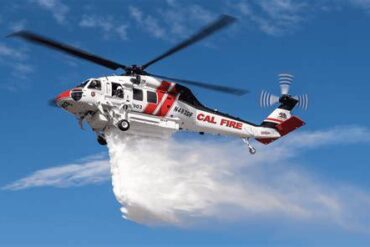
Helicopters also supply water in wildfire missions, but even the largest models carry significantly less volume and must hover during intake operations. The Super Scooper’s ability to reload while moving enables a tempo that rotary-wing aircraft simply cannot equal.
Endless Water Sources That Change the Battle
A firefighting aircraft is only as effective as the consistency of its drops. Because Super Scoopers operate independently of airports and ground crews, they thrive when deployed near coastlines, mountain lakes, and reservoirs. These planes can scoop from any water body at least 6.5 feet deep and roughly 300 feet wide, offering unparalleled operational flexibility.
During the massive Los Angeles wildfires of 2025, Super Scoopers repeatedly skimmed the Pacific Ocean for water, delivering constant, uninterrupted cycles of suppression. With enough fuel onboard to remain in the field for hours, these aircraft provided near-continuous coverage without leaving the combat zone.
Pilots face extreme demands in this environment. Each mission involves navigating smoke-obscured skies, threading through terrain at minimal altitude, performing dozens of water landings, and executing high-G climbing turns while hauling several tons of shifting weight. The operation remains profoundly analog despite the sophistication of modern avionics; the most critical decisions rely on pilot judgment, reflexes, and experience.
The Future of Water-Scooping Firefighting Aircraft
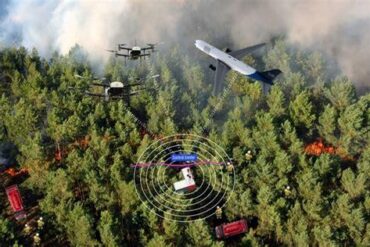
Emerging concepts propose autonomous or semi-autonomous firefighting drones, yet the precision, spatial awareness, and split-second adaptability required in water scooping and low-level drops make full automation a distant goal. For now, the Super Scooper remains a frontline hero—its combination of amphibious engineering and pilot skill forming a nimble, self-contained strike force against fast-moving wildfires.
As demand for rapid-response aerial firefighting grows across a warming planet, the strategic advantage of aircraft that can turn any lake or coastline into a refill station will only become more crucial.