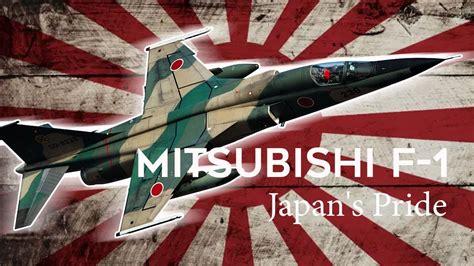
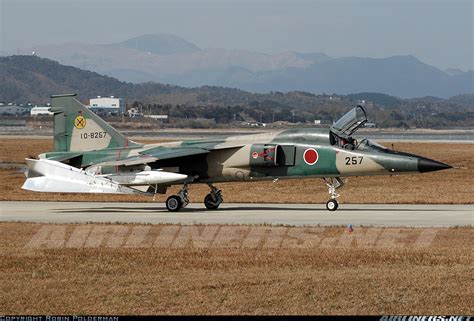
The Mitsubishi F-1 holds a distinguished place in aviation history as Japan’s first indigenously developed supersonic jet fighter after World War II. Jointly developed by Mitsubishi Heavy Industries and Fuji Heavy Industries, the aircraft not only symbolized a rebirth of Japan’s aerospace capabilities but also served a vital strategic role during the Cold War era. Entering service in 1977 and remaining operational until 2006, the F-1 was affectionately dubbed the “Supersonic Zero” — a reference to the famed WWII-era Mitsubishi A6M Zero, and a marker of national pride and engineering revival.
The backdrop of its development reflects both geopolitical tension and technological ambition. With the Soviet Union’s growing naval presence in the Pacific during the Cold War, Japan urgently required an aircraft tailored to anti-ship missions, capable of defending its maritime boundaries with speed and precision. The F-1 emerged from this necessity, bridging foreign design philosophies with domestic innovation, and marking Japan’s confident return to the arena of advanced military aviation.
From Trainer to Fighter: Development Based on the Mitsubishi T-2
The Mitsubishi T-2, a supersonic trainer aircraft influenced by the Anglo-French SEPECAT Jaguar, served as the design foundation for the F-1. The decision to repurpose the T-2 stemmed from both budgetary constraints and engineering practicality. The T-2 already featured a robust supersonic airframe, twin-engine configuration, and a high-mounted wing — elements favorable for adaptation into a combat aircraft. To transform it into a frontline fighter, engineers removed the rear cockpit, installed more advanced avionics, and modified the airframe to comply with area rule requirements for efficient supersonic flight.
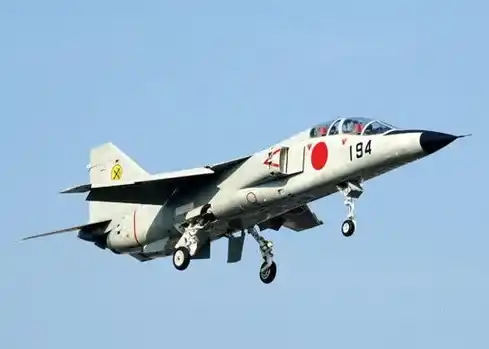
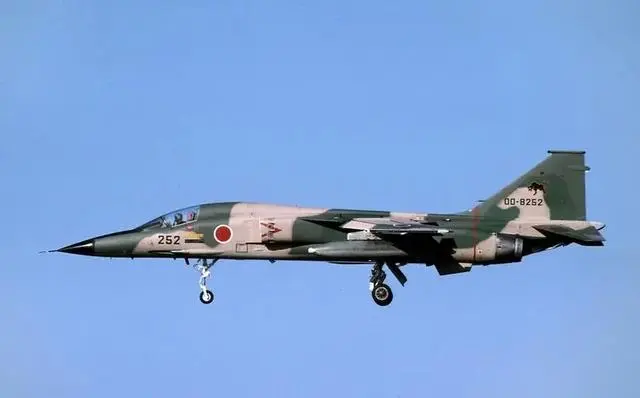
Aerodynamically, the F-1 featured a distinctively sleek fuselage with sharply swept wings and sawtooth leading edges, contributing to greater low-altitude stability and drag reduction at high speeds. The forward fuselage was refined to house more complex electronics, and the tail surfaces, including downward-canted horizontal stabilizers and dual ventral fins, were optimized for enhanced control at high velocities.
Engine and Propulsion: Twin TF40-IHI-801A Turbofans
At the heart of the F-1’s performance lay two TF40-IHI-801A turbofan engines, license-produced by Ishikawajima-Harima Heavy Industries (IHI) based on the British Rolls-Royce Turbomeca Adour design. Each engine delivered 3.31 tons of thrust with afterburner, enabling the F-1 to reach a top speed of Mach 1.6. While not breaking new ground in engine innovation, the use of the Adour-derived powerplant ensured mechanical reliability and maintenance compatibility, both essential for long-term fleet operations.
The aircraft’s combat radius of approximately 560 kilometers suited it for Japan’s coastal defense doctrine, particularly for sorties against hostile naval units in nearby waters. Its structural lifespan, originally set at 4,000 flight hours and later extended to 4,500 after upgrades in the 1980s, showcased the airframe’s durability and adaptability.
Weapons and Role: A Dedicated Maritime Strike Platform
The F-1’s weapons loadout and mission profile were built around anti-ship operations, a reflection of Japan’s self-defense military posture. At its core was a 20mm JM61A1 rotary cannon, a locally produced version of the American M61A1 Vulcan. This internal gun, mounted in the port fuselage, gave the aircraft credible short-range firepower for aerial or surface engagements.
For longer-range strikes, the F-1 could carry:
- ASM-1 and ASM-2 anti-ship missiles, Japan’s indigenous standoff weapons designed to attack surface vessels from extended distances.
- AIM-9 Sidewinder or Japanese AAM-1 short-range air-to-air missiles mounted on wingtip rails for self-defense.
- MK-82 general-purpose bombs, cluster munitions, and rocket pods for ground attack missions.
- Up to 2.72 tons of ordnance across wing and fuselage hardpoints.
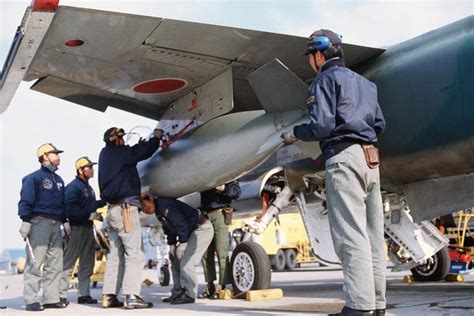
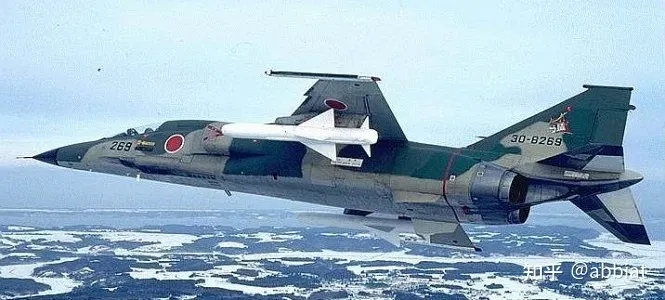
The standard anti-ship configuration typically included two ASM-1 missiles accompanied by an external fuel tank, aligning with the JASDF’s mission of maritime interdiction rather than deep-penetration strike.
Avionics Suite: Bridging Analog and Digital Generations
To fulfill its maritime strike role, the F-1 was outfitted with a reasonably advanced set of avionics for its time. The central sensor was the Mitsubishi Electric J/AWG-12 pulse radar, a derivative of the earlier J/AWG-11 used on the T-2. The radar system provided surface search and target tracking capabilities, essential for identifying and engaging naval targets.
Supporting systems included:
- Inertial Navigation System (INS) for autonomous navigation.
- J/APR-3 Radar Warning Receiver, alerting the pilot to threats.
- Heads-Up Display (HUD) and multifunction indicators in the cockpit to improve situational awareness.
While the F-1 lacked advanced fly-by-wire controls or multi-mode radars found in contemporary Western aircraft like the F-16, it successfully met Japan’s specific defense requirements, offering a blend of analog robustness and digital reliability.
Operational History: Limited Numbers, Strategic Presence
Only 77 F-1 units were produced between 1975 and 1987, with operational deployment primarily in the 3rd Air Wing of the Japan Air Self-Defense Force (JASDF), stationed at airbases including Misawa and Tsuiki. The modest production volume reflected Japan’s constitutional constraints on military buildup, as well as the aircraft’s specialized mission scope.
The F-1 never saw combat, a testament to both Japan’s pacifist defense doctrine and its regional deterrence posture. Nonetheless, it remained an active deterrent and played a vital role in training, maritime patrols, and coastal defense readiness exercises. Its presence during heightened Cold War tensions sent a clear signal of Japan’s intent to protect its territorial waters without escalation.
By the early 2000s, the F-1 began to show signs of obsolescence. Newer technologies, aging airframes, and shifting defense priorities led to its gradual retirement. The aircraft was officially phased out in 2006, succeeded by the more versatile and advanced Mitsubishi F-2, which was itself based on the F-16 but significantly customized for Japan.
Strategic Significance: Symbol of Technological Autonomy
The Mitsubishi F-1 represents more than just a weapon system — it is a milestone of Japanese aerospace independence. Emerging from an era when Japan was heavily reliant on American military imports, the F-1 project demonstrated that domestic companies could master complex fighter design, production, and systems integration.
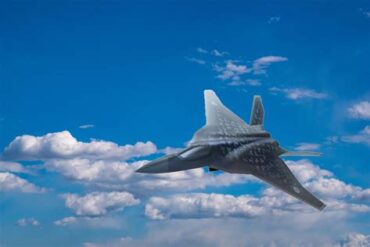
The aircraft’s development also spurred the growth of supporting industries, such as avionics manufacturing, composite materials research, and turbine engine licensing. These capabilities laid the groundwork for subsequent programs, most notably the F-2 multirole fighter and the next-generation F-X (F-3) project, which aims to produce a sixth-generation stealth fighter by the mid-2030s.
Moreover, the F-1’s emphasis on indigenous weapons development — particularly the ASM missile series — illustrated Japan’s shift from platform-dependent imports to systems-level autonomy. This strategic move allowed the JASDF to tailor its arsenals precisely to its unique maritime defense challenges.
Legacy: The F-1 in Retrospect
Although the F-1 may not have matched the versatility or technological sophistication of its global contemporaries, it fulfilled its mission parameters with precision and reliability. It provided Japan with a credible maritime strike option, allowed the military to test and integrate new technologies, and most importantly, rekindled the spirit of domestic aviation design after decades of postwar restriction.
The aircraft’s design lineage, from the T-2 trainer to the F-1 fighter, and eventually to the F-2 multirole platform, tells a story of incremental mastery — a strategy rooted in adaptation, experience, and long-term vision. Today, preserved examples in Japanese aviation museums stand as silent reminders of an era when Japan, in the shadow of superpowers, charted its own course back into the skies.