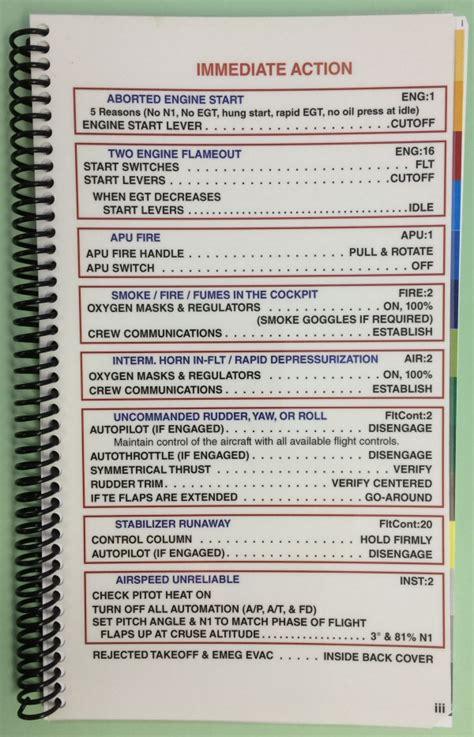
The Quick Reference Handbook (QRH) is designed to provide essential procedures for abnormal and emergency situations in a straightforward format. It also includes performance data corrections for specific scenarios. The QRH stands alone as a crucial document. Often, the back cover features the Normal Checklists as well.
For aircraft without an Electronic Centralized Aircraft Monitor (ECAM) or Engine Instruments and Crew Alerting System (EICAS), the QRH serves as the primary guide for managing abnormal or emergency conditions. In aircraft equipped with ECAM/EICAS, the QRH complements these systems or acts as a backup.
To fully appreciate the QRH’s purpose, it’s important to understand how ECAM/EICAS functions. These systems have three types of procedures. The first type includes self-contained procedures that are activated when the aircraft can detect a failure, trigger alerts, display relevant actions, and assess pre-conditions for further steps. This also involves confirming the status of any system changes and identifying inoperative systems along with their limitations.
The second type consists of procedures that prompt the use of QRH when the aircraft systems cannot gather all necessary conditions and signals. This helps ensure that the crew can still follow appropriate actions even if some information is missing. Finally, QRH procedures are utilized when ECAM/EICAS cannot sense a failure, such as during electrical power loss or unmonitored system failures.
For planes lacking ECAM/EICAS, all procedures come from the QRH. For those equipped with these systems, a blend of all three procedure types exists, which may vary based on different generations of technology. When conditions allow, flight crews can refer to expanded abnormal and emergency procedures in the AOM/FCOM for further guidance after following ECAM/EICAS and QRH procedures.
Creating the QRH involves careful planning and testing to ensure it effectively addresses various abnormal and emergency scenarios. Each procedure is divided into phases, with action steps tied to pre-conditions. The challenge lies in conveying the dynamic nature of these procedures, including the overall strategy, phases, conditional actions, feedback on crew actions, and links to other QRH procedures.
The layout of the QRH is crucial for preventing errors. Clear presentation helps avoid omitting actions or performing irrelevant ones. Key design elements include identifying preconditions with symbols, proper indentation of related actions, and adequate spacing between different procedure phases.
To reinforce its error-resistant design, the QRH encourages adherence to golden rules, like verifying the outcome of each action before moving to the next step. This practice helps catch any potential mistakes early.
In conclusion, the QRH’s design and development are vital for responding effectively to various situations. For aircraft equipped with ECAM/EICAS, the QRH works closely with these systems to ensure optimal use. Each procedure within the QRH represents a strategy aimed at managing failure conditions and minimizing their impact on operations. To achieve its goals, the QRH emphasizes ergonomic presentation to reduce errors, whether in training simulations or real-world applications.