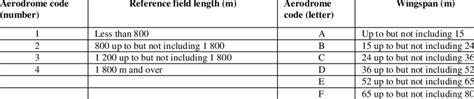
The ICAO Aerodrome Reference Code is a system that helps identify if a specific aircraft can operate at a given aerodrome. This code, detailed in ICAO Annex 14, consists of two parts. The first part is a numeric code based on the Reference Field Length, which has four categories. The second part is a letter code determined by the aircraft’s wingspan and outer main gear wheel span.
Element 1 of the code includes:
-
Code Number
-
Aeroplane Reference Field Length
-
1: Less than 800 m (e.g., DE HAVILLAND CANADA DHC-6, PIPER PA-31)
-
2: 800 m to less than 1200 m (e.g., ATR ATR-42-300/320, BOMBARDIER Dash 8 Q300)
-
3: 1200 m to less than 1800 m (e.g., SAAB 340, BOMBARDIER Regional Jet CRJ-200)
-
4: 1800 m and above (e.g., BOEING 737-700, AIRBUS A-320)
-
Field length refers to the balanced field length, where the required take-off distance equals the required accelerate-stop distance. The aeroplane reference field length is defined as the minimum distance needed for take-off at maximum certified weight, at sea level, under standard atmospheric conditions.
Element 2 of the code considers either the wingspan or the outer main gear wheel span of the aircraft. The categories are:
-
Code Letter
-
A: Less than 15 m (e.g., PIPER PA-31, CESSNA 404 Titan)
-
B: 15 m to less than 24 m (e.g., BOMBARDIER Regional Jet CRJ-200, DE HAVILLAND CANADA DHC-6)
-
C: 24 m to less than 36 m (e.g., BOEING 737-700, AIRBUS A-320, EMBRAER ERJ 190-100)
-
D: 36 m to less than 52 m (e.g., B767 Series, AIRBUS A-310)
-
E: 52 m to less than 65 m (e.g., B777 Series, B787 Series, A330 Family)
-
F: 65 m to less than 80 m (e.g., BOEING 747-8, AIRBUS A-380-800)
Element 2 is frequently used alone due to its importance in airport design. Additionally, the FAA employs a similar but distinct code called the Airplane Design Group (ADG).