Definition
The aerodrome traffic circuit refers to the designated path that aircraft follow when operating near an aerodrome. This is crucial for maintaining order in the skies.
Description
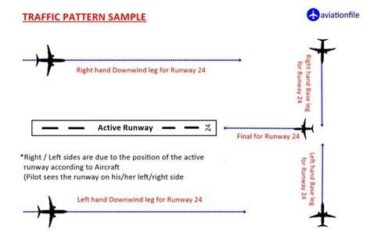
The traffic circuit consists of five segments and four turns. While it’s mainly used by aircraft flying under Visual Flight Rules (VFR) or during visual approaches and departures, it’s not explicitly mentioned in the definition. The two primary features that define the circuit are the runway and the direction of the turns. Circuits can be classified as ‘left-hand’ (all turns to the left) or ‘right-hand’ (all turns to the right).
For example, let’s consider a left-hand circuit for runway 09. Some segments, like upwind, crosswind, and downwind, are named based on the fact that aircraft typically take off and land into the wind. The upwind leg is sometimes referred to as ‘departure’ because it’s the path taken after takeoff. The downwind leg runs parallel to the runway but in the opposite direction of landing. Its length can vary depending on instructions from air traffic control. For instance, a controller might tell a pilot to extend the downwind leg to create the necessary spacing between aircraft.
The ‘base’ leg is where the aircraft turns at a right angle from downwind to prepare for final approach. Unlike the downwind leg, the base leg cannot be extended, which means the distance to touchdown becomes fixed once the turn begins. The final leg is where the aircraft aligns with the runway, preparing to land. An example of downwind extension is when the red aircraft (number 2 for landing) continues on the downwind leg to maintain adequate spacing with the blue aircraft (number 1 for landing).
Uses of the Aerodrome Traffic Circuit
The aerodrome traffic circuit serves multiple purposes:
-
Traffic Management: Once an aircraft enters the circuit, its future behavior is largely determined, helping maintain situational awareness for everyone involved. This is beneficial for both controlled and uncontrolled aerodromes, ensuring safe and efficient traffic sequencing.
-
Pilot Training: The circuit allows pilots to practice take-offs and approaches repeatedly under similar conditions, focusing on the critical parts of flight without the need for climbing, cruising, or descending. This way, training can emphasize more complex tasks.
-
Navaid Testing and Certification: Test flights are conducted to check and adjust navigational aids like ILS and VOR systems. These flights often involve prototype aircraft or occur after maintenance.
Restrictions
The aerodrome traffic circuit may have various restrictions:
-
A default turn direction may be chosen for uniformity, meaning if the opposite runway is in use, the active side becomes non-active.
-
The active side may also be fixed for reasons like noise abatement or terrain considerations.
-
There could be level restrictions for entering or flying the circuit, with altitudes specified for safety.
-
The maximum number of aircraft allowed in the circuit may also be limited, especially at night.
-
Different circuits may be established for various aircraft types, such as helicopters or light general aviation planes.
-
Joining and leaving points for the circuit may be restricted, and the circuit might be defined in the Aeronautical Information Publication (AIP).
If the circuit isn’t published, relevant terms can still apply, but aircraft positions may be less precise. Nevertheless, this can still ensure safe operations. Controllers might set additional restrictions on specific circuit parts, like the start of turns or the altitude to be maintained.
Phraseology
Here are some key phrases:
-
Pilot Reporting Position: “PRE0365, downwind” or “PRE0365, turning base.” Controllers may request these reports for situational awareness.
-
Controller Instructions for Joining the Circuit: “REK1453, join downwind runway 18” or “REK1453, join right-hand downwind runway 18.” Specifying right-hand patterns is essential, while left-hand can often be assumed unless noted otherwise.
-
Controller Spacing Instructions: “EKR078, extend downwind, number two, follow piper on base.”
Local Peculiarities
Different regions may have unique terms and practices:
-
In the US, the term “traffic pattern” is common.
-
The UK refers to the active side as the “live side” and the non-active as the “dead side.”
-
In Australia, left turns are standard unless stated otherwise.
-
In Russia, the circuit is described by turns rather than legs, such as stating an aircraft is “between the second and third turn.”
This understanding of the aerodrome traffic circuit helps ensure safety and efficiency in aviation operations.