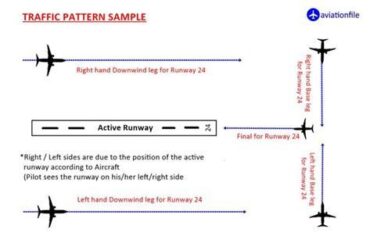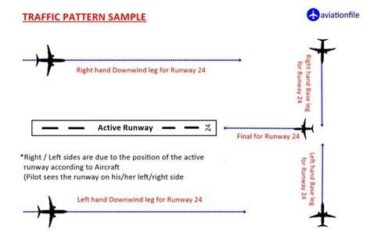
An aerodrome traffic zone (ATZ) is a specific area of airspace set up around an aerodrome to protect the traffic operating there. This term is recognized in ICAO Annex 2, which covers “Rules of the Air,” as well as in Regulation (EU) No. 923/2012, known as the Standardised European Rules of the Air (SERA). The main purpose of the ATZ is to safeguard aircraft that are moving in the vicinity of the aerodrome, especially those on the manoeuvring area and in the traffic circuit.
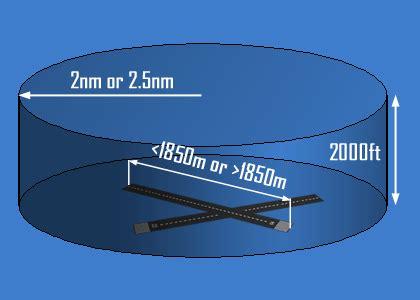
While there isn’t a universally accepted definition regarding the size of ATZs, they are generally thought of as “small-volume” airspaces. Typically, an ATZ is shaped like a cylinder, extending from the ground to a few thousand feet above, with a radius that can vary from a couple of miles. The center of this zone may be located at the aerodrome reference point (ARP), the midpoint of the longest runway, or another appropriate location.
The airspace within an ATZ can either be controlled, with guidance from an aerodrome control tower, or uncontrolled, where services like the aerodrome flight information service (AFIS) are provided instead. It’s important to note that the exact structure and dimensions of ATZs can differ by country. For example, in the UK, there are specific guidelines: an ATZ may extend from the ground up to 2000 feet with a radius of 2.5 nautical miles around the midpoint of the longest runway if that runway exceeds 1850 meters in length. If the runway is shorter than 1850 meters, the ATZ radius may be reduced to 2.0 nautical miles. Additionally, offshore installations may have a zone extending from sea level to 2000 feet with a radius of 1.5 nautical miles.