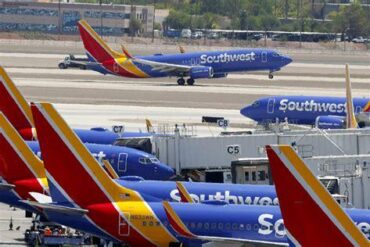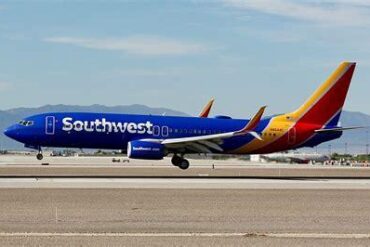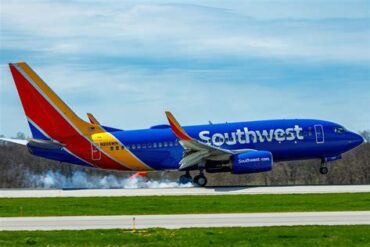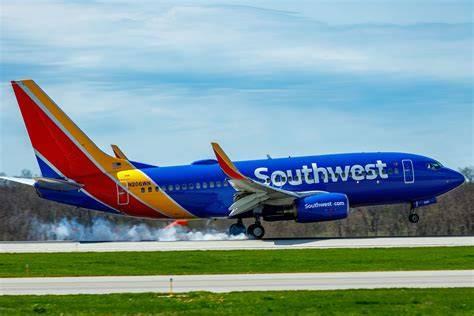
A Southwest Airlines Boeing 737 was forced to return to the gate at Harry Reid International Airport in Las Vegas after other pilots reported smoke coming from its right main landing gear on Friday afternoon. The aircraft was preparing to depart for Chicago Midway International Airport when the incident prompted an emergency response, preventing it from reaching the runway. Although initial reports raised concerns about a possible landing gear fire, Southwest said there were no reports of an actual fire, while a spokesperson identified a potential hydraulic problem as an area of concern.
The aircraft was operating Southwest Airlines Flight WN759, a scheduled service from Las Vegas (LAS) to Chicago Midway (MDW). The crew returned the jet to the terminal area, where airport emergency personnel responded. Passengers subsequently disembarked and transferred to a replacement aircraft, allowing the airline to continue the journey several hours behind schedule.
Southwest Pilots Report Smoke From Boeing 737 Landing Gear
The incident came to light while the aircraft was taxiing for departure. According to air traffic control audio, pilots aboard another Southwest Boeing 737, operating Flight WN334 to Houston Hobby Airport, noticed a potentially serious problem with the aircraft ahead of them.
The crew reported that the right landing gear appeared to be on fire and requested emergency assistance. Another pilot subsequently described heavy smoke coming from the affected area, prompting a response from airport fire crews.
The reports became more concerning when pilots indicated that what appeared to be chunks of brake material had been left on the taxiway. They also observed a trail of fluid around the debris, suggesting that the problem could involve damaged landing gear components or a leak.
These observations provided important clues about the potential nature of the incident, although they did not establish a definitive cause. Smoke around an aircraft’s wheels can indicate overheating brakes, leaking hydraulic fluid, mechanical damage, or an actual fire. Distinguishing between these possibilities requires a closer inspection of the aircraft and its affected components.
Crucially, the Boeing 737 was still taxiing when the problem was reported. It had not begun its takeoff roll, allowing the crew to stop the departure before the aircraft entered the runway.
Could a Hydraulic Leak Have Caused the Smoke?
Southwest spokesperson Lynn Lunsford told KSNV News 3 that the airline was concerned about a possible hydraulic issue, while confirming that there were no reports of a fire. That distinction is significant because smoke does not necessarily mean flames are present.
The Boeing 737 uses a braking system designed to slow and stop the aircraft during taxiing, landing, and rejected takeoffs. Each of its four main landing gear wheels has an individual brake assembly. Hydraulic pressure normally supplied by hydraulic system B operates the brakes, with system A available as an alternative source.
The nose wheels do not have brakes, making the reported right main landing gear a logical focus for investigating a possible brake-related problem.
A hydraulic leak could help explain the combination of smoke and fluid observed by the pilots. If hydraulic fluid reaches hot brake components, it can produce substantial smoke. Excessive brake temperatures or mechanical damage could also contribute to the release of debris around the wheels.
However, the available information does not establish whether the aircraft experienced a hydraulic leak, a brake failure, an actual fire, or a combination of mechanical problems. A trail of fluid and suspected brake fragments are evidence of an abnormal condition, but neither observation alone confirms the underlying failure.
At the time of reporting, neither the National Transportation Safety Board (NTSB) nor the Federal Aviation Administration (FAA) had publicly commented on the incident. Further technical details would be needed to determine the precise cause and whether any components required replacement.
Emergency Response Prevents a Potentially More Serious Departure
The incident highlights the importance of communication between aircraft crews and air traffic controllers during busy airport operations. The initial warning came from pilots aboard a separate Southwest aircraft, rather than from a report made after the affected jet had reached the runway.
That warning gave controllers an opportunity to coordinate the response while the aircraft remained on the ground. Airport fire crews were called to the scene, and the affected Boeing 737 was returned to the terminal area before being towed back to the gate.
Although the reported smoke did not result in a confirmed fire, the possibility of a landing gear or hydraulic system problem warranted caution. A compromised brake assembly could affect the aircraft’s ability to stop safely, particularly during a high-speed rejected takeoff. Continuing toward departure without investigating the warning would have introduced an unnecessary operational risk.
The aircraft was therefore removed from service for the immediate operation, and passengers transferred to another jet. The decision added considerable disruption to the journey, but it allowed Southwest to continue the flight using a replacement aircraft rather than attempting to operate the original jet before its condition had been assessed.
Southwest Flight WN759 Departs Nearly Four and a Half Hours Late
Flight-tracking data showed that WN759 eventually departed Las Vegas at 4:44 p.m. local time, compared with its scheduled departure at 12:15 p.m. The replacement aircraft was a Boeing 737 MAX 8, which arrived at Chicago Midway at 9:40 p.m., almost four hours after its scheduled 5:45 p.m. arrival.
Southwest did not disclose how many passengers were aboard the original aircraft. Its Boeing 737 MAX 8 fleet can accommodate up to 175 passengers, depending on the aircraft’s configuration, providing an indication of the potential number of travelers affected by the disruption.
WN759 normally operates between Las Vegas and Chicago Midway three times a week, on Mondays, Thursdays, and Fridays. The scheduled flight takes approximately three and a half hours, connecting two important markets for Southwest’s domestic network.
The incident also occurred at an airport where Southwest has a substantial operational presence. The airline carried approximately 21.8 million passengers through Harry Reid International Airport in 2025, well ahead of Delta Air Lines, which carried around 5.2 million.
What Compensation Can Passengers Expect After the Delay?
For affected travelers, the lengthy delay raises questions about passenger rights and possible refunds. Under US Department of Transportation rules, passengers generally are not entitled to automatic cash compensation simply because a domestic flight arrives several hours late.
However, travelers may qualify for a refund if they choose not to travel after a significant schedule change or delay that meets the applicable DOT criteria. For domestic itineraries, a delay of at least three hours at arrival can qualify as a significant change for refund purposes. International itineraries generally use a six-hour threshold. Eligibility depends on the circumstances and the applicable refund rules.
Passengers who accept the replacement flight and complete their journey are not automatically entitled to cash compensation solely because they arrived late. Southwest’s specific response to the incident, including any additional assistance offered, was not detailed in the available reports.
The most important unanswered question remains the condition of the original Boeing 737’s right main landing gear. While the aircraft’s return to the gate and the use of a replacement jet resolved the immediate transportation problem, determining whether the smoke came from overheating brakes, hydraulic fluid, or another mechanical fault will require further technical information. For now, the incident demonstrates how a warning received during routine taxiing can prevent a potentially serious mechanical problem from progressing into a takeoff emergency.