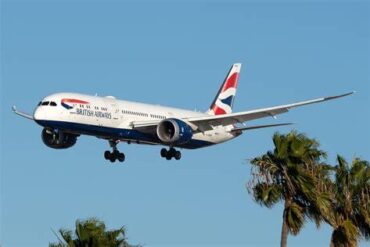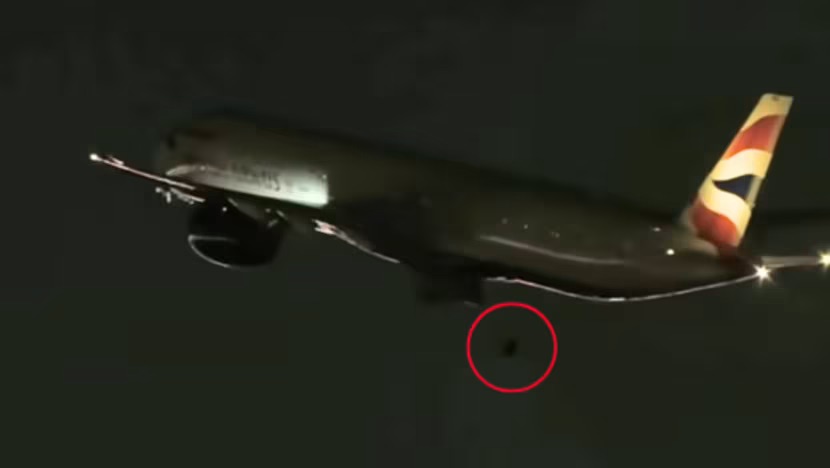
The moment was brief, startling, and captured clearly on video: a British Airways Airbus A350-1000 accelerating down the runway in Las Vegas as a wheel suddenly separates from the aircraft and drops to the ground. The incident occurred during takeoff from Harry Reid International Airport (LAS) on January 26, 2026, as the widebody jet departed for London Heathrow (LHR). Despite the dramatic visual, the aircraft continued its transatlantic journey and later landed safely in the United Kingdom.
The flight, operating as BA274, did not declare an emergency or divert. Passengers onboard were largely unaware that a wheel from the main landing gear had detached just minutes after liftoff. Aviation tracking data later showed that the aircraft has remained grounded since the event, indicating the seriousness with which such anomalies are treated even when outcomes are benign.
Video footage circulating online shows the wheel separating as the landing gear was retracting, a phase of flight where mechanical tolerances are tight and systems transition rapidly. While unsettling to watch, aviation safety design assumes failures will occur and builds layers of redundancy around them.
The Exact Moment the Wheel Came Loose
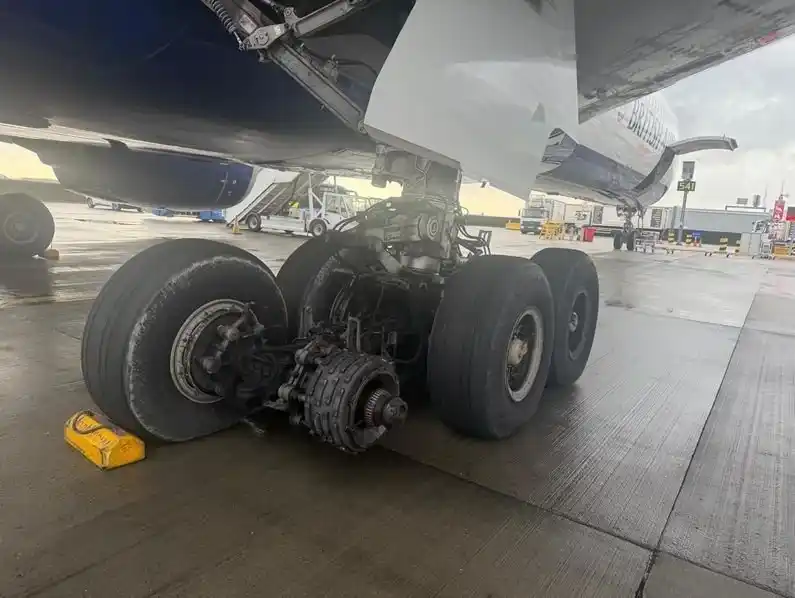
The aircraft involved was Airbus A350-1000, registration G-XWBN, a relatively young airframe in British Airways’ long-haul fleet. The wheel detached shortly after takeoff, captured clearly by an airport-area camera as the main landing gear began retracting into the fuselage. The timing is critical, as the landing gear is still under load from rotation and initial climb forces.
The A350-1000 uses a six-wheel bogie on each main landing gear assembly, totaling 12 main wheels plus two on the nose gear. This configuration distributes weight efficiently for the aircraft’s higher maximum takeoff weight compared to the smaller A350-900. Losing a single wheel, while serious, does not automatically compromise landing capability due to this redundancy.
British Airways confirmed the incident in a brief statement, emphasizing that safety underpins every operation and that the airline is cooperating fully with investigative authorities. No injuries were reported, and there was no damage to airport infrastructure disclosed at the time of departure.
Why the Aircraft Was Able to Continue to London
Modern widebody aircraft are engineered to tolerate isolated component failures without cascading consequences. In this case, the loss of one wheel did not affect braking symmetry or structural integrity enough to require an immediate return. Fuel weight, weather conditions, and landing performance calculations at Heathrow would all have been reassessed during cruise.
The aircraft’s arrival in London without incident underscores how certification standards assume worst-case scenarios, including partial landing gear failures. Pilots train for such events in simulators, and maintenance procedures following landing are exhaustive.
According to Flightradar24, the aircraft has not operated further flights since January 26, suggesting it remains under inspection. Such pauses are standard, even when flights conclude safely, as investigators determine whether the cause was mechanical fatigue, installation error, or an external factor such as debris ingestion.
Aircraft Profile and Fleet Context
Delivered just 2.7 years ago, G-XWBN had accumulated 12,167 flight hours and 1,369 cycles by late 2025. The aircraft is powered by Rolls-Royce Trent XWB-97 engines and configured to carry 331 passengers across business, premium economy, and economy cabins.
British Airways currently operates 18 A350-1000 aircraft, with six more on order. Notably, the airline does not fly the A350-900 variant, instead favoring the higher-capacity -1000 for long-haul efficiency. The rest of its widebody fleet is dominated by Boeing 777 and 787 aircraft, alongside a smaller number of Airbus A380s.
Similar Incidents and the Broader Safety Picture
Wheel and tire separations remain rare but documented occurrences in commercial aviation. In 2024, a United Airlines Boeing 777-200ER lost a tire during takeoff from San Francisco, prompting a diversion and causing significant ground damage when the tire struck a parked vehicle. No passengers were harmed, but the incident intensified regulatory scrutiny.
These events highlight an important truth about aviation safety: failures are anticipated, studied, and designed around. Each incident feeds back into maintenance procedures, inspection intervals, and manufacturing standards. The Las Vegas A350 event, while visually dramatic, fits into a long-established framework of investigation and improvement rather than alarm.
For passengers, the outcome matters most. In this case, everyone arrived safely, and the system worked exactly as it was designed to do.