Definition
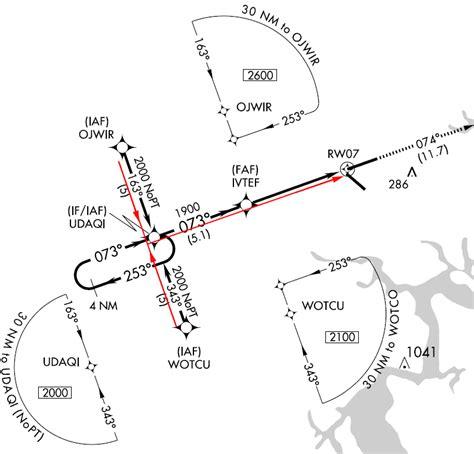
The terminal arrival altitude (TAA) is the lowest altitude that ensures at least 300 meters (1,000 feet) of clearance above all objects within a circular area. This area has a radius of 46 kilometers (25 nautical miles) centered on the initial approach fix (IAF). If there is no IAF, the TAA is based on the intermediate approach fix (IF). The limits are defined by straight lines that connect the ends of the arc to the IF. Importantly, the combined TAAs for an approach procedure must cover a full 360-degree area around the IF, according to ICAO Doc 8168 PANS-OPS.
Purpose
The terminal arrival altitude (TAA) serves as a crucial transition point. It helps pilots move from the en-route phase to an Area Navigation Systems approach procedure. For more detailed information, refer to ICAO Doc 8168 PANS-OPS Part II, Section 1, Chapter 2.