The Cold War was an era marked by paranoia, secrecy, and technological brinkmanship. Among the most fearsome symbols of Soviet aerospace prowess stood the Mikoyan-Gurevich MiG-25 Foxbat, a machine that terrified Western defense analysts and sparked an arms race in the skies. But beneath its intimidating facade lay a series of compromises and limitations that would only come to light when a courageous defector pulled back the Iron Curtain.
The Birth of a Phantom Menace
In the late 1960s, spy satellite imagery sent shockwaves through the Pentagon. The photographs revealed an enormous Soviet interceptor under development, boasting engine intakes the size of small cars and wings that suggested unprecedented maneuverability. These prototypes were soon identified as the MiG-25 Foxbat. Western analysts feared the Soviets had achieved a quantum leap in aeronautical engineering, surpassing even the formidable McDonnell F-4 Phantom II.
The Foxbat made its public debut in July 1967, immediately fueling speculation. Early records set by the YE-155R (reconnaissance variant) and YE-155P (interceptor variant) were staggering: a top speed of 1,852 mph, a climb to 98,425 feet in just over 4 minutes, and an absolute altitude record of 123,520 feet. To the outside world, the MiG-25 was a marvel capable of chasing down any intruder in Soviet airspace.
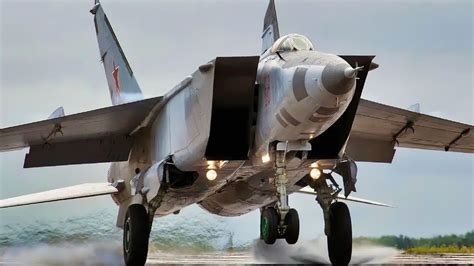
Yet, this terrifying visage was, in reality, a Potemkin Village of Soviet propaganda. Much of the “Foxbat hysteria” stemmed from misinterpretation and flawed assumptions. Though the aircraft’s size and speed were undeniable, its design concealed fundamental weaknesses. The Soviets, lacking access to lightweight titanium alloys used in Western jets, resorted to stainless steel construction. This choice made the MiG-25 three times heavier than its aluminum counterparts, resulting in an unarmed weight of 64,000 pounds—far heavier than the modern F-35A’s sub-50,000-pound airframe.
Engineering by Necessity, Not Supremacy
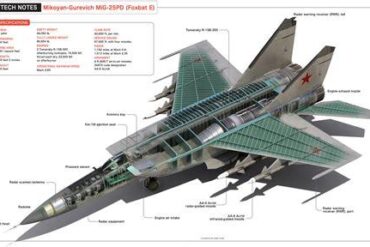
The Foxbat’s sheer bulk was only part of the story. Its fuselage, extending nearly nine feet longer than an Avro Lancaster and towering 2.5 feet higher than a B-24 Liberator, was essentially a welded steel fuel tank aft of the cockpit. Western observers were baffled by its rough, uneven paneling, mistaking factory-standard skinning for crude field repairs. One analyst quipped that the jet looked like it had been “patched up by a country tinker.”
Designed under the doctrinal constraints of strict ground control interception, the MiG-25 was tailored to eliminate high-flying bombers like the B-58 Hustler and the canceled B-70 Valkyrie. However, evolving air defense technology rendered such bomber missions suicidal. The introduction of surface-to-air missiles quickly made high-altitude bombing runs obsolete, leaving the Foxbat optimized for a threat that no longer existed.
Its avionics were similarly antiquated. The aircraft relied on a vacuum-tube radar system weighing nearly half a ton, with a paltry 56-mile detection range and no look-down/shoot-down capability until the 1980s. Its radar was effectively blind below 500 meters, rendering it ineffective against low-flying threats.
The Defection That Shattered Illusions
The West’s misconceptions about the MiG-25 endured until September 6, 1976, when Soviet pilot Viktor Belenko dramatically defected, flying his Foxbat to Hakodate Airport in Japan. Landing with a mere 30 seconds of fuel remaining, Belenko handed the jet—and its secrets—into Western hands. His defection provided an unprecedented glimpse into the Foxbat’s reality.
American and Japanese engineers spent two months meticulously disassembling the aircraft. Their findings were sobering. Far from being an agile super-interceptor, the MiG-25 was revealed as a blunt instrument of speed—too heavy to maneuver effectively at low altitudes, limited to a mere 4.5 G load factor (and 2.2 G with full fuel), and highly restricted in operational altitude and endurance. Though officially rated for 89,000 feet, a fully armed Foxbat could barely reach 68,900 feet and sustain under 79,000 feet for two minutes with only two missiles aboard.

Further compounding its shortcomings, the Foxbat lacked midair refueling capability, drastically limiting its operational range. Its Tumansky R-15 engines, optimized for brief bursts of supersonic speed, suffered catastrophic failure if pushed beyond Mach 2.83. Attempts to exceed this threshold would destroy the engine cores due to thermal stresses. The aircraft’s enormous AA-6 “Acrid” missiles, each over 20 feet long with a 220-pound warhead, had a maximum range of just 50 miles and were vulnerable to being torn from their hardpoints at high G-loads.
The Foxbat in Combat and Legacy
Despite its limitations, the MiG-25 did achieve select successes. Iraqi Foxbats managed to shoot down a U.S. Navy F/A-18 Hornet in 1991, marking its most notable combat kill. Yet overall, its combat record was underwhelming. Syrian MiG-25s suffered multiple defeats at the hands of Israeli F-15 Eagles during the early 1980s, with Israeli pilots orchestrating ambushes that exposed the Foxbat’s vulnerabilities.
Iraq’s claims of 15 aerial victories during the Iran-Iraq War remain dubious, with many attributed kills likely exaggerated or propaganda-driven. Even so, the Foxbat’s psychological impact persisted. Its fearsome reputation spurred the U.S. to accelerate the F-X program, culminating in the creation of the legendary F-15 Eagle, an aircraft with a perfect 104-0 air combat record.
Beyond the battlefield, the Foxbat found peculiar niches. India operated six reconnaissance MiG-25RBKs, using them for high-altitude surveillance of the Himalayas. Indian Air Marshal Sumit Mukerji lauded its ability to cruise at Mach 2.5 on minimal afterburner, calling it an “awesome airplane” despite its crude handling at low altitudes. Missions, however, often ended with only 200–400 kg of fuel remaining, highlighting its razor-thin operational margins.

Perhaps the most bizarre feature of the Foxbat was its air-conditioning system, which used 240 liters of grain alcohol and distilled water. Soviet mechanics were notorious for siphoning off the alcohol, earning the MiG-25 the nickname “Flying Restaurant.” Toasts to its “health” were as common as its maintenance logs.
The MiG-25’s design even influenced the hobbyist world. Using Belenko’s captured aircraft as a reference, Hasegawa’s model division released an accurate plastic kit in just 100 days, a product that remains popular among aviation enthusiasts to this day.
Conclusion: A Symbol of Soviet Aspirations and Limitations
The MiG-25 Foxbat remains a testament to Soviet ingenuity under resource constraints and strategic miscalculations. Initially heralded as a world-beating super-interceptor, it was ultimately a product of compromise, overestimation, and obsolescence by design. Its development shaped Western aerospace strategy, directly inspiring aircraft like the F-15 Eagle, yet its battlefield impact was marginal at best.
In the end, the Foxbat’s most significant victory was not in air-to-air combat but in triggering a technological response from its adversaries. Its image loomed larger than its capabilities, proving that in the Cold War, perception was often as potent as reality.