When evaluating the aerodynamic performance of an aircraft, particularly gliders, two crucial performance metrics often come into play: Maximum Glide Ratio and Minimum Sink Rate. Although both are foundational in assessing how efficiently an aircraft can descend, they optimize for distinctly different flight conditions. Misunderstanding or conflating the two can lead to suboptimal decisions in both flight planning and aircraft design.
At their core, these two concepts are derived from the same aerodynamic principles but applied toward very different objectives. Maximum Glide Ratio is about covering the greatest horizontal distance per unit of altitude lost, while Minimum Sink Rate is concerned with staying aloft as long as possible, or minimizing the vertical speed at which the aircraft descends. These performance states occur at different airspeeds, involve distinct aerodynamic configurations, and serve separate mission profiles.
Defining Maximum Glide Ratio
Maximum Glide Ratio refers to the optimal horizontal distance an aircraft can travel per unit of altitude lost. Expressed as a ratio (e.g., 40:1), it means the aircraft can travel 40 units forward for every 1 unit of descent. This metric becomes critical in emergency engine-out scenarios or when attempting to reach a distant landing site. Glider pilots also rely on this value when attempting to transition from one thermal to another or during cross-country competition flights.
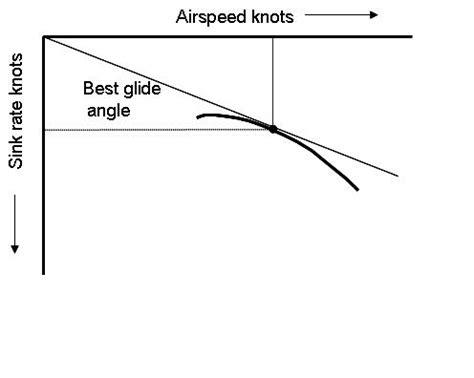
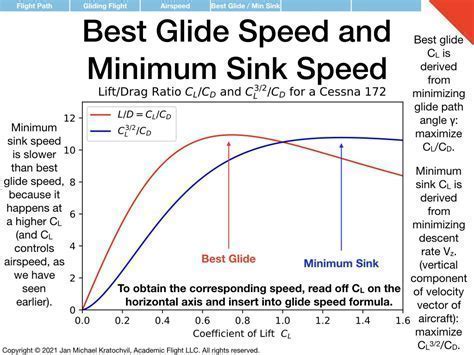
The point of maximum glide efficiency occurs at a specific airspeed known as the Best Glide Speed. This speed varies based on aircraft type, configuration, and current loading. Flying either faster or slower than this optimal speed increases the descent angle, thereby reducing the distance one can glide.
Key characteristics of Maximum Glide Ratio:
- Optimized for horizontal distance traveled per altitude lost
- Occurs at a higher airspeed than minimum sink rate
- Ideal for transitioning across terrain or escaping unfavorable air
- Dependent on wing shape, angle of attack, and aircraft configuration
Defining Minimum Sink Rate
On the other hand, Minimum Sink Rate is the slowest vertical descent rate achievable in stable flight. This condition is crucial when the objective is maximizing time aloft, such as when soaring in rising air currents (thermals). It provides the best opportunity to gain or maintain altitude when surrounded by weak lift.
Minimum sink occurs at a lower airspeed compared to maximum glide. At this slower speed, although the glider stays in the air longer, the forward distance covered per unit altitude lost (glide ratio) is worse. Therefore, despite staying aloft longer, the aircraft does not travel as far horizontally.
Key characteristics of Minimum Sink Rate:
- Optimized for vertical endurance—staying in the air longer
- Occurs at a lower airspeed than best glide
- Crucial for thermal soaring or waiting out poor conditions
- Represents lowest possible descent rate in still air
Why They Are Not the Same
A common misconception is assuming that a slower descent (minimum sink) automatically yields a better glide ratio. However, the physics of flight efficiency disprove this. Glide ratio is defined as forward speed divided by sink rate. Therefore, an aircraft might sink slightly faster, but if it travels forward significantly more during that descent, its glide ratio improves.
Consider the following example:
- Glider A sinks at 100 ft/min and moves forward at 1,000 ft/min → Glide Ratio = 10:1
- Glider B sinks at 200 ft/min but moves forward at 3,000 ft/min → Glide Ratio = 15:1
Despite a worse sink rate, Glider B travels farther per foot of altitude lost, giving it a better glide ratio. This underscores the distinct performance trade-offs that gliders and powered aircraft must navigate.
Aerodynamic Basis: Polar Curves
These differences are graphically depicted in a glide polar diagram. The polar curve represents the relationship between sink rate and forward airspeed. The minimum point on the curve indicates the Minimum Sink Speed—the speed at which vertical descent is lowest. In contrast, a line drawn from the origin tangent to the curve identifies the Best Glide Speed, corresponding to the Maximum Glide Ratio.
Polar curves are unique to each aircraft and heavily influenced by:
- Wing design and aspect ratio
- Airframe drag characteristics
- Weight and wing loading
- Air density and temperature conditions
The polar diagram becomes an essential flight planning tool, especially for sailplane pilots.
Practical Implications for Pilots
Understanding and applying the correct performance speed is mission-critical in gliding and emergency flight. When attempting to cover ground—such as reaching a designated landing field—pilots should adopt the Best Glide Speed to maximize lateral travel. In contrast, when searching for lift or flying within a thermal, maintaining Minimum Sink Speed allows for prolonged loitering and better chances of catching rising air.
This nuanced understanding is especially important when transitioning between thermals or while flying competitions where strategic energy management differentiates winners from the rest.

Effects of Aircraft Weight and Wing Loading
Both minimum sink and maximum glide performance are influenced by weight. As an aircraft becomes heavier:
- Best Glide Speed increases, though the glide ratio remains roughly the same
- Minimum Sink Rate worsens, because more lift (and thus more drag) is needed to support the extra weight
While heavier gliders may penetrate stronger headwinds more efficiently, they also demand faster speeds to maintain performance, which raises the sink rate. Lightening the aircraft improves minimum sink performance but can reduce energy efficiency in turbulent or windy air.
Helicopters and Rotary-Wing Considerations
While the principles discussed are derived from fixed-wing aerodynamics, rotary-wing aircraft such as helicopters follow analogous patterns. During autorotation (power-off glide), helicopters also exhibit distinct best glide speeds and minimum rate of descent speeds. The rotor RPM, blade efficiency, and airspeed work in tandem to determine performance. For instance, maximum glide distance often comes at a higher descent rate than the minimum sink configuration. This difference is vital during engine-out scenarios or autorotative landings.
Engineering and Design Perspective
From an aerospace engineering viewpoint, optimizing for either maximum glide or minimum sink involves trade-offs in airfoil selection, aspect ratio, and wing loading. High-performance gliders with long, slender wings (high aspect ratios) tend to offer both better sink rates and higher glide ratios, but achieving both simultaneously is structurally and economically challenging.
Designers must balance:
- Structural weight limits
- Control surface effectiveness
- Stall characteristics
- Cost and material complexity
Additionally, variable-geometry wings and adaptive flight control systems in advanced UAVs and next-gen sailplanes attempt to dynamically shift between optimal configurations for endurance (minimum sink) and range (maximum glide).
Tactical Application in Competitive Gliding
In cross-country soaring competitions, pilots must constantly switch between minimum sink speeds when thermalling and maximum glide speeds when cruising between lift sources. The ability to recognize, calculate, and adapt flight speed based on real-time conditions is a hallmark of elite pilot skill.
Moreover, modern soaring computers and variometers assist pilots by computing MacCready values, which help determine optimal speed to fly based on expected lift ahead, integrating both minimum sink and max glide concepts into a single dynamic profile.
Conclusion
In summary, while Minimum Sink Rate and Maximum Glide Ratio are closely related aerodynamic concepts, they are not interchangeable. Each optimizes for a different goal—endurance versus range—and is achieved at different airspeeds, under different conditions, and with distinct strategic implications. Mastering the difference between the two empowers pilots to make smarter, safer, and more efficient decisions in both powered and unpowered flight.
An adept understanding of these performance regimes not only enhances pilot proficiency but also plays a pivotal role in the design philosophy of high-performance aircraft. Whether navigating thermals in a sailplane, planning autorotation in a helicopter, or managing an engine-out emergency in a powered plane, the choice between minimum sink and maximum glide can spell the difference between success and failure.