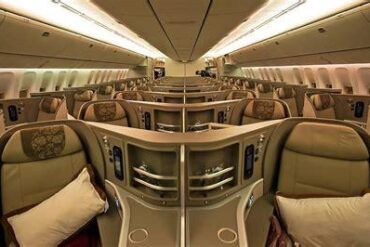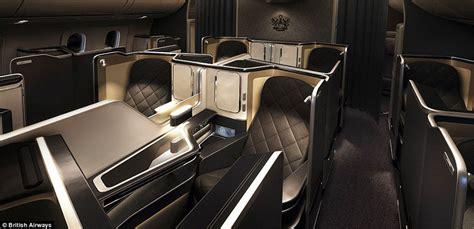
Long-haul travel changes character the moment space becomes a defining feature rather than a compromise. When legroom turns into genuine freedom of movement, when seats stop feeling like furniture and start feeling like rooms, and when privacy becomes architectural rather than symbolic, flying shifts from endurance to experience. On Boeing widebody aircraft, a small number of airlines still deliver that kind of first class—cabins designed not merely to impress, but to physically liberate the passenger at 35,000 feet.
This is not about champagne brands or amenity kits. This is about dimensions, layout, density, and spatial intelligence. The airlines below operate some of the most expansive first class seats installed on Boeing aircraft, available to book today on real-world routes. These cabins are rare, meticulously engineered, and intentionally unconcerned with efficiency. That is precisely the point.
Singapore Airlines Boeing 777-300ER First Class: Precision Space Without Excess
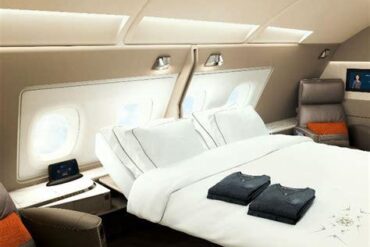
Singapore Airlines’ Boeing 777-300ER first class represents a philosophy of measured luxury, where space is not exaggerated but perfectly controlled. The cabin occupies the nose of the aircraft and contains just four seats in a 1-2-1 layout, immediately setting a tone of scarcity and calm. This ultra-low density is the first clue that personal space, not capacity, drives the design.
Each seat is remarkably wide, upholstered in supple leather, and positioned to allow natural movement without obstruction. Unlike many first class products that rely on visual drama, Singapore Airlines prioritizes functional openness. There is ample floor area to stand, change, and dine without contorting the body. When converted into a bed, the sleeping surface becomes fully flat and generously proportioned, allowing taller passengers to stretch out completely without diagonal positioning.
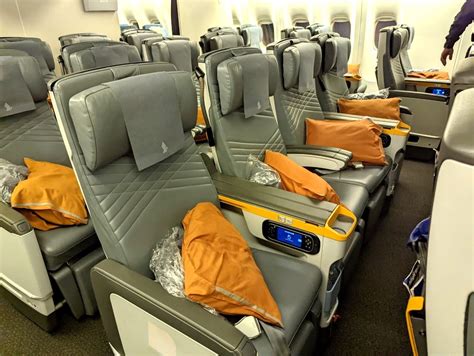
What elevates this product is not just width or pitch, but the absence of visual clutter. Storage is integrated cleanly, the side consoles are expansive without being intrusive, and the aisle spacing feels closer to that of a private jet than a commercial airliner. On long-haul routes from Singapore Changi Airport to London Heathrow, Tokyo Narita, and select transpacific destinations, this Boeing-based first class remains one of the most physically comfortable ways to cross hemispheres.
Emirates Boeing 777-300ER First Class Suites: Maximum Volume, Minimal Compromise
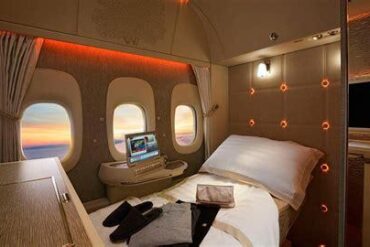
If Singapore Airlines treats space as a precision instrument, Emirates treats it as a spectacle—and on its Boeing 777-300ER fleet, the result is one of the most voluminous first class experiences ever installed on a twin-engine aircraft. The latest-generation Emirates 777 first class features just six fully enclosed suites in a 1-1-1 configuration, eliminating the traditional center block entirely.
Each suite is effectively a self-contained room, with floor-to-ceiling walls, a closing door, and enough internal volume to stand upright and move freely. The seat itself is exceptionally wide, but the surrounding real estate is what sets it apart. Side tables are deep and expansive, storage is abundant, and the distance between the seat and the suite walls prevents any sense of enclosure-induced claustrophobia.
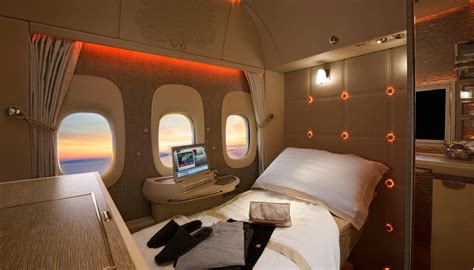
From Dubai International Airport, Emirates deploys these aircraft on select high-yield routes to Europe, Asia, and North America, where demand for true first class remains strong. What makes this product spatially exceptional is not just square footage, but vertical perception. Lighting, mirror placement, and ceiling height manipulation create an environment that feels significantly larger than the aircraft’s physical dimensions suggest. This is first class designed to overwhelm the senses—in the best possible way.
All Nippon Airways Boeing 777-300ER “THE Suite”: Japanese Minimalism, Maximum Width
All Nippon Airways’ Boeing 777-300ER first class, branded as THE Suite, redefines spaciousness through intelligent restraint. Introduced in 2019, this product occupies the forward cabin in a 1-2-1 configuration, but the resemblance to conventional layouts ends there. Each suite is enclosed by high walls and sliding doors, creating private spaces that feel architectural rather than modular.
The defining feature of THE Suite is sheer width. The seat is among the widest in commercial aviation, allowing passengers to sit cross-legged, recline sideways, or work without ever feeling constrained. The bed mode transforms the entire seating area into a broad, flat sleeping surface with hotel-like proportions, supported by thick padding and premium bedding.
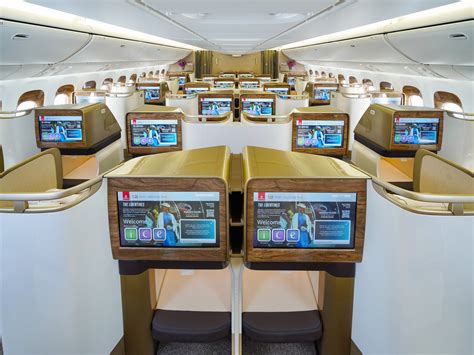
ANA deploys these aircraft on flagship long-haul routes from Tokyo Haneda and Tokyo Narita to New York JFK, London Heathrow, and San Francisco. The cabin’s spatial calm is amplified by muted color palettes, indirect lighting, and an absence of unnecessary ornamentation. This is first class for travelers who value physical freedom and mental quiet in equal measure, delivered on one of Boeing’s most capable long-haul platforms.
American Airlines Boeing 777-300ER Flagship First: Space as a Strategic Upgrade
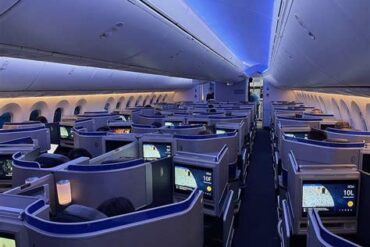
American Airlines’ Flagship First is not marketed as a traditional first class, yet on the Boeing 777-300ER it offers one of the most spacious seating environments available on a U.S. carrier. Configured in a 1-2-1 layout, the cabin emphasizes width and separation over theatrical privacy, creating a noticeably more open atmosphere than standard business class.
The seats are wider, the console areas more generous, and the pitch allows for comfortable movement even when the cabin is fully occupied. In bed mode, the sleeping surface is long and flat, supported by upgraded bedding that enhances rest on ultra-long-haul sectors. The cabin density remains low enough that noise and foot traffic rarely intrude on the experience.
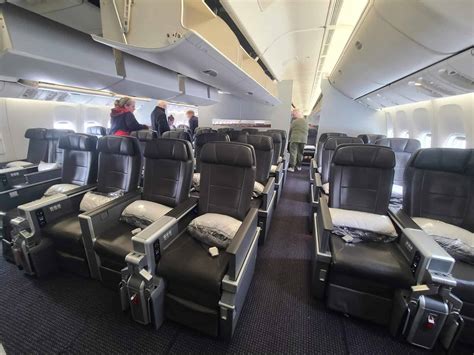
Operating primarily from hubs such as Dallas/Fort Worth and Miami to major international gateways, Flagship First on the 777-300ER serves travelers who prioritize physical comfort over ornamentation. While it lacks enclosed suites, the sense of space—particularly shoulder and elbow room—places it firmly among the most comfortable Boeing-based premium cabins still available to book.
Qatar Airways First Class and the Boeing Context: Scarcity as a Statement
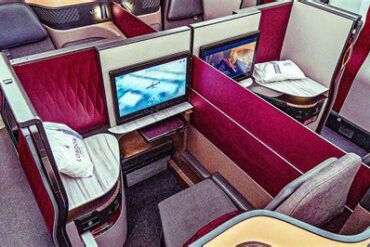
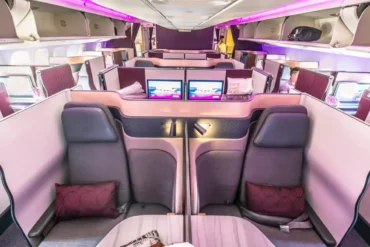
Qatar Airways occupies a unique position in any discussion of first class. While the airline’s current first class offering is confined to the Airbus A380, its relevance in a Boeing-focused conversation lies in what it chooses not to do. Qatar has deliberately refrained from installing first class on its Boeing widebody fleet, instead channeling resources into an expansive, suite-based business class.
This strategic absence highlights an important truth: true first class is no longer an efficiency-driven product. Airlines that maintain it do so as a statement, not a necessity. Qatar’s decision underscores how rare genuinely spacious first class cabins have become on Boeing aircraft—and why those that remain command such attention and loyalty.
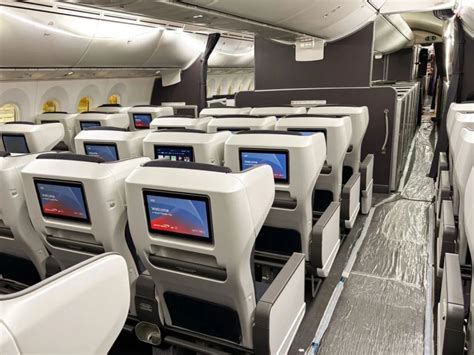
For travelers specifically seeking Boeing-operated flights with maximum personal space, Qatar’s approach reinforces the value of the few carriers still willing to dedicate significant real estate to first class on these aircraft. Scarcity, in this context, becomes part of the luxury equation.
Why Boeing First Class Still Matters in a Shrinking Premium World
Boeing’s long-haul aircraft, particularly the 777-300ER, offer a structural advantage for first class cabins: a wide fuselage, long range, and design flexibility that allows airlines to sacrifice density without compromising performance. The products highlighted here exploit those characteristics fully, creating environments where space is not negotiated but guaranteed.
In an era where many carriers have eliminated first class entirely, these cabins represent a philosophical outlier. They exist for travelers who value room to breathe, room to sleep, and room to exist without constant proximity to others. On Boeing aircraft, that experience is becoming increasingly rare—and therefore increasingly valuable.
For those willing to seek them out, these first class seats remain exceptional not because they are flashy, but because they are physically transformative. They turn long-haul flight from a test of endurance into a controlled, deeply comfortable passage across the globe.