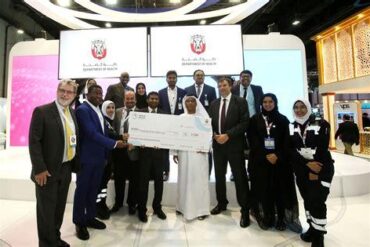
Abu Dhabi International Airport has taken a decisive step toward reshaping global airport intelligence by signing a groundbreaking Memorandum of Understanding with SITA. This partnership sets the stage for a next-generation airport ecosystem driven by artificial intelligence, real-time data, and predictive operational management. With this alliance, Abu Dhabi positions itself at the forefront of a new era where airports function as interconnected smart hubs capable of making fast, accurate, and highly coordinated decisions.
The emerging digital platform—known as the Intelligent Total Airport Management (iTAM) system—aims to unify every operational touchpoint, from airline activity and ATC interactions to ground operations and passenger movement. Built on continuous data-stream analysis, this system is set to minimize delays, predict disruptions, and optimize airport-wide efficiency with a precision traditionally associated with high-frequency trading algorithms.
This marks one of the most ambitious AI-driven transformations in modern aviation, signaling a shift toward predictive airports rather than reactive ones.
Intelligent Total Airport Management: The Digital Brain of Abu Dhabi Airport
The proposed iTAM platform serves as a central nervous system that ingests data from every corner of the airport ecosystem. This ranges from airlines and ground handlers to government agencies and real-time weather intelligence. By merging these disparate data sources into a single AI-powered command center, the platform unlocks capabilities previously impossible with legacy systems.
The heart of the platform lies in its analytical depth. Real-time predictions allow airport operators to anticipate runway congestion before it forms, reroute passenger flows before queues become bottlenecks, and proactively allocate staff and resources before disruptions escalate. This intelligent oversight can dramatically improve on-time performance, boosting operational reliability and helping Abu Dhabi Airport maintain a competitive edge among global hub airports.
Beyond operational gains, the system is engineered to strengthen airport safety. Early anomaly detection—powered by machine learning—gives operators a sharper eye on emerging risks, ensuring a safer and more secure travel environment.
Next-Generation Technologies Already Shaping Zayed International Airport
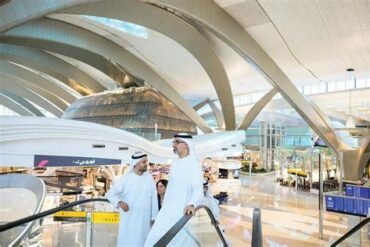
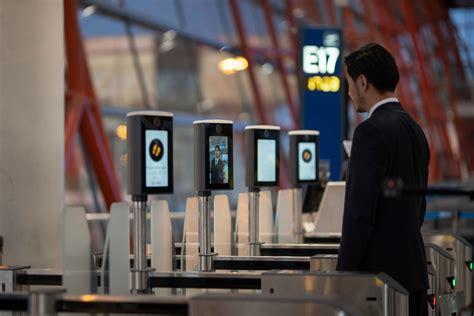
Abu Dhabi’s new Terminal A, opened in 2023, is already a testament to the city’s commitment to aviation innovation. The airport introduced biometric touchpoints, advanced security lanes, and expansive self-serve infrastructure. These upgrades were designed not as flashy add-ons but as foundational building blocks for a fully interconnected airport of the future.
Sustainability also plays a central role in this strategy. The terminal’s vast solar-powered car park, equipped with 7,542 solar panels, significantly cuts carbon emissions—saving nearly 5,300 tonnes of CO₂ annually. This renewable energy effort ranks as one of the most ambitious airport solar installations in the region.
Another fascinating technology is the airport’s kinetic flooring, installed in high-footfall areas. With every step passengers take, the panels capture energy and convert it into electricity that powers nearby screens. This clever use of movement-generated power not only supports sustainability but also emphasizes Abu Dhabi’s strong drive toward adopting experiential, data-generating innovations.
Dubai International Airport Joins the AI Surge
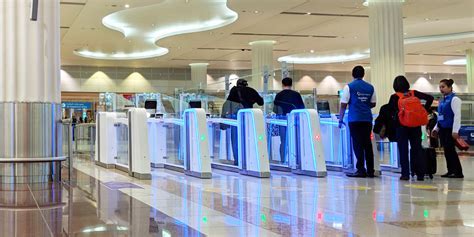
While Abu Dhabi accelerates its AI vision, Dubai International Airport (DXB) is propelling its own evolution with advanced biometrics and autonomous security processes. The airport’s highly publicized Smart Corridor, located in Terminal 3, processes travelers using AI-powered cameras capable of handling up to ten passengers simultaneously. Passport control times have been reported as low as six to fourteen seconds, signaling a dramatic transformation in the passenger flow experience.
DXB’s steady adoption of smart gates and AI-assisted identity verification demonstrates a collective regional ambition: to design airports that operate at the speed of thought while maintaining strict aviation safety standards. Together, Abu Dhabi and Dubai are creating a blueprint that airports worldwide are likely to follow as global aviation enters an era dominated by automation and real-time intelligence.
What the AI-Driven Gulf Hub Means for Global Aviation
The Gulf region has long positioned itself as an aviation powerhouse, but with the rise of AI-driven airports, it is now spearheading a technological revolution. The partnership between Abu Dhabi Airports and SITA signals a powerful shift away from traditional airport management and toward dynamic ecosystems that act, predict, and optimize with machine-level precision.
Travelers of the future can expect faster flows through terminals, fewer delays, and a more consistent journey—even at peak demand. Operators will rely on constant analytical feedback rather than static historical data. Airlines will benefit from seamless coordination, and ground operations will catch up to the speed of digital transformation long overdue in global aviation.
The new iTAM platform is more than a digital upgrade; it is a blueprint for the next chapter of airport evolution—one where vast, data-rich hubs operate like synchronized intelligent organisms capable of self-optimizing with every passing minute.
Abu Dhabi’s move is poised to accelerate international competition, prompting airports across Asia, Europe, and the Americas to adopt similar AI-driven ecosystems. The transformation has begun, and the Gulf is leading the charge into the era of the AI-controlled smart airport.