The Airplane Design Group (ADG) is a classification established by the FAA to categorize aircraft based on their wingspan and tail height. Defined in FAA Advisory Circular 150/5300-13, the ADG consists of six distinct groups. This system can sometimes replace element 2 of the ICAO Aerodrome Reference Code.
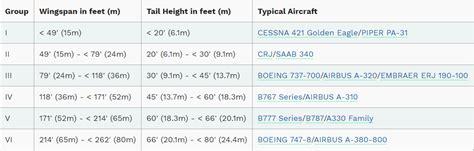
The ADG relies on the more restrictive measurement between an aircraft’s wingspan and tail height. Here’s a breakdown of the different groups:
Group I: Wingspan less than 49 feet (15 meters) and tail height under 20 feet (6.1 meters). Typical aircraft include the CESSNA 421 Golden Eagle and PIPER PA-31.
Group II: Wingspan ranges from 49 feet (15 meters) to less than 79 feet (24 meters), with a tail height between 20 feet (6.1 meters) and under 30 feet (9.1 meters). Examples are the CRJ and SAAB 340.
Group III: Covers wingspans from 79 feet (24 meters) to less than 118 feet (36 meters) and tail heights from 30 feet (9.1 meters) to under 45 feet (13.7 meters). Notable aircraft in this group include the BOEING 737-700 and AIRBUS A-320.
Group IV: This group features wingspans from 118 feet (36 meters) to less than 171 feet (52 meters) and tail heights ranging from 45 feet (13.7 meters) to under 60 feet (18.3 meters). The B767 Series and AIRBUS A-310 fit here.
Group V: Wingspan ranges from 171 feet (52 meters) to less than 214 feet (65 meters) with tail heights between 60 feet (18.3 meters) and under 66 feet (20.1 meters). The B777 Series, B787, and A330 Family are typical examples.
Group VI: This final group includes aircraft with wingspans from 214 feet (65 meters) to less than 262 feet (80 meters) and tail heights from 66 feet (20.1 meters) to under 80 feet (24.4 meters). The BOEING 747-8 and AIRBUS A-380-800 are included in this category.
The ADG plays a crucial role in the FAA’s Runway Design Code (RDC). This code combines three classifications related to aircraft types to ensure proper design for specific runways.