Altimeter Pressure Settings
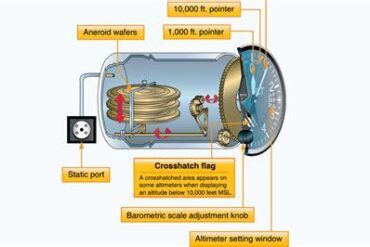
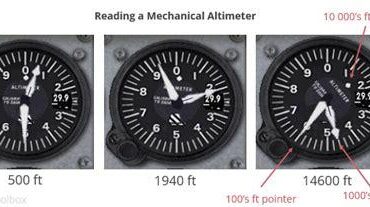
Aircraft pressure altimeters are crucial for indicating how high an aircraft is above a specific reference point, known as a datum. The choice of datum depends on the barometric pressure set on the altimeter’s sub-scale. Proper altimeter settings are vital for maintaining safe distances from the ground and other aircraft.
The metric unit for barometric pressure is the hectopascal (hPa), which is used in ICAO Annex 5. Other units mentioned in the Supplement to ICAO Annex 5 include millibar (mb), where 1 mb equals 1 hPa, inches of mercury (inHg), commonly used in North America, and millimeters of mercury, used in some CIS countries and Southeast Europe.
There are three main references for barometric pressure: QNH, QFE, and Standard Pressure.
QNH is the pressure set on the altimeter’s subscale to indicate height above sea level. When set correctly, the altimeter reads the runway elevation when the aircraft is on the runway. Airfield QNH is derived by correcting a measured QFE to sea level using the International Standard Atmosphere (ISA) model. This means that at the airfield reference point, the altimeter shows accurate altitude, but at different heights, it may not be precise due to variations in atmospheric temperature.
QFE is the pressure setting on the altimeter so it shows height above a specific reference elevation. According to PANS-OPS Doc 8400, QFE refers to the atmospheric pressure at aerodrome elevation or runway threshold. When the aerodrome QFE is set, the altimeter will read zero at the highest point of the runway, and at different altitudes, it shows the height above that reference. For precision approaches, if the runway threshold is 7 feet or more below the aerodrome elevation, the QFE can be based on that threshold elevation.
When Standard Pressure (1013.2 mb) is set, the altimeter indicates pressure altitude, which is used by all aircraft flying above the transition altitude. This setting provides a common reference for vertical measurements, equivalent to the air pressure at mean sea level in the ISA.
Effects of Temperature on Altimeter Readings
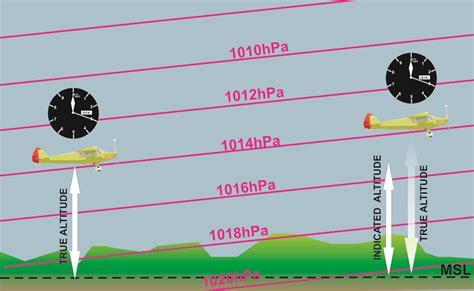
Pressure-to-height conversions in altimetry follow ISA guidelines. Typically, this conversion is 27 feet per hPa in lower atmospheric conditions. However, when temperatures deviate from ISA, the altimeter readings can differ significantly from actual altitude. Cold air is denser than warm air, which compresses isobaric surfaces closer to the ground. In colder-than-ISA conditions, the altimeter tends to overestimate altitude because it uses the standard ratio. Conversely, in warmer air, the increased distance between isobaric surfaces leads to an underestimation of altitude.
It is essential to be cautious when flying in colder-than-ISA conditions, as the altimeter may mislead pilots into thinking they are at a higher altitude than they truly are, potentially leading to dangerous situations. Despite instrument errors, altimeter readings between different aircraft generally remain consistent, except in mountainous regions or low-altitude scenarios.
Definitions
-
QNH: The altimeter sub-scale setting for elevation when on the ground.
-
QFE: The atmospheric pressure at aerodrome elevation or runway threshold, as defined by ICAO documents.