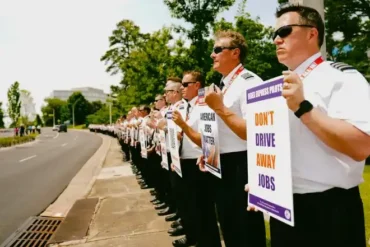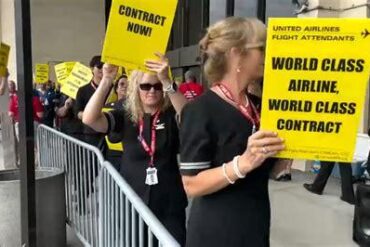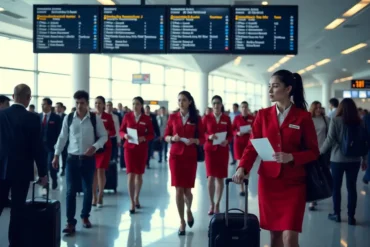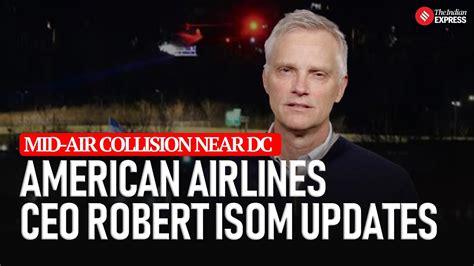
The labor tensions simmering inside American Airlines have erupted into an unprecedented public confrontation, as the carrier’s flight attendant union delivers a historic rebuke of corporate leadership. In a unanimous decision that signals deepening unrest among frontline staff, the Association of Professional Flight Attendants (APFA) has issued its first-ever vote of no confidence in CEO Robert Isom, marking a watershed moment in the airline’s labor relations and corporate governance history.
Union Declares Leadership Failure Amid “Downward Spiral”
The APFA, representing roughly 28,000 American Airlines flight attendants, framed the vote as a necessary escalation after months of frustration over financial performance, operational breakdowns, and executive decision-making. Union leadership described the airline’s trajectory under Isom as “a relentless downward spiral,” arguing that systemic failures now threaten both employee welfare and long-term competitiveness.
APFA President Julie Hedrick delivered some of the sharpest criticism yet leveled at the executive suite, tying disappointing profits directly to management strategy. She pointed to operational disruptions that left frontline crew members stranded during irregular operations, including severe weather events that reportedly forced some flight attendants to rest in airport terminals rather than hotels.
Hedrick’s remarks underscored what the union views as a widening disconnect between leadership rhetoric and worker reality, accusing top management of neglecting the “human element” essential to airline operations.
Operational Chaos and Frontline Strain
Behind the dramatic vote lies a catalog of operational grievances. Union officials argue that post-pandemic recovery exposed structural weaknesses that management failed to correct. Irregular operations—particularly during winter storms—became flashpoints, with scheduling breakdowns, crew displacement, and inadequate support systems compounding employee fatigue.
Flight attendants reported extended duty disruptions without sufficient logistical backup, reinforcing perceptions that cost controls had eclipsed operational resilience. For labor groups, these episodes symbolized a broader erosion of corporate preparedness in an industry where real-time crisis management defines brand credibility.
The union maintains that such failures are not isolated incidents but symptoms of leadership miscalculation, particularly in balancing network growth with staffing, fleet readiness, and contingency planning.
Financial Performance and Profit-Sharing Frustrations
Economic performance sits at the center of the dispute. American Airlines’ recent earnings results lagged behind key competitors, intensifying scrutiny from labor groups who link profitability directly to worker compensation structures such as profit sharing.
Flight attendants argue they are absorbing the consequences of strategic missteps without sharing in the financial upside typically expected during industry recoveries. The contrast between modest profits and operational strain has amplified dissatisfaction, especially as rival carriers posted stronger margins and more stable recovery trajectories.
From the union’s perspective, the issue is not merely profitability but the distribution of financial risk and reward within the corporate hierarchy.
Executive Compensation Under Fire
Nothing crystallizes labor anger faster than executive pay, and APFA leaders seized on disclosures from corporate filings to sharpen their critique. Despite deteriorating financial and operational metrics, CEO compensation packages and senior executive benefits rose—fueling perceptions of misaligned incentives.
Union officials highlighted proxy statements and earnings call commentary in which leadership acknowledged underwhelming results while maintaining substantial remuneration. To frontline employees navigating disrupted schedules and stagnant profit sharing, the optics proved combustible.
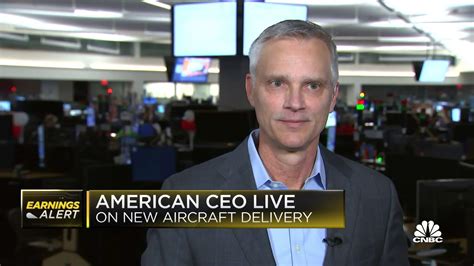
The compensation debate has become symbolic, representing a wider philosophical divide over accountability. Labor groups argue that meaningful leadership responsibility must include financial consequences when performance falters.
Corporate Sales Strategy Backlash
Another pillar of the no-confidence vote centers on a controversial corporate sales and distribution strategy that unions say alienated high-value business customers. The initiative, backed by executive leadership, sought to reshape booking channels and agency relationships but instead triggered backlash across the corporate travel ecosystem.
Revenue impacts followed. Business travel buyers—historically among the most lucrative customer segments—reportedly shifted loyalty to competing airlines offering more stable distribution frameworks and service reliability.
The fallout extended into leadership turnover. The former chief commercial officer associated with the strategy departed abruptly yet received significant compensation and severance, a detail unions cite as further evidence of accountability gaps.
Customer Satisfaction Rankings Slide
Brand perception metrics reinforced union concerns. In multiple industry rankings, American Airlines slipped behind competitors across premium and economy categories. A J.D. Power study placed the carrier last in first and business class satisfaction, while economy segments also trailed rival airlines.
Simultaneously, The Wall Street Journal’s airline rankings recorded a drop from mid-tier placement to last overall within two years. For unions, these standings validate their operational warnings, linking service degradation to strategic and staffing decisions at the executive level.
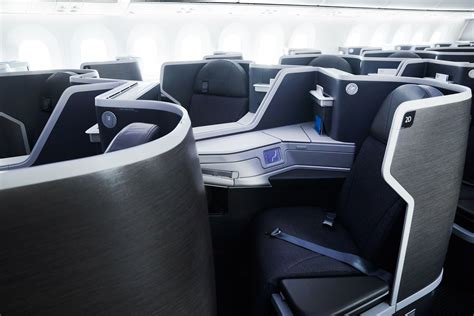
Customer satisfaction, after all, is inseparable from employee working conditions. Crew morale, staffing ratios, and operational consistency form the experiential backbone passengers ultimately judge.
Cross-Union Pressure Intensifies
Flight attendants are not alone in their discontent. The Allied Pilots Association (APA), representing approximately 16,000 American Airlines pilots, recently issued its own letter to the Board of Directors calling for “decisive change” and expressing lost confidence in management’s corrective capacity.
This multi-union alignment significantly raises stakes. When separate labor groups converge on leadership criticism, it signals structural—not situational—discord. Such unity can amplify bargaining leverage, public scrutiny, and investor attention.
Yet corporate response thus far has remained measured rather than transformative.
Board Response and Leadership Calculus
CEO Robert Isom acknowledged pilot concerns in internal communications, emphasizing alignment with the board on strengthening airline performance. His proposed remedy centered on dialogue—meeting with union leadership to discuss operational and strategic pathways forward.
For labor advocates, the response felt procedural rather than substantive. Critics argue that listening sessions, while symbolically constructive, fall short of the structural change unions demand.
The airline’s Board of Directors now occupies a pivotal governance position. Historically, corporate boards balance shareholder interests, executive continuity, and labor stability. Removing a CEO—particularly absent acute financial crisis—remains an extraordinary step.
Why This Vote Matters Historically
Votes of no confidence are not routine union gestures, especially within U.S. commercial aviation. Contentious negotiations occur regularly, but formal repudiations of sitting CEOs are rare.
That this marks the first such vote in APFA history elevates its symbolic weight. It transforms labor frustration from cyclical dispute into institutional censure, creating a documented rupture in leadership legitimacy—at least from the workforce perspective.
Even if no immediate executive change follows, the vote becomes part of the airline’s governance narrative, shaping investor perception, analyst questioning, and future labor negotiations.
Short-Term Impact vs. Long-Term Consequences
Despite the historic tone, immediate corporate upheaval appears unlikely. Boards typically evaluate CEO performance across multi-year financial arcs, not single earnings cycles or union motions.
American Airlines remains marginally profitable, reducing urgency for leadership overhaul. However, sustained underperformance—financial or operational—could gradually shift board calculus, particularly if labor unrest begins affecting reliability, brand equity, or revenue streams.
In that sense, the vote functions less as a trigger and more as an early warning system.
Strategic Crossroads for American Airlines
The airline now stands at a strategic inflection point shaped by three converging pressures:
- Workforce morale and retention risks
- Competitive performance gaps versus major U.S. carriers
- Customer satisfaction and brand perception decline
Balancing cost discipline with operational investment will likely define the next phase of leadership evaluation. Airlines operate on thin margins, but service failures carry outsized reputational costs in a hyper-competitive network market.
Whether through leadership restructuring or operational recalibration, stakeholders increasingly expect a credible turnaround framework.
Industry Context: Labor Power Resurgent
The no-confidence vote also reflects a broader aviation labor resurgence. Post-pandemic demand recovery strengthened union leverage across pilots, flight attendants, and ground staff globally.
Staffing shortages, fatigue concerns, and contract renegotiations have empowered unions to push more aggressively on compensation, scheduling protections, and executive accountability.
American Airlines’ internal conflict therefore mirrors an industry-wide recalibration of labor-management power dynamics rather than an isolated corporate dispute.
Outlook: Symbolism Today, Leverage Tomorrow
For now, the APFA vote stands as a symbolic but potent rebuke—historic in precedent, uncertain in immediate consequence. Leadership remains intact, board support appears steady, and operational reforms have yet to materialize in a form unions deem credible.
Yet symbolism accumulates force over time. Should financial results stagnate or operational disruptions persist, this vote may be reinterpreted not as protest, but as prophecy—an early institutional signal that frontline confidence had already eroded.
In aviation, where safety culture, service delivery, and operational precision depend on workforce cohesion, confidence in leadership is not cosmetic. It is infrastructural.