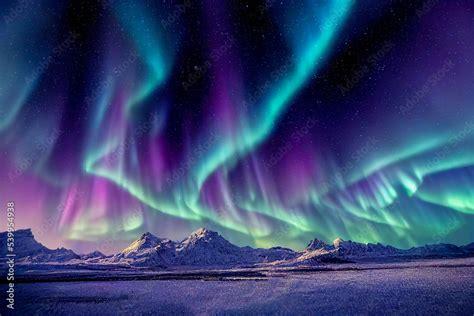
An aurora is a stunning natural light display seen in the sky, especially near the poles. This phenomenon happens when charged particles collide with the Earth’s magnetic field. Typically, auroras are visible at night and occur in the ionosphere. They are often called polar lights or polar auroras. You can usually spot them between 60 and 72 degrees north and south latitudes, which forms a ring around the Arctic and Antarctic polar circles. While auroras can sometimes be found deeper within the polar regions, these occurrences are rare and not always visible to the naked eye.
In the northern parts of the world, we refer to this effect as the aurora borealis, or the northern lights. The name comes from Aurora, the Roman goddess of dawn, and Boreas, the Greek name for the north wind. If you’re close to the North Magnetic Pole, your chances of seeing the aurora borealis increase. When viewed near the magnetic pole, auroras appear high in the sky. From farther away, they show up as a greenish glow on the northern horizon or even a faint red, resembling a sunrise from an odd direction. Interestingly, the aurora borealis is most commonly seen around the equinoxes.
On the flip side, we have the aurora australis, or the southern lights, which shares similar characteristics. However, it can only be observed from high southern latitudes like Antarctica, South America, or Australasia. The term ‘australis’ means ‘of the South’ in Latin. Auroras are not limited to Earth; they can also be spotted on other planets. Their visibility is highest near the poles due to extended periods of darkness and the influence of the magnetic field.