Mastering the Aviation Cover Letter: Your Passport to Career Takeoff
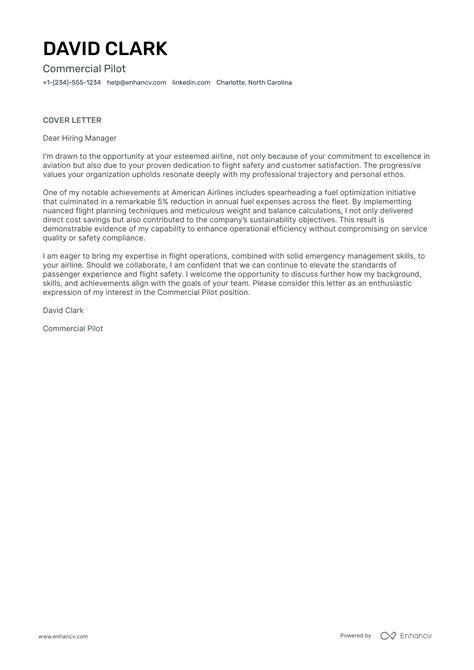
The aviation industry, known for its rigorous standards and global reach, offers an expansive range of career paths — from commercial pilots to maintenance engineers, air traffic controllers, and cabin crew. With more than 87 million aviation-related jobs worldwide, competition for roles at top-tier carriers like Delta Air Lines, American Airlines, or Lufthansa is fierce. This is why crafting a strategically written aviation cover letter is not merely an optional supplement — it is a competitive advantage that positions applicants for success.

In a field where safety, precision, and communication are paramount, a well-structured cover letter serves as your first flight check — demonstrating your technical expertise, FAA compliance, and alignment with airline values. Beyond summarizing your resume, the aviation cover letter must capture your unique flight path, presenting your aeronautical competencies, leadership capabilities, and customer-focused mindset with quantifiable authority.
What Makes an Aviation Cover Letter Stand Out in 2025?
The aviation sector’s rapid evolution, including digitization, sustainability mandates, and customer experience enhancements, means candidates must demonstrate adaptability alongside core proficiencies. An effective cover letter includes:
-
Personalized salutation and contact details
-
A powerful opening statement with measurable achievements
-
Body paragraphs that align with the hiring airline’s mission
-
Strategic insertion of technical skills and certifications
-
A persuasive call to action and professional sign-off
Let us now explore each segment of an aviation cover letter that wins interviews in 2025.
Opening With Precision: A Sky-High Introduction
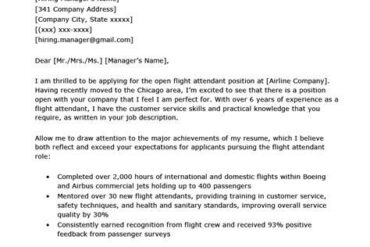
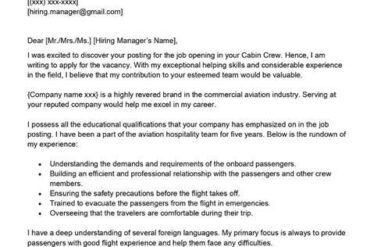
An opening paragraph should act as your boarding pass, immediately identifying you as a qualified candidate. Avoid generic clichés. Instead, lead with an impactful achievement:
“As a commercial pilot with 3,200 hours of flight time, including 1,800 hours as Pilot-in-Command (PiC) operating Boeing 737 and Airbus A320 aircraft, I’ve cultivated a deep commitment to FAA safety compliance and passenger service excellence.”
This instantly communicates technical authority and implies a proven track record, making your candidacy hard to ignore.

The Midsection: Showcasing Industry-Proven Competence
The body of your aviation cover letter is your altitude climb — steadily reinforcing your credibility with industry-specific language and quantifiable results. Instead of broad claims, aviation employers value evidence:
“At JetBlue Airways, I maintained 98% on-time departures and achieved a customer satisfaction rating of 96% across over 250 domestic and transcontinental routes.”
If applying for non-flight roles, such as in aviation safety, mechanical engineering, or air traffic control, integrate highly specialized terms:
“As an FAA-certified Aviation Safety Inspector, I conducted 135 in-depth compliance audits across commercial fleets, ensuring adherence to Part 121 and 135 regulations and contributing to a 40% reduction in inspection violations over 18 months.”
This level of specificity demonstrates deep familiarity with Federal Aviation Regulations (FARs) and shows that the applicant is mission-ready.
Aligning With Airline Culture and Values
Aviation is as much about team culture and safety ethos as it is about airworthiness and equipment mastery. Top airlines invest heavily in training and culture. Your letter must reflect this understanding:
“I’m drawn to Delta Air Lines’ leadership in carbon-neutral aviation, and I am eager to contribute to your ESG-aligned fleet modernization goals through my background in **sustainable avionics integration and carbon impact analysis.”
If applying to American Airlines, consider:
“Your long-standing reputation for safety, service excellence, and community impact resonates with my own values as a professional committed to operational integrity and inclusive passenger experiences.”
Embedding Technical Certifications and Competencies
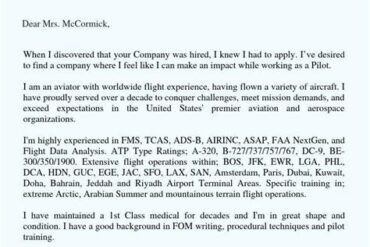
Technical fluency is the core of aviation recruitment. Whether you’re certified under ATP, CPL, AME, or FAR Part 107, incorporate these organically:
“I hold a current Airline Transport Pilot (ATP) certificate, FAA First Class Medical, and am endorsed for Multi-Engine Land (MEL) aircraft. My flight training included extensive simulator and IFR procedures, with over **700 hours logged in night and cross-country operations.”
Even for roles outside the cockpit, embed operational fluency:
“As an aviation customer service lead, I leveraged Sabre and Amadeus systems to coordinate over 4,000 passenger rebookings, achieving a zero-escalation rate during disruption events.”
Crafting the Final Descent: A Persuasive Closing Paragraph
The final paragraph is your landing gear deployment. Invite an interview without sounding generic:
“I look forward to the opportunity to discuss how my operational acumen and dedication to safe, efficient flight align with your mission at Southwest Airlines. I am available for interviews at your convenience and welcome the chance to contribute to your distinguished team.”
Be courteous, but assertive. The close must feel professional and confident:
“Thank you for considering my candidacy. I am excited by the potential to contribute to your legacy of excellence in global aviation.”

The 2025 Standard: Adapting to New-Age Expectations
In the age of AI screening tools, ATS (Applicant Tracking Systems), and diversity-first recruiting, an aviation cover letter must also be digitally optimized:
-
Use keywords from the job listing, including aircraft types, certifications, and regulatory language.
-
Mention employer-specific goals, such as sustainability targets or customer satisfaction metrics.
-
Keep formatting clean — avoid dense bullet lists and overly technical jargon without context.
-
Use PDF format to retain visual integrity across devices.
These optimizations signal not just professionalism, but also your adaptability in a tech-driven aviation ecosystem.
Final Thoughts: Why the Aviation Cover Letter Still Matters
In an industry where attention to detail, discipline, and communication can mean the difference between success and risk, the aviation cover letter remains a powerful lever for showcasing your alignment with aviation values — especially when targeted to the employer’s mission, safety goals, and operational needs.
Do not underestimate this document. It’s not just about getting noticed; it’s about proving your readiness to contribute at 35,000 feet or on the ground with precision and purpose.
Frequently Asked Questions About Aviation Cover Letters
What is the ideal length for an aviation cover letter?
The best aviation cover letters are three to four paragraphs long, with no more than 400-500 words total. The goal is to be informative yet concise, focusing on high-impact achievements and specific competencies.
Should I include flight hours and certifications in my cover letter?
Yes. Especially for pilot and maintenance roles, including flight hours, type ratings, and certifications (like ATP, CPL, FAA Medical) provides essential data hiring managers expect. These details separate qualified applicants from unqualified ones.
How do I tailor my aviation cover letter for different airline companies?
Research each airline’s brand reputation, safety mission, and operational focus. Then align your achievements with those values. For example, mention sustainability efforts when applying to Alaska Airlines, or innovation for Emirates.