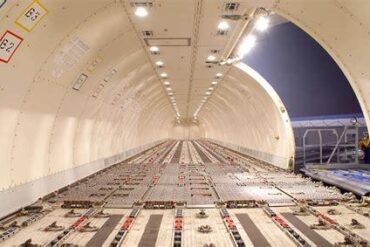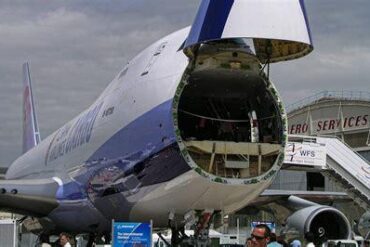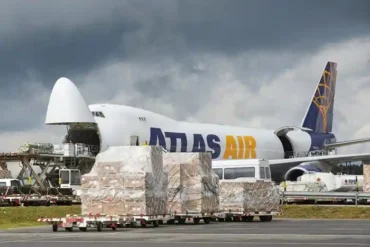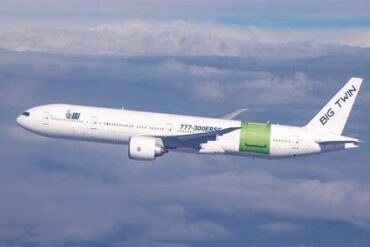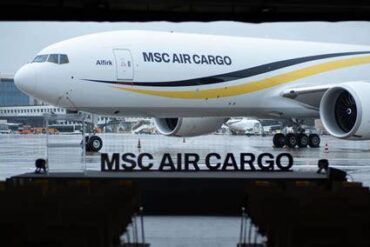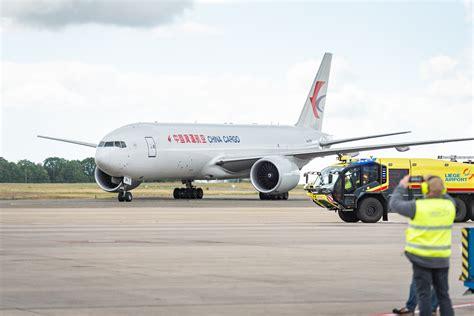
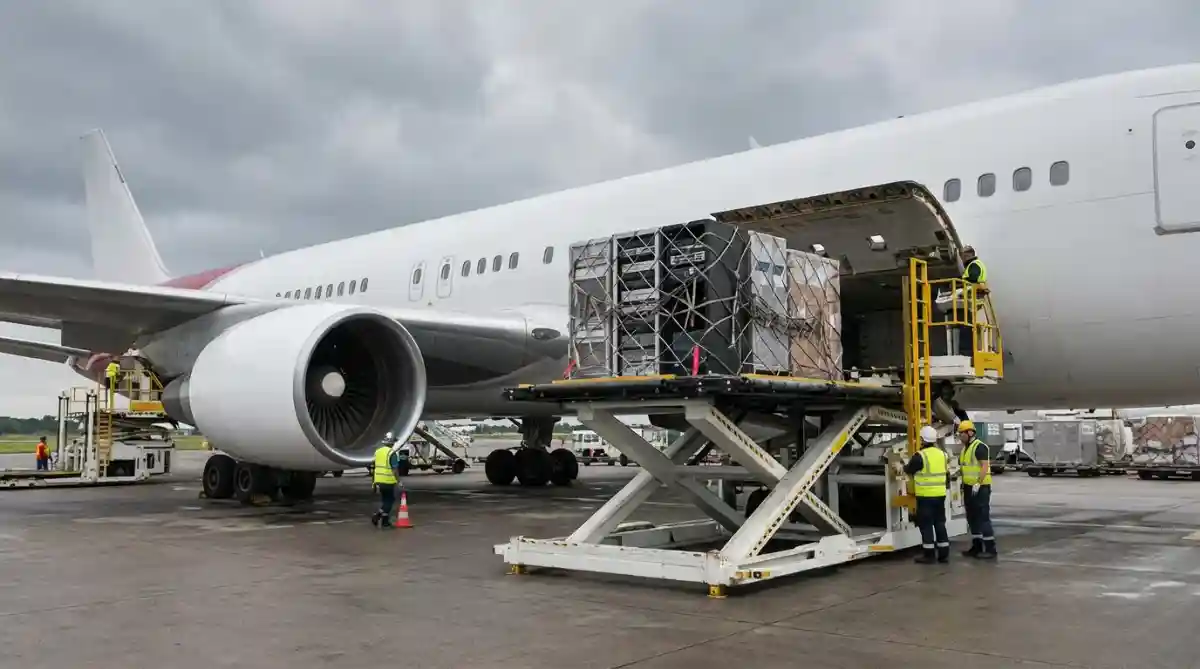
The Boeing 777 Freighter has quietly become one of the most consequential commercial aircraft programs of the modern era, a widebody hauler that turned a passenger airliner’s DNA into the backbone of intercontinental air cargo. Built with the same fuselage cross-section and length as the 777-200LR, the 777F was never a stripped-out airliner hurriedly converted for freight. Boeing engineered the aircraft from the ground up for palletized logistics: the cabin was gutted of seats, overhead bins, and passenger windows, replaced by a reinforced main deck floor rated for heavy container loads and a cavernous side cargo door measuring 12 feet 3 inches wide by 10 feet high (3.73 by 3.05 meters). That opening lets handlers drive oversized freight straight onto the main deck, a capability no standard passenger-to-freighter conversion matches without compromise. The main deck swallows 27 standard pallets, while the lower hold takes 10 pallets or a blend of pallets and LD3 containers, giving operators a flexible loading plan for everything from e-commerce parcels to industrial machinery.
The numbers behind the airplane explain why freight planners build networks around it. The 777F carries a maximum structural payload of 107 tonnes (235,895 pounds), lifts a maximum takeoff weight of 766,800 pounds (347,810 kilograms), and reaches 5,000 nautical miles (9,260 kilometers) on a full load. Its 209-foot, 1-inch length, 212-foot, 7-inch wingspan, and 61-foot, 1-inch height make it a physically imposing machine, while a pair of GE90 turbofans from GE Aerospace delivers the thrust needed to haul that mass off long runways at high-altitude or hot-weather stations. Those engines are the commercial heart of the design: their fuel burn and dispatch reliability underpin the aircraft’s vaunted tonne-kilometer economics, the single metric that determines whether a cargo route earns or bleeds money.
Boeing assembled the first 777F airframe at its Everett, Washington, facility on January 29, 2008, and the completed aircraft rolled off the factory floor on April 30 that same year. The Federal Aviation Administration granted certification on February 3, 2009, and from that moment the freighter began reshaping long-haul logistics. It now ranks as the most popular widebody freighter in production, and Boeing has stated the type carries roughly 20 percent of all global air freight. No other dedicated freighter combines that payload with that range at that operating cost, which is precisely why airlines that once split their fleets between older conversions have consolidated around it.
Payload, Range, and Tonne-Kilometer Economics: Why the 777F Wins Long-Haul Cargo Routes
The decisive advantage of the Boeing 777 Freighter is not any single specification but the combination of them, which allows airlines to fly nonstop cargo missions between markets that previously required a technical stop. A 107-tonne payload at 5,000 nautical miles means an operator can launch from Asia with manufactured goods, electronics, and high-value components and land directly in the United States or Europe without a fuel stop in Anchorage, Sharjah, or elsewhere. Each eliminated stop removes landing fees, ground-handling costs, crew duty complications, and, most importantly, transit hours that shippers of perishables and time-critical inventory will not tolerate. Because air freight competes on speed and reliability against ocean shipping, the value of a freighter is measured in how many hours it can subtract from a door-to-door journey while holding cost per tonne-kilometer at a level cargo sales teams can actually sell.
The tonne-kilometer economics of the 777F rest on two pillars: the efficiency of the GE90 engines and the structural lightness of an airframe designed from the outset without passenger systems. Twin-engine operation also matters enormously. Compared with four-engine freighters, the 777F burns less fuel per tonne carried and requires half the engine maintenance events, a difference that compounds across a fleet flying 4,000 to 5,000 hours annually. These advantages explain why the type became the default choice for express integrators and combination carriers alike, and why the freighter’s residual values have stayed resilient even as the global cargo market swung through pandemic peaks and post-pandemic corrections. When rates spike, the 777F harvests the upside with volume; when rates fall, its low seat-mile-equivalent cost keeps routes viable that would sink older, thirstier types.
FedEx exemplifies the aircraft’s operational value. As the largest operator of the 777F, with a fleet of 59 of the cargo haulers, the express giant leaned on these aircraft during fiscal year 2025 to move an average of roughly 19 million pounds of freight per day across its US and predominantly international operations. That figure illustrates the freighter’s role not as a niche long-hauler but as an everyday production asset whose dispatch reliability and payload consistency keep global express networks synchronized. For an integrator, a grounded 777F is not an inconvenience; it is a broken promise to thousands of shippers relying on overnight delivery guarantees spanning continents.
How ICAO Emissions Rules Nearly Ended 777F Production
The Boeing 777 Freighter‘s commercial success collided with a regulatory reality that threatened to end its production years ahead of schedule. In March, the International Civil Aviation Organization Council adopted stricter environmental rules for newly designed aircraft worldwide, including next-generation supersonic and subsonic jets. The updated CO₂ emissions certification standard became 10 percent more stringent for large, newly designed aircraft, with the requirement applying from 2031. The revision tightens the allowable CO₂ certification metric relative to the prior standard, pushing manufacturers toward airframes and engines that consume measurably less fuel per unit of work performed.
The United States, as an ICAO member, carries obligations under the Convention on International Civil Aviation to implement such standards through its own regulatory process. In 2024, under the Biden Administration, the Federal Aviation Administration finalized a rule adopting the ICAO aircraft CO₂ certification standard into US regulations. That rule applies to aircraft receiving new airworthiness certifications, not to aircraft already flying. Under its terms, certain aircraft failing to meet specified fuel-efficiency and greenhouse-gas limits cannot receive an original airworthiness certificate on or after January 1, 2028. For Boeing, the stakes were existential for the program: because the 777F remains the most popular widebody freighter in production, the rule threatened the company’s most reliable source of freighter revenue, and Boeing estimated it could have lost more than $15 billion in export sales if the impending production restriction had taken effect.
The resolution arrived in September, when the FAA granted Boeing an exemption from the upcoming emissions requirements, permitting up to 35 additional 777Fs to receive their first airworthiness certificates beyond the January 1, 2028, deadline. The agency concluded the exemption served the public interest, citing demand for widebody freighters and the role these aircraft play in global freight operations. The relief covers aircraft receiving first certificates through the end of 2030, creating a deliberate bridge between the current freighter and its successor. The decision acknowledged something regulators rarely state so plainly: in air cargo, an airplane’s environmental shortcomings must be weighed against the economic cost of removing capacity the world’s supply chains depend upon.
Inside the Everett Factory: Where the World’s Largest Aerospace Building Builds the 777F
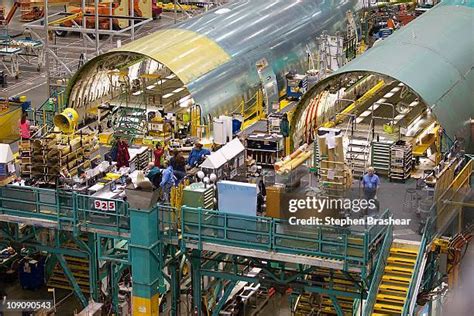
The 777F is born inside the Boeing Everett factory, the largest aerospace manufacturing facility on Earth. By volume, the building encloses roughly 476,358,000 cubic feet (13,485,378 cubic meters), constructed on a 98.7-acre (39.95-hectare) site near Paine Field in Everett, Washington. Inside that immense envelope, Boeing’s Pacific Northwest operations employ tens of thousands of workers across shifts running around the clock, moving fuselage sections, wings, and engines through a choreography measured in inches and hours. In 2025, Boeing delivered 600 commercial aircraft across the 737, 767, 777, and 787 Dreamliner families, alongside 131 military aircraft including helicopters, fighters, transports, and refueling platforms. Those totals reflect company-wide output rather than Everett alone, but they capture the scale of an industrial system in which the 777F occupies a small yet disproportionately valuable slot.
Order and delivery data reveal a freighter still winning new business despite its regulatory limbo. Boeing recorded six 777F orders this year, with the most recent customer being Ethiopian Airlines, which ordered two of the aircraft in September as part of a larger commitment for eight new 777-8Fs. Earlier, in June, China Airlines and China Southern Cargo each ordered two 777Fs, signaling that Asian carriers see years of productive life remaining in the type. By September, 20 of the freighters had been handed over to customers, with FedEx and Air China Cargo each taking delivery of one aircraft. Those deliveries matter beyond the balance sheet: every 777F entering service extends the operational reach of a cargo network already built around its payload and range, reinforcing the fleet commonality that makes the type so difficult to replace.
The GE9X and the 777-8F: Boeing’s Next-Generation Cargo Successor
The aircraft destined to inherit the 777F’s mantle is the Boeing 777-8F, a freighter designed to meet the tougher environmental standards head-on while improving the commercial case that made its predecessor indispensable. Boeing’s newest freighter will pair improved cargo capabilities with General Electric’s GE9X engines, reducing fuel consumption and CO₂ emissions by 30 percent compared with the airplanes it will replace. It will also carry the largest payload of any freighter on the market, transporting 110 tonnes (121.3 US tons) over a range of 5,000 nautical miles (9,260 kilometers). Entry into service is expected in 2029, positioning the new freighter to shape the future of long-haul air cargo for the following two decades.
The GE9X is the world’s largest commercial jet engine, with a fan roughly 11 feet (3.35 meters) in diameter and a weight of about 21,000 pounds (9,525 kilograms). It is designed to produce approximately 100,000 pounds-force of thrust, roughly 445 kilonewtons, compared with the 27,000 lbf (120 kN) generated by the engine powering the Lockheed Martin F-16. That thrust class is what allows the 777-8F to lift a heavier payload than the 777F while burning substantially less fuel. The engine’s weight has been trimmed through components manufactured from heat-resistant ceramic matrix composites, materials that withstand temperatures approaching 2,400°F (1,316°C), a range in which even the most advanced alloys begin to soften. Of the 35,370 parts that make up the engine, several are produced from these composites, and a 16-blade fan further reduces mass without sacrificing airflow.
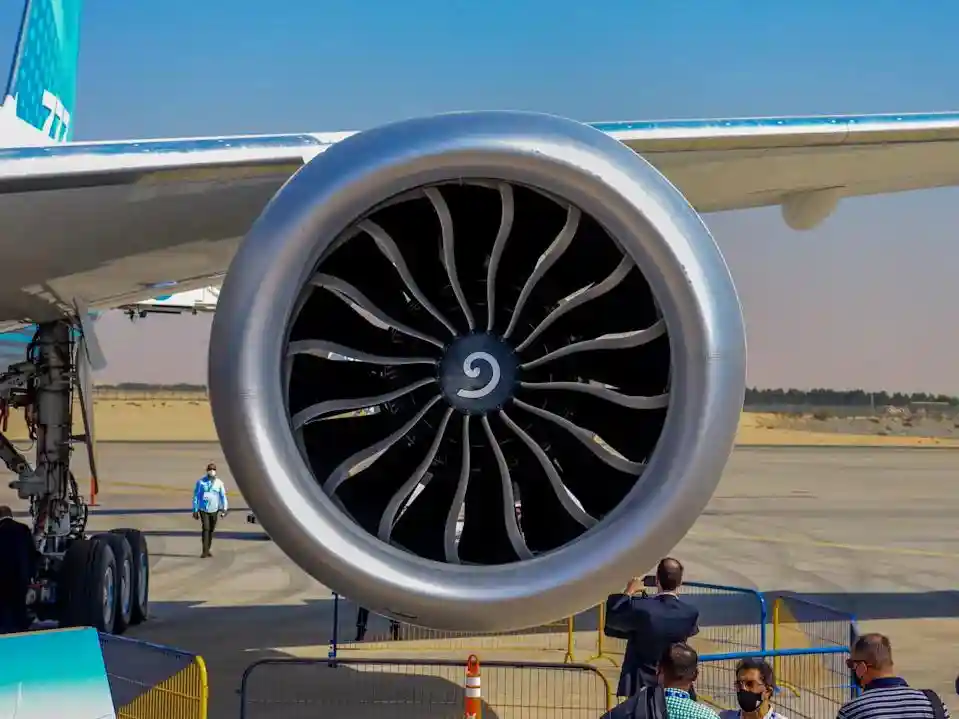
GE has already accumulated hundreds of orders for the GE9X, with customers including Emirates, Qatar Airways, British Airways, Lufthansa, Singapore Airlines, ANA, Cathay Pacific, and Etihad Airways. That order book reflects confidence not only in the engine but in the aircraft family carrying it, and it gives Boeing a valuable bridge as it transitions production from the 777F to the 777-8F. The first 777-8F has already completed its rollout in Everett, marking a significant milestone in the next-generation program.
The Boeing 777F’s Legacy and the Future of Long-Haul Air Cargo
The Boeing 777F has earned its status as a cornerstone of international air freight by delivering the payload capacity, range, and efficiency operators need to connect global markets profitably. Its legacy is written in the tonnage it moves daily and in the route structures it made possible: direct long-haul cargo links between Asia, North America, and Europe that did not exist at scale before the type entered service. Tightening environmental standards have created uncertainty around its continued production, exposing the tension manufacturers face in balancing proven aircraft capabilities against evolving regulatory demands. Yet the FAA exemption has preserved a production bridge through 2030, and the freighter continues to attract orders from carriers unwilling to cede long-haul capacity while they await its successor.
The upcoming 777-8F represents the next chapter in that story, powered by GE Aerospace’s GE9X engines and promising improved fuel efficiency, reduced emissions, and substantial cargo capacity when it enters service in 2029. Together, the two aircraft form a continuity plan that few competitors can match: a proven workhorse still earning its keep while a more efficient successor prepares to take over. For cargo airlines, the calculus remains straightforward, because replacing the 777F outright would mean surrendering payload, range, and route economics that no alternative in production today replicates. That is why the Boeing 777 Freighter, even as regulatory deadlines close in, remains the cargo workhorse airlines cannot replace.