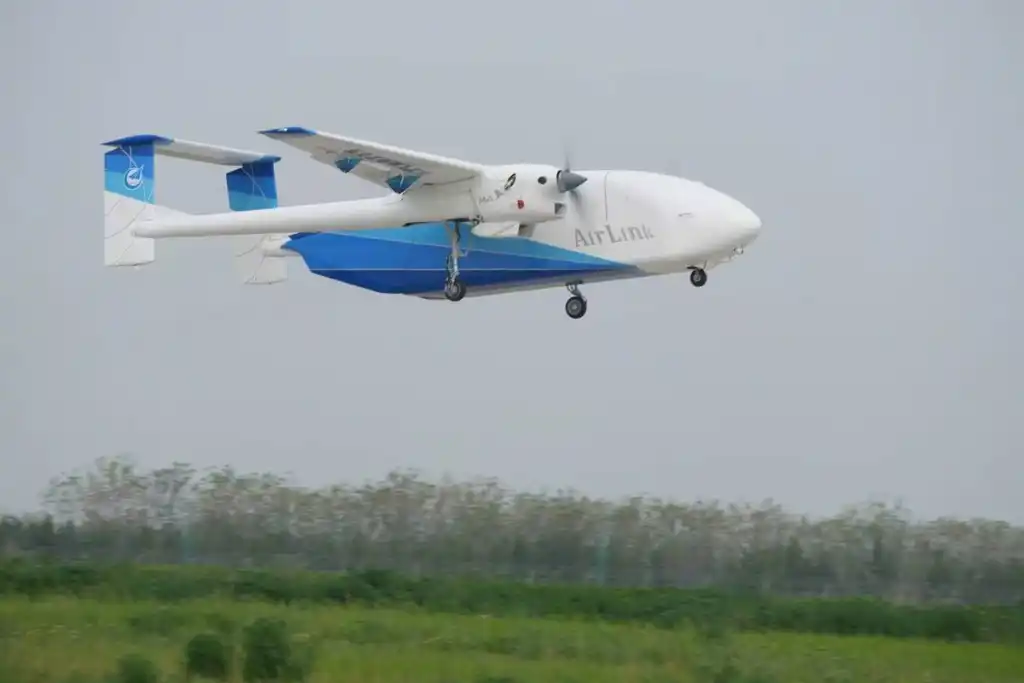
China has taken another major step toward dominating the emerging cargo drone sector with the successful maiden flight of the AVIC HH-200, a large unmanned cargo aircraft capable of carrying payloads exceeding one tonne. Developed by state-owned aerospace giant Aviation Industry Corporation of China, the HH-200 represents the latest addition to an increasingly ambitious Chinese ecosystem of heavy-lift logistics drones designed to reshape freight transportation across remote regions, islands, and international trade corridors.
The aircraft completed its first test flight in Pucheng, located in Shaanxi Province, according to Chinese state media outlet Xinhua News Agency. During the flight, the drone reportedly executed all planned maneuvers successfully, marking another milestone in Beijing’s rapidly accelerating push into the medium-altitude, long-endurance unmanned aviation market.
Unlike many Western cargo drone concepts still focused on urban air mobility or electric air taxi derivatives, China is aggressively pursuing what industry observers increasingly describe as “flying trucks” — large, rugged unmanned aircraft optimized for practical cargo transport over long distances and difficult terrain.
The HH-200 reflects that strategy perfectly. The aircraft features a modular cargo hold with a standard capacity of 12 cubic metres, expandable to 18 cubic metres depending on mission requirements. It is capable of transporting payloads of up to 1.5 tonnes while cruising at speeds reaching 310 kilometers per hour. Perhaps even more significant is its operational range of approximately 2,360 kilometers, placing it among the more capable unmanned logistics platforms currently under development globally.
22 minutes that could reshape cargo delivery — China’s HH-200 aerial commercial #unmanned transportation system completed its #maidenflight test on April 15.
It includes a ground system & a drone with a 1.5-tonne payload and a maximum flight range of 2,360 km. pic.twitter.com/BCbltWdWsS
— Wu Lei (@wulei2020) April 15, 2026
China’s Expanding Fleet of Heavy Cargo UAVs
The HH-200 is not an isolated project. Instead, it forms part of a broader Chinese national effort to build a layered fleet of autonomous cargo aircraft covering multiple payload classes and operational roles.
Only weeks before the HH-200 announcement, China completed test operations involving the enormous Changying-8 LUCA, a seven-tonne cargo UAV developed by NORINCO. At the same time, Chinese developers are progressing work on the CAAA YH-1000S, a future ten-tonne cargo drone currently undergoing scaled flight demonstrations.
Another major contender is the Air White Whale W5000, a five-tonne unmanned logistics aircraft designed to support regional freight operations. Together, these projects reveal a coordinated industrial strategy rather than isolated aerospace experiments.
The scale of China’s investment suggests Beijing views autonomous cargo aviation as a future pillar of both domestic logistics and geopolitical influence. The ability to move cargo quickly without pilots offers enormous advantages for remote infrastructure projects, emergency response operations, military sustainment, and international supply chains.
HH-200 Designed for Remote and Strategic Logistics Missions
Chinese officials describe the HH-200 as a versatile aircraft capable of serving both civilian and government operations. Planned mission profiles include emergency rescue, firefighting support, agricultural operations, weather modification, and aerial remote sensing.
However, analysts widely consider these aircraft inherently dual-use. While state media avoided explicit military references, drones capable of transporting heavy cargo over thousands of kilometers naturally attract defense interest. Large unmanned logistics aircraft can support border resupply missions, maritime outposts, disaster relief operations, and contested logistics environments without risking flight crews.
According to Chinese reports, the HH-200 is expected to support operations across border regions, coastal freight routes, and island logistics networks throughout Southeast Asia. The aircraft is also envisioned as part of expanding air cargo corridors connected to Beijing’s Belt and Road infrastructure strategy.
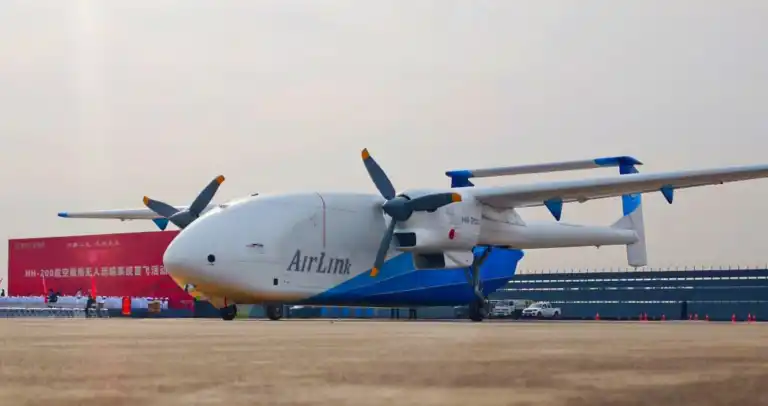
The drone was reportedly engineered for a service life of 50,000 flight hours or 15,000 takeoff-and-landing cycles, figures that indicate serious commercial ambitions rather than purely experimental development. AVIC also claims operating costs of roughly $0.69 per tonne-kilometer, potentially making the aircraft economically attractive for underserved cargo markets.
The Global Cargo Drone Race Intensifies
China’s rapid progress is placing increasing pressure on Western aerospace companies attempting to enter the same market. In the United States, firms such as BETA Technologies, Archer Aviation, and Joby Aviation are developing cargo-capable unmanned or semi-autonomous aircraft, though many remain tied to urban air mobility concepts rather than heavy freight transport.
American projects with closer similarities to China’s “flying truck” philosophy include Sabrewing Aircraft and its Rhaegal platform, along with Grid Aero and its scalable Lifter series.
Europe’s most prominent competitor remains Dronamics, whose Black Swan cargo drone is already commercially available for regional freight missions.
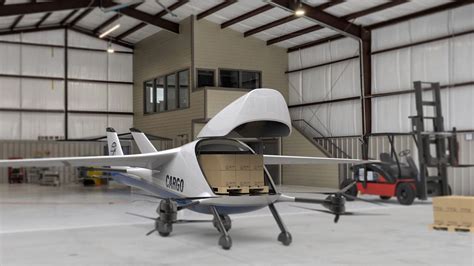
Yet China possesses one advantage few competitors can match: direct state backing. With Beijing openly prioritizing dominance in unmanned aviation and logistics infrastructure, Chinese manufacturers benefit from long-term financing, centralized industrial coordination, and government-supported deployment strategies that private Western firms often struggle to counter.
The HH-200’s successful first flight therefore represents more than a technological achievement. It signals China’s accelerating effort to control the future architecture of autonomous global cargo transport — a sector that could become as strategically important in coming decades as commercial aviation itself.