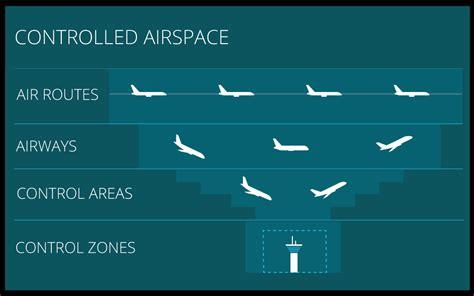
A Control Zone, or CTR, is a specific type of controlled airspace that stretches from the ground up to a designated height. These zones are typically set up around airports to manage incoming and outgoing IFR (Instrument Flight Rules) traffic. They cover areas not included in control areas like TMAs (Terminal Control Areas) or CTAs (Control Areas), ensuring smooth air traffic control (ATC) services.
The airspace within a CTR is usually classified as Class C or Class D. Class A airspace does not permit VFR (Visual Flight Rules) flights, while Class E is restricted for such use. Notably, CTRs are the only airspace types that can support special VFR flights. A CTR can be designed around a single airport or multiple airports that are close to each other.
The lateral boundaries of a CTR extend at least 5 nautical miles from the center of the relevant airport(s) in the direction of possible approaches. The lower boundary of a CTR is always at the surface of the earth, contrasting with TMAs or CTAs, which start at a defined altitude above ground level. Often, a CTR sits below a control area, with its upper limit reaching at least up to the lower boundary of that control area. In some cases, the CTR’s upper limit may be even higher.
When the upper boundary of a CTR goes above 3000 feet MSL (Mean Sea Level), it often aligns with a VFR cruising level, such as FL35 or FL45. Typically, a CTR is named after the ATC unit that oversees it, which is commonly a control tower. For more detailed information about CTRs, you can refer to the relevant Aeronautical Information Publications (AIPs).