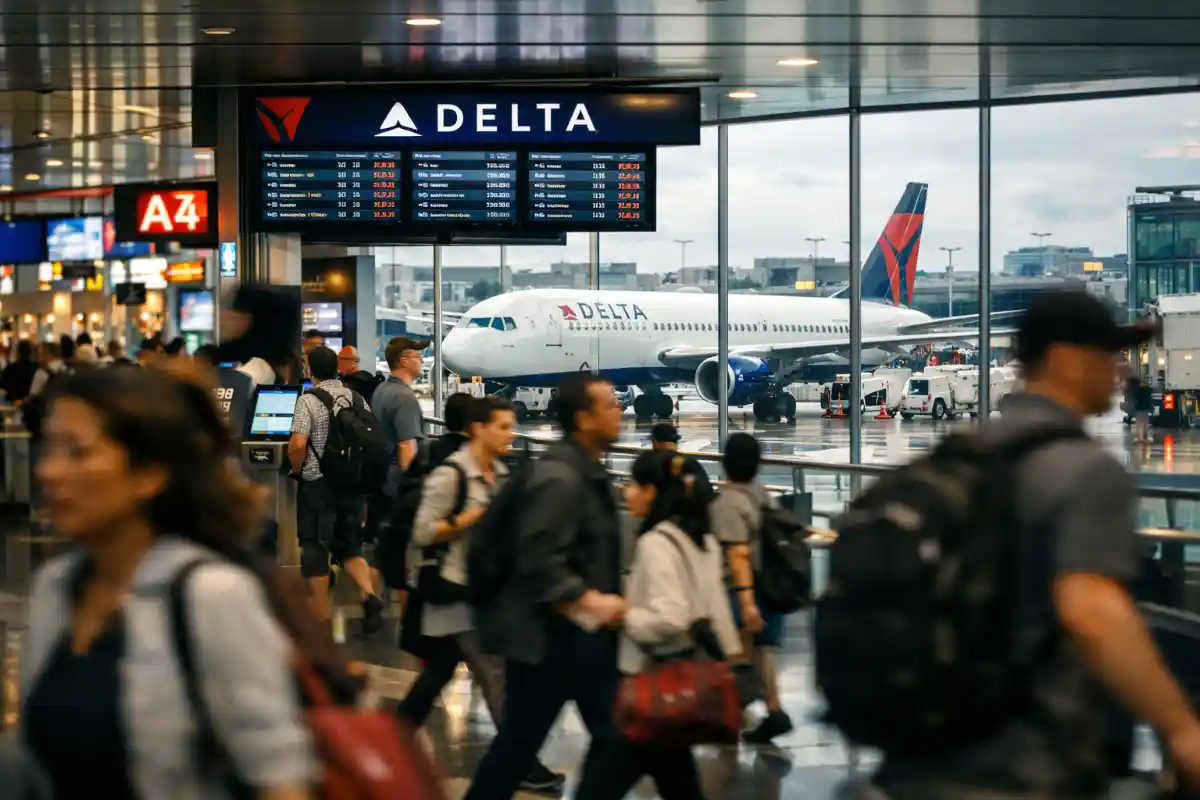
Delta Air Lines moves people the way rivers move water — constantly, invisibly, and with astonishing scale — and its hub system is the hidden engine making that possible. What looks like a simple map of airports is actually a finely tuned machine built over a century of experimentation, mergers, and ruthless operational learning. In early 2026, Delta is running more than 142,000 flights in Q1 alone, a number that feels abstract until you realize it means hundreds of metal birds lifting off every single day, stitched together through five strategic gateways that shape how Americans travel and how the United States connects to the world.
Hubs are not just big airports; they are choreography. At a true hub, planes arrive in waves, passengers shuffle between gates, bags sprint through underground tunnels, and departures launch again like clockwork. Delta has perfected this rhythm better than almost anyone, concentrating power in a handful of airports where it controls the majority of gates, schedules, and local demand. That dominance lets the airline offer frequency that competitors simply cannot match, which in turn makes travelers more loyal — a virtuous cycle that has been decades in the making.
By 2026, this system looks both stable and dynamic. Stable because the same five airports remain at the core of Delta’s universe. Dynamic because within those hubs, capacity is growing, routes are evolving, and international reach is expanding faster than at any point since the mid-2010s. If you want to understand modern American aviation, you have to understand these five airports — not as dots on a map, but as living organisms humming with aircraft, crews, and millions of travelers.
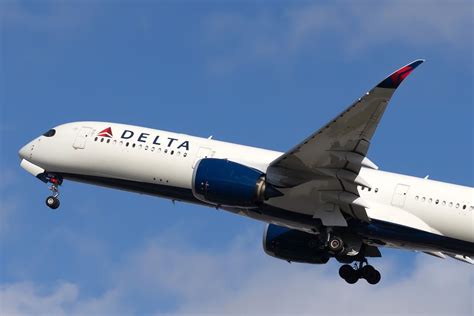
Hartsfield-Jackson Atlanta: The Unquestioned Crown Jewel
Hartsfield-Jackson Atlanta International Airport is not just Delta’s biggest hub; it is the gravitational center of the entire airline. In Q1 2026, Delta scheduled 74,482 one-way flights from Atlanta, offering more than 11.5 million seats — numbers so large they blur into abstraction. More than 700 Delta flights depart daily, making ATL less an airport and more a launch platform for America.
Delta controls roughly 80% of all capacity in Atlanta, a level of dominance that would raise eyebrows in almost any other industry. This is not accidental. Delta chose Atlanta early, built relentlessly, and never looked back. Since 2021 alone, capacity here has risen by over 20%, proof that the airline still sees room to grow in what is already the busiest passenger airport on Earth.
Operationally, Atlanta functions like a national circulatory system. The most frequent routes — Orlando (up to 16 daily), LaGuardia (up to 14), Fort Lauderdale, Tampa, and Washington National — reveal Delta’s strategy: knit the Southeast tightly together while feeding the rest of the country through a single superhub. Internationally, Atlanta is also a powerhouse, linking the U.S. to Europe, Latin America, and Africa with long-haul widebody aircraft. If Delta were a country, Atlanta would be its capital.
Detroit: The Post-Merger Powerhouse of the Midwest
Detroit Metropolitan Wayne County Airport became central to Delta after the 2008 merger with Northwest Airlines, and nearly two decades later it remains one of the airline’s most strategically valuable assets. In Q1 2026, Delta operated 27,010 flights from Detroit, offering 3.45 million seats, cementing it as the carrier’s second-busiest hub by flight volume.
Delta controls about 75% of Detroit’s capacity, effectively making DTW a Delta city. What makes Detroit fascinating is its dual personality. Domestically, it connects the industrial Midwest to the rest of the country with workhorse routes like Atlanta (9–11 daily), Orlando, and Fort Lauderdale. Internationally, it serves as a quieter but critical gateway to Europe and Asia, particularly for business travel.
Over the past few years, Delta has steadily expanded Detroit’s global footprint, turning what was once seen as a purely domestic hub into a more balanced transatlantic player. The airport’s location makes it ideal for routing traffic from smaller Midwest cities onto long-haul flights, a logistical advantage that Delta continues to exploit with surgical precision.

Minneapolis–St. Paul: The Quiet Giant of the North
If Atlanta is loud and Detroit is industrial, Minneapolis–St. Paul International Airport is the cerebral hub — less flashy, but deeply important. Delta inherited MSP from Northwest, and by 2026 it has become one of the airline’s most efficient and fastest-growing bases. The airline flies roughly 200–300 departures per day from Minneapolis.
Interestingly, while Detroit has slightly more flights, Minneapolis actually offers more total seats in Q1 2026 — 3.55 million versus Detroit’s 3.45 million — meaning Delta tends to deploy larger aircraft here. That tells a subtle story: MSP is becoming more internationally oriented and less purely regional.
Delta controls about 76% of the market at Minneapolis, and its route map reflects a smart mix of leisure and business travel. High-frequency domestic routes include Atlanta, Phoenix, Las Vegas, Orlando, and LaGuardia. But the real excitement lies across the Atlantic. Recently launched services to Rome, Copenhagen, and Sicily signal that Delta sees Minneapolis as a growing European gateway rather than just a domestic connector.
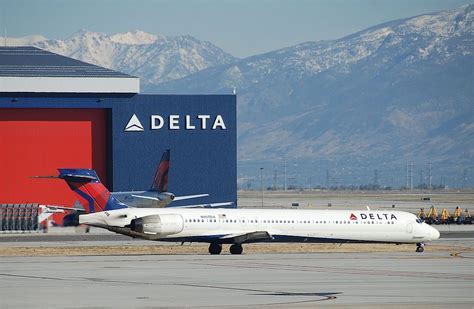
Salt Lake City: The Rocky Mountain Connector
Utah’s Salt Lake City Airport sits at a geographic sweet spot in the American West, making it ideal for connecting travelers between California, the Pacific Northwest, and the interior of the country. In Q1 2026, Delta operated 21,242 flights from SLC with 2.79 million seats, ranking it fourth among Delta hubs by volume.
Delta holds about 69% of capacity in Salt Lake City, and it has steadily invested in modernizing its operations there alongside the airport’s ambitious redevelopment program. The most frequent routes — Atlanta, Los Angeles, Seattle, Santa Ana, and San Diego — show how SLC functions as both a regional hub and a national bridge.
What makes Salt Lake especially interesting is its role in Delta’s westward strategy. As the airline grows in Seattle and Los Angeles, SLC acts as a flexible intermediate node, absorbing traffic from smaller mountain and western cities and redistributing it across the network. Think of it as a high-altitude switchboard humming above the Rockies.
New York LaGuardia: Precision in a Congested Sky
New York LaGuardia Airport is not Delta’s biggest hub by seats, but it may be its most politically and operationally challenging. With 20,382 flights in Q1 2026 and 2.14 million seats, LGA ranks fifth in flight volume, yet punches far above its weight in strategic importance.
Delta controls roughly 47% of capacity at LaGuardia, a lower share than its other hubs but still dominant in one of the most competitive aviation markets on the planet. Slot constraints mean every flight must be carefully planned, making LGA a laboratory for Delta’s scheduling and efficiency skills.
The airline’s busiest routes from LaGuardia — Atlanta, Boston, Chicago O’Hare, Orlando, and Washington National — reveal its mission here: connect New York seamlessly to key domestic markets rather than serve as a major international gateway (that role belongs more to JFK). LaGuardia is about frequency, reliability, and proximity to Manhattan — qualities Delta has mastered.
How Delta Dominates Its Core Airports
Across all five hubs, Delta’s strategy follows a clear pattern: secure overwhelming local market share, flood the airport with frequency, and use that strength to build durable national and international connectivity. In Atlanta, Detroit, Minneapolis, and Salt Lake City, Delta controls between 69% and 80% of all capacity — a level of dominance that effectively shapes how those regions fly.
This control is not merely about crowding out competitors; it allows Delta to operate complex “banked” schedules where dozens of flights arrive and depart in synchronized waves. That structure maximizes connection possibilities for passengers while keeping aircraft utilization high — the holy grail of airline economics.
At the same time, Delta has avoided stagnation. Rather than resting on its domestic strength, the airline has steadily layered on more long-haul routes, particularly from secondary hubs like Minneapolis and Detroit. This dual focus — strong home markets plus growing global reach — is what separates Delta from many U.S. carriers that lean too heavily on either domestic or international flying.

Summer 2026: A Bold Transatlantic Expansion
The hub story becomes even more compelling when viewed through Delta’s Summer 2026 plans. The airline is preparing its largest transatlantic schedule since 2015, with more than 650 weekly flights to nearly 30 European destinations. That is not incremental growth; it is a statement of confidence.
New routes include Boston to Madrid and Nice, Seattle to Rome and Barcelona, and New York JFK to Porto, Malta, and Olbia in Sardinia. Seasonal favorites like Catania return in April, while winter stalwarts such as Amsterdam, Paris, London Heathrow, Dublin, Athens, and Zurich remain firmly in place.
Although many of these flights operate from JFK, they are fed by Delta’s domestic hubs, particularly Atlanta, Minneapolis, Detroit, and Salt Lake City. In other words, the hub network does not just serve U.S. travel — it fuels Delta’s global ambitions by funneling passengers efficiently onto long-haul aircraft.
What These Five Hubs Really Mean for Travelers
For passengers, Delta’s hub system delivers two things that rarely coexist: breadth and reliability. You can fly from tiny regional airports in the Midwest to far-flung cities in Europe because Detroit or Minneapolis sits in between. You can travel from Florida to California through Atlanta with multiple daily options. The system works not because it is simple, but because it is meticulously engineered.
There is also a subtle geography lesson embedded here. Delta’s hubs map the economic and cultural spine of the United States: the Southeast (Atlanta), the industrial Midwest (Detroit), the northern plains (Minneapolis), the mountain west (Salt Lake City), and the financial capital (New York). Together, they form a kind of airborne nervous system.
The Bigger Picture in 2026
By 2026, Delta’s hub strategy looks less like a legacy of past mergers and more like a coherent design. Each airport plays a distinct role: Atlanta as the mega-connector, Detroit as the Midwest gateway, Minneapolis as the emerging transatlantic star, Salt Lake City as the western bridge, and LaGuardia as the high-precision urban node.
Airlines are often judged by their fleets, but hubs are the real DNA. They determine who you can reach, how often you can fly, and how resilient the network is when storms roll in. Delta’s five hubs are not just busy; they are interlocked, complementary, and increasingly global.
If you watch them long enough, you start to see something almost organic — a system that breathes in passengers from across America and exhales them toward the world. That, more than any single statistic, explains why Delta remains one of the most powerful airlines in the sky.