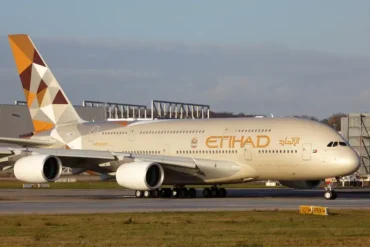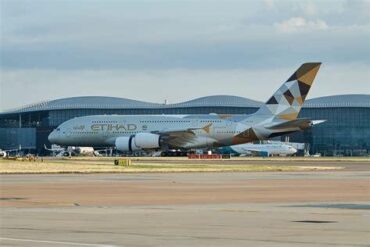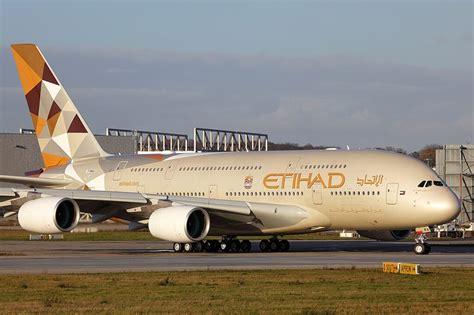
Etihad Airways is making a decisive statement in Southeast Asia. Beginning October 25, the Abu Dhabi-based carrier will deploy its flagship Airbus A380 on the high-demand route between Abu Dhabi International Airport and Bangkok Suvarnabhumi Airport, transforming one of its strongest Asian corridors into a true high-capacity showcase. With this move, Bangkok becomes the fifth global destination to welcome Etihad’s superjumbo this year—and notably, the fifth airline operating the A380 into the Thai capital in 2026.
This is not a symbolic upgrade. It is a strategic capacity play on a market that has consistently delivered premium leisure, business, and connecting traffic across multiple continents. The introduction of the double-deck aircraft signals sustained demand strength and renewed confidence in long-haul widebody economics.
Etihad’s A380 Bangkok Launch: Schedule, Capacity and Strategic Timing
The first A380-operated service, flight EY402, will depart Abu Dhabi International Airport at 9:20 p.m., arriving at Bangkok Suvarnabhumi Airport at 6:35 a.m. local time the following morning. The return leg, EY403, departs Bangkok at 8:30 a.m. and lands back in Abu Dhabi at 12:20 p.m. The overnight pattern is precisely engineered: it allows passengers to maximize arrival-day productivity while feeding seamlessly into Etihad’s mid-morning European and regional bank.
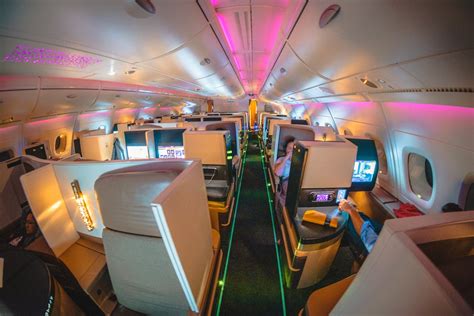
The scale of the upgrade is substantial. Etihad’s Airbus A380 is configured for up to 488 passengers, delivering a major jump in daily seat supply on a route already operating between four and six frequencies per day. Bangkok has long ranked among the airline’s top-performing Asian destinations, and the addition of the superjumbo reflects sustained, not speculative, demand.
Bangkok’s Rise as a Global A380 Hotspot
Bangkok’s emergence as a multi-carrier A380 hub is no accident. According to international travel metrics, the Thai capital consistently ranks among the most visited cities in the world, drawing leisure travelers, corporate traffic, medical tourism, and long-stay visitors across every major global region.
With Etihad’s deployment, Bangkok joins a small circle of airports sustaining five active A380 operators in the same year. The roster is striking. Emirates operates extensive A380 rotations from Dubai International Airport, including services that continue onward to Hong Kong International Airport. Qatar Airways dispatches multiple daily A380 departures from Hamad International Airport in Doha. Lufthansa maintains a daily A380 from Munich Airport, while Asiana Airlines connects Bangkok with Seoul Incheon International Airport using the type.
Notably absent is Thai Airways, which once operated the superjumbo but has since withdrawn the aircraft from its fleet. The vacuum left by the home carrier has been filled decisively by foreign operators capitalizing on Bangkok’s inbound demand strength.
A380 Economics: Why the Superjumbo Still Works in Bangkok
The Airbus A380 is often described as a relic of pre-pandemic aviation optimism. Yet in dense, slot-constrained, tourism-heavy markets, it remains economically potent. Bangkok fits this profile precisely.
High passenger throughput, limited premium cabin competition during peak waves, and strong long-haul connecting flows make large-gauge aircraft viable. Middle Eastern carriers, in particular, leverage Bangkok as both a destination and a transfer node for Australia, Europe, and secondary Asian markets. Filling nearly 500 seats daily is realistic when traffic flows are diversified across continents rather than dependent on a single origin-destination pair.
Etihad’s broader fleet mix on the Abu Dhabi–Bangkok corridor underscores this layered demand. Scheduled operations across February 2026 show deployment of multiple aircraft types, including the Boeing 777-300ER, 787-9, 787-10, Airbus A321neo, and A350-1000. The A380 does not replace these aircraft; it complements them. It concentrates capacity into a premium-heavy overnight departure while preserving flexibility elsewhere in the schedule.
This multi-aircraft strategy reflects calibrated network planning rather than headline chasing.
Competitive Signaling in the Middle East–Thailand Corridor
The Gulf carriers have long viewed Thailand as a cornerstone leisure market. However, the scale of current A380 activity reveals something deeper: Bangkok is functioning as a pressure valve for pent-up global travel demand and premium leisure spending.
For Emirates, the A380 remains the backbone of its Dubai–Bangkok corridor, including tagged operations to Hong Kong. Qatar Airways uses the aircraft to maintain high-density connectivity between Europe and Southeast Asia through Doha. Etihad’s entry into the Bangkok A380 club is therefore not isolated; it is competitive alignment.
The introduction of the aircraft also reinforces Etihad’s broader brand reset strategy. After restructuring and capacity discipline in recent years, the airline is selectively restoring flagship aircraft on routes that justify the economics. Bangkok qualifies. It delivers consistent inbound tourism, year-round travel patterns, and diversified passenger segments—from honeymooners and retirees to multinational executives.
What This Means for Abu Dhabi and Regional Aviation
The Abu Dhabi–Bangkok A380 service strengthens Abu Dhabi International Airport as a high-capacity hub linking Europe, the Middle East, and Asia-Pacific. The timing of the outbound and inbound flights supports banked connections into secondary European cities and regional Middle Eastern markets, increasing feed potential across the network.
More broadly, Bangkok’s multi-carrier A380 ecosystem signals resilience in long-haul aviation. Despite industry debates about aircraft size versus frequency, there remain specific corridors where sheer scale wins. Tourism magnets with strong premium traffic and geographic bridging advantages can still sustain the largest passenger aircraft ever built.
The symbolism matters as well. The Airbus A380, once written off prematurely, continues carving out strategic niches. Bangkok is becoming one of its strongest contemporary theaters.
Etihad’s move does not simply add seats. It reinforces Bangkok’s position as a global aviation crossroads and reaffirms that, in the right market, the superjumbo still commands commercial gravity.