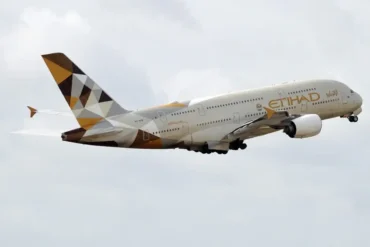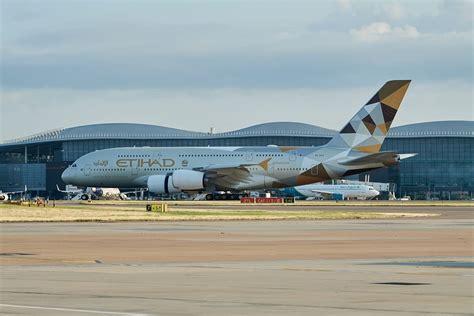
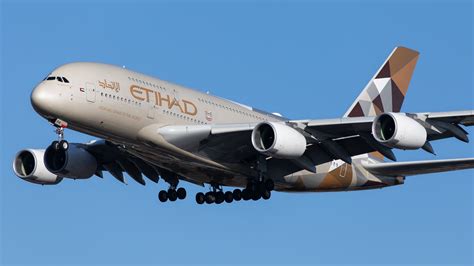
The return of a dormant Airbus A380 is never a routine event, and Etihad Airways’ latest revival marks a symbolic turning point for one of aviation’s most ambitious aircraft. After years of uncertainty, storage, and quiet speculation, one of the UAE flag carrier’s long-forgotten superjumbos has finally taken flight again, signaling renewed confidence in global long-haul demand and the enduring relevance of the world’s largest passenger jet.
This particular aircraft, registered A6-APC, represents more than a single reactivation. It embodies the slow, deliberate recovery of international aviation after the pandemic-era collapse that forced airlines to sideline their most capacity-heavy assets. For Etihad, the decision to bring another A380 back into service reflects both strategic necessity and renewed optimism across premium long-haul markets.
After spending nearly a year grounded in Abu Dhabi and more than five additional years in long-term storage in France, A6-APC’s return flight to the United Arab Emirates marks the end of an extended exile that began at the height of the global aviation shutdown.
A Long-Awaited Departure From Storage
The aircraft departed Tarbes-Lourdes-Pyrénées Airport in southwestern France, lifting off in the morning hours and beginning its ferry flight back to Abu Dhabi. Flight tracking data confirmed a smooth departure, with the 11-year-old quadjet climbing steadily toward the Middle East, closing a chapter that began in March 2020 when the world’s borders abruptly shut.
For years, Tarbes became a familiar resting place for grounded A380s from multiple airlines. Its long runway and specialized storage facilities allowed operators to preserve these massive aircraft during an era when demand simply could not justify their operation. A6-APC was among the quiet giants, parked wingtip to wingtip with other superjumbos awaiting an uncertain future.
Unlike aircraft retired permanently, this A380 was preserved with the possibility of a return in mind. Minimal test flights in 2023 and again in late 2025 hinted that Etihad had not fully closed the door on its revival. Now, that patience has paid off.
From Pandemic Casualty to Strategic Asset
The grounding of Etihad’s A380 fleet was a direct consequence of the COVID-19 pandemic, which decimated international travel and made ultra-large aircraft economically unviable. Even before the crisis, the A380’s future had been debated across the industry, with many airlines accelerating retirements as demand shifted toward smaller, more flexible widebodies.
Etihad initially kept A6-APC close to home, storing it in Abu Dhabi for several months in 2020 in case travel rebounded quickly. When that recovery failed to materialize, the aircraft was ferried to France, joining a growing global fleet of grounded superjumbos. For nearly six years, it remained there, preserved but unused.
What has changed is the sustained post-pandemic rebound in long-haul travel, particularly on premium-heavy routes linking global financial centers. High load factors, rising yields, and slot constraints at major hubs have once again made the A380 a powerful tool for airlines capable of filling it profitably.
Etihad’s Expanding A380 Comeback
With the reactivation of A6-APC, Etihad now moves closer to operating nearly its full A380 fleet once again. The airline has confirmed that eight superjumbos will soon be active, with plans already in place to bring a ninth aircraft online, while the final example will be retained as a dedicated source of spare parts.
This measured approach allows Etihad to balance capacity growth with operational resilience. Rather than flooding the network, the airline is deploying its A380s on carefully selected routes where demand for premium cabins is strongest and airport infrastructure fully supports the aircraft.
Key A380 destinations now include:
- London Heathrow
- Paris Charles de Gaulle
- Singapore Changi
- Toronto Pearson
- Tokyo Narita (launching in 2026)
The return of the A380 to Japan underscores Etihad’s confidence in Asia-Pacific demand and its willingness to commit flagship capacity on strategically important routes.
A Cabin That Redefined Luxury in the Sky
Etihad’s A380s are widely regarded as some of the most luxurious ever to enter commercial service. While the lower deck is configured entirely for economy class, accommodating more than 400 passengers, the upper deck is where the aircraft truly distinguishes itself.
Seventy business class seats and nine first class suites occupy the top level, offering an experience that emphasizes space, privacy, and refinement. At the very front sits The Residence, a three-room private suite featuring a living area, separate bedroom, and en-suite shower—an offering that remains unmatched in commercial aviation.
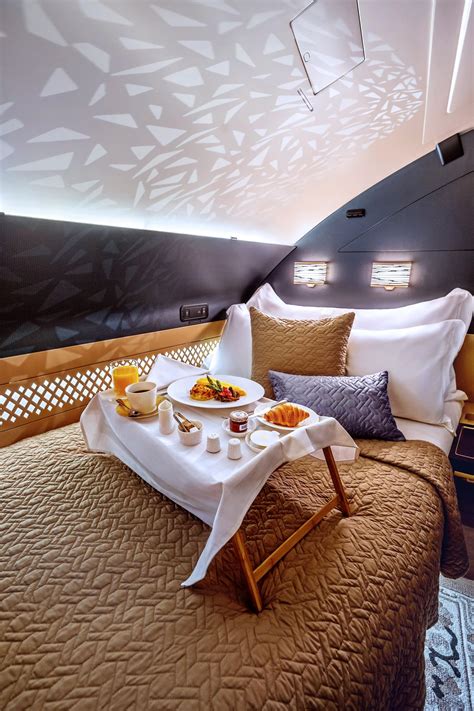
This level of onboard product has become increasingly relevant as premium travelers return in force, seeking differentiation and exclusivity rather than simply transportation.
A Symbol of Aviation’s Second Act
The flight of A6-APC back to Abu Dhabi is not merely a ferry mission; it is a statement. It reflects how aviation’s recovery has reached a point where once-questioned aircraft types are again economically justified. For Etihad, the A380 has transformed from a pandemic-era liability into a strategic flagship capable of anchoring its long-haul identity.
As airlines worldwide reassess capacity strategies in an era of constrained aircraft deliveries and growing demand, the A380’s revival at Etihad stands as a reminder that scale, when matched with the right markets and product, still has a place in modern aviation. The superjumbo is no longer forgotten—it is flying again, carrying with it the weight of a hard-earned comeback.