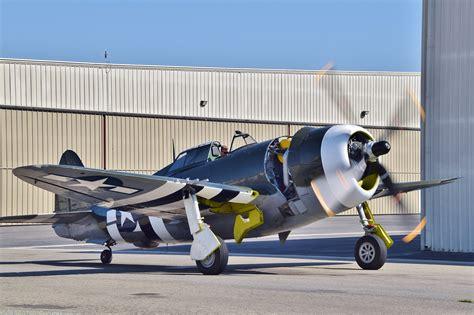
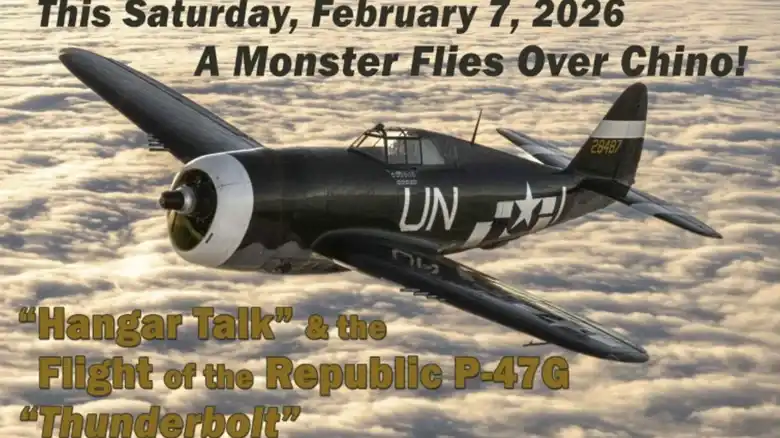
The thunder of a Pratt & Whitney R-2800 Double Wasp radial engine is not easily forgotten. For aviation enthusiasts, it is less a sound than a physical force — a rolling, metallic heartbeat that defined Allied airpower in World War II. On February 7, 2026, that sound will once again echo across Chino Airport in California as the historic Republic P-47G Thunderbolt, serial number 42-25254, returns to flight after six years on the ground.
World War II accelerated aviation technology at a pace unmatched before or since. Among the era’s most formidable machines stood the P-47 Thunderbolt, a fighter aircraft whose size and brute strength earned it the enduring nickname “Juggernaut of the Air.” Unlike the lighter, more delicate fighters of its time, the Thunderbolt was unapologetically massive. It was engineered not merely to duel in the skies but to absorb punishment and deliver devastating firepower in return.
Built in 1944 by Republic Aviation at its Evansville, Indiana plant, the P-47G variant was produced under license during a period when American industry operated at full wartime intensity. Planes of Fame’s example served as a trainer during the war, operating from Grand Central Airport in Glendale, California, preparing pilots for the brutal realities of aerial combat over Europe and the Pacific. After the conflict ended, the aircraft passed through private ownership before eventually becoming part of the museum’s flying collection.
The Six-Year Grounding and Comprehensive Overhaul
Grounded in 2020, the Thunderbolt’s absence from the air was not the result of neglect but of necessity. Vintage warbirds demand meticulous maintenance, and the museum undertook a complete engine overhaul, temporarily removing and displaying the powerplant during restoration. The R-2800, an 18-cylinder radial engine capable of producing more than 2,000 horsepower, is a masterpiece of 1940s engineering — but it is also a complex mechanical organism that tolerates no shortcuts.
Restoration teams focused on returning the aircraft to full operational integrity, ensuring structural reliability, engine performance, and system authenticity. For a warbird weighing up to 14,500 pounds at maximum takeoff weight, precision is everything. Every rivet, cable, and hydraulic line matters when reintroducing such a machine to the sky.
Performance That Defined an Era
The P-47G was never subtle. With a maximum speed of 433 mph, a combat range of roughly 800 miles, and a service ceiling reaching 43,000 feet, it combined altitude performance with high-speed dive capability. Its eight .50 caliber machine guns could unleash an extraordinary volume of fire, while the ability to carry two 500-pound bombs transformed it into a formidable ground-attack platform.
In comparison to the lighter P-51 Mustang, which had a lower maximum takeoff weight of 12,100 pounds, the Thunderbolt’s mass translated into survivability. Its rugged airframe and turbo-supercharged engine allowed it to endure battle damage that would have crippled other fighters. Pilots trusted it not because it was elegant, but because it brought them home.
The Return of the Juggernaut
The February 7 event at Chino Airport will begin with a detailed presentation at 10:30 a.m., followed by the scheduled 12:15 p.m. flight. Spectators will not merely witness an aircraft take off; they will experience a living artifact of industrial might and wartime innovation.
Airshows featuring a flying P-47 are rare. Seeing one climb under full power, banking heavily against the California sky, offers a visceral connection to the 1940s. The Thunderbolt’s agility often surprises modern audiences, its bulk masking responsive handling that once made it a dominant escort and strike fighter.
When the Juggernaut lifts off once more, it will not simply mark the end of a six-year pause. It will reaffirm the enduring legacy of a machine that helped shape the outcome of the largest conflict in human history — and prove that, even eight decades later, some legends still fly.