After more than three decades grounded by conflict and political instability, Somali Airlines has triumphantly returned to the skies, signaling a bold new chapter in Somalia’s aviation history. The revival of the national flag carrier, first launched in 1964, was officially announced on July 28, 2025, by Transport and Civil Aviation Minister Mohamed Farah Nuuh, marking a historic moment backed by the approval of Prime Minister Hamza Abdi Barre. This strategic relaunch, after a 34-year absence, reflects not just a return to commercial operations but a profound assertion of national sovereignty, economic renewal, and international ambition.
A Long-Awaited Return Rooted in National Sovereignty
The collapse of Somali Airlines in 1991, amid the outbreak of the Somali Civil War, symbolized the broader disintegration of national infrastructure during a period of immense turmoil. With airspace control ceded to international bodies and no civil aviation framework remaining intact, the country’s aviation industry entered a prolonged dormancy.
However, the foundation for Somali Airlines’ return was laid with Somalia’s regained authority over its sovereign airspace in January 2023, when the International Civil Aviation Organization (ICAO) granted it a Category A classification. This pivotal upgrade recognized Somalia’s aviation safety, oversight capabilities, and regulatory framework as meeting international standards, paving the way for renewed commercial operations.
Acquisition of Airbus A320s: Modernizing with Purpose
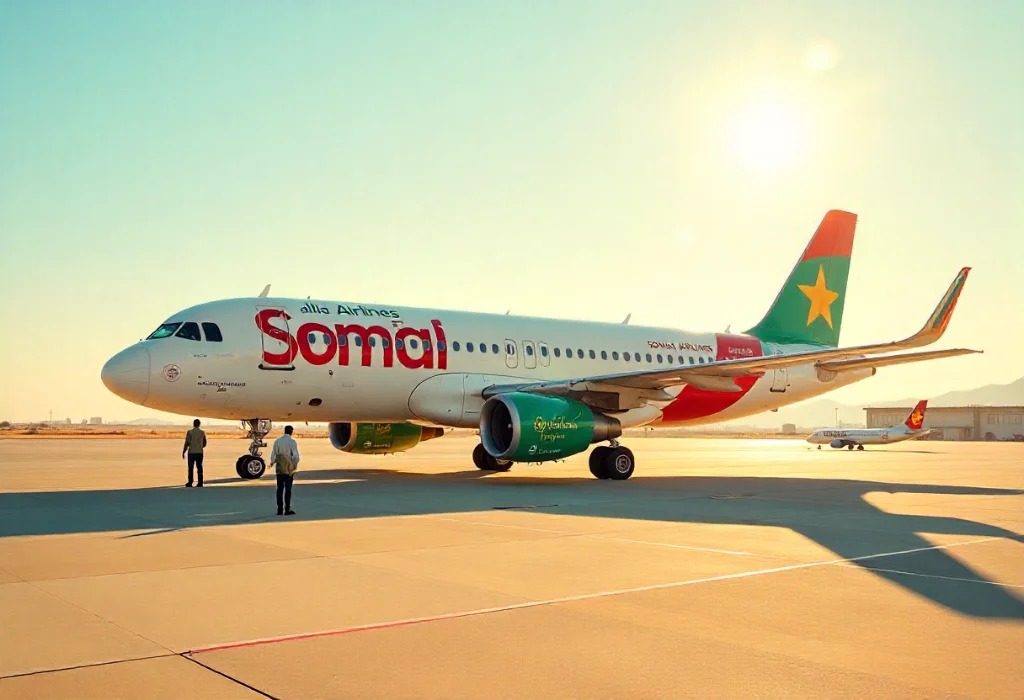
As a tangible commitment to its operational revival, Somali Airlines confirmed the acquisition of two Airbus A320 aircraft. These jets—renowned for their fuel efficiency, versatility, and short-to-medium haul reliability—are expected to be operational within two months from the announcement date.
According to the Somali National News Agency (SONNA), the aircraft were obtained through a purchase agreement with Lima Holding Group, a move that underscores the government’s partnership-based approach to rebuilding its aviation infrastructure. While the exact configuration of the aircraft has not yet been detailed, the A320s are widely used for regional and international routes, hinting at Somali Airlines’ intentions to quickly scale operations beyond domestic service.
This initial fleet acquisition represents more than a technical upgrade; it is a symbol of modernization and an essential step in reconnecting Somalia with regional and global aviation networks.
Future Fleet Expansion and International Ambitions
The revival of Somali Airlines is not limited to the two A320s. SONNA reported that additional aircraft, including larger jets, are expected to join the fleet over time. These additions are designed to support international operations, positioning Somali Airlines to serve not only the Somali diaspora but also regional trade hubs and transcontinental routes.
This phased fleet expansion will likely align with the resumption of key routes from Somali Airlines’ historical network, which previously connected Mogadishu to destinations such as Nairobi, Cairo, Jeddah, and Frankfurt. With regional carriers currently dominating East African air travel, Somali Airlines’ return could introduce competitive dynamics while enhancing Somalia’s economic diplomacy and bilateral connectivity.
Diplomatic Endorsement and Public Sentiment
International and domestic reactions to the announcement have been overwhelmingly positive. The Somali Embassy in Serbia issued a public statement:
“Congratulations to Somali Airlines! After 34 years, we look forward to seeing our national carrier take to the skies once again. A powerful symbol of resilience and national pride for the Somali people.”
This sentiment reflects the broader narrative of national rebirth, wherein Somali Airlines becomes both a functional air transport provider and a cultural icon of perseverance, not unlike other flag carriers that represent post-conflict recovery. For millions of Somalis, both at home and in the diaspora, the sight of Somali Airlines aircraft bearing the national livery will be a powerful emotional and patriotic symbol.
Infrastructure Development: New Airport Near Mogadishu
Coinciding with Somali Airlines’ return is the construction of a new international airport near Mogadishu. Initially announced in 2024, the project reached a key milestone in June 2025 with the laying of its foundation stone. The new facility is intended to supplement Aden Adde International Airport and serve as a modern aviation hub equipped to support higher traffic volumes and more advanced logistics operations.
The new airport’s proximity to the capital, strategic location along the Indian Ocean, and potential for dual civilian-commercial use suggest it will play a crucial role in Somalia’s aviation and economic transformation. With Somali Airlines anchoring its operations from this future airport, the synergy between fleet acquisition and infrastructure investment becomes clear—both are critical components of a long-term national aviation strategy.
Challenges Ahead: Operational, Security, and Market Pressures
While the return of Somali Airlines is momentous, it is not without significant challenges. Operating in a region still marked by security concerns, regulatory flux, and infrastructural limitations, the airline will need to establish robust safety protocols, efficient logistics, and transparent governance to gain passenger trust and international partnerships.
Additionally, the East African aviation market is fiercely competitive, dominated by carriers such as Ethiopian Airlines, Kenya Airways, and RwandAir. To succeed, Somali Airlines must offer competitive pricing, reliable schedules, and strategic partnerships—perhaps through codeshares or alliances—to re-establish itself as a viable option for travelers and cargo operators alike.
Internal capacity building is also critical. From pilot training and crew development to air traffic control and ground operations, Somalia will need to invest significantly in human capital and aviation services. The potential collaboration with global aviation consultants and national carriers from friendly nations could accelerate this process.
Symbol of National Unity and Global Reintegration
Beyond economic utility, Somali Airlines carries deep symbolic weight. Its rebirth is emblematic of a country reasserting its sovereignty, reclaiming its identity, and projecting stability to the world. It stands as a national asset with the power to unify diverse communities and promote development, both domestically and internationally.
With a young, rapidly growing population and expanding remittance economy, Somalia is poised to leverage air travel as a tool of social mobility and global engagement. Whether transporting students, professionals, traders, or tourists, Somali Airlines could evolve into a vital artery of connectivity, linking Somalia to Africa, the Middle East, and beyond.
The airline’s future success will ultimately depend on its ability to balance commercial realities with national aspirations, operating sustainably while serving as a bridge between Somalia’s storied past and its increasingly promising future.
What Lies Ahead
As the two Airbus A320s undergo final preparations before their inaugural flights, Somali Airlines stands on the threshold of a transformational journey. If managed with strategic vision, operational discipline, and genuine public accountability, it can emerge not merely as a transportation enterprise, but as a pillar of national renewal.
The coming months will reveal how effectively the carrier can translate symbolic momentum into practical achievement. But one thing is certain: for the first time in a generation, the skies over Somalia will once again carry the proud blue and white emblem of Somali Airlines.