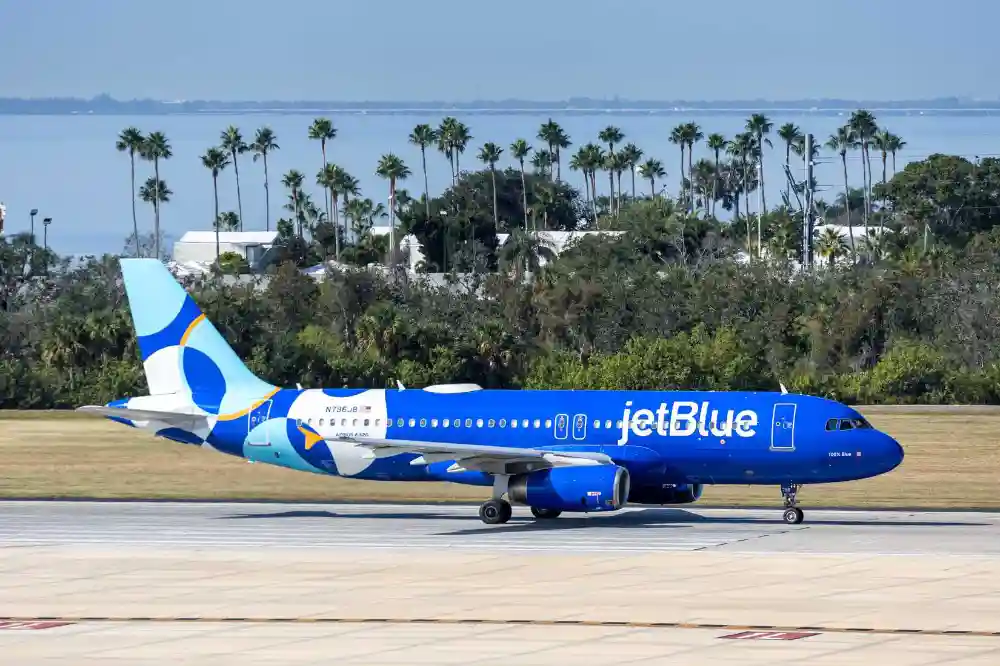
JetBlue has returned one of its Airbus A320 aircraft to regular operations after a lightning strike damaged its onboard weather radar, forcing the crew to divert shortly after departure from Westchester County Airport en route to Orlando International Airport. Although lightning strikes are a routine hazard in commercial aviation, this incident was unusual because the electrical discharge disabled a critical flight system, prompting an immediate precautionary landing.
JetBlue Flight 195 departed from Westchester following a lengthy delay caused by the late arrival of its inbound aircraft. Instead of leaving at its scheduled evening departure time, the Airbus A320 pushed back shortly after midnight. Only minutes after takeoff, the flight crew reported that the aircraft had been struck by lightning and that the impact had effectively “fried” the weather radar, leaving the aircraft unable to safely continue toward Florida.
The pilots promptly coordinated with air traffic controllers and requested a diversion to John F. Kennedy International Airport (JFK). The decision reflected standard aviation safety procedures, as a functioning weather radar is essential for avoiding thunderstorms and hazardous weather during flight, particularly on longer routes.
The aircraft landed safely at JFK approximately 44 minutes after departure, allowing passengers and crew to disembark without injury. Despite the unexpected disruption, the airline quickly arranged a replacement flight from JFK early the following morning, enabling travelers to continue their journey to Orlando after an overnight delay.
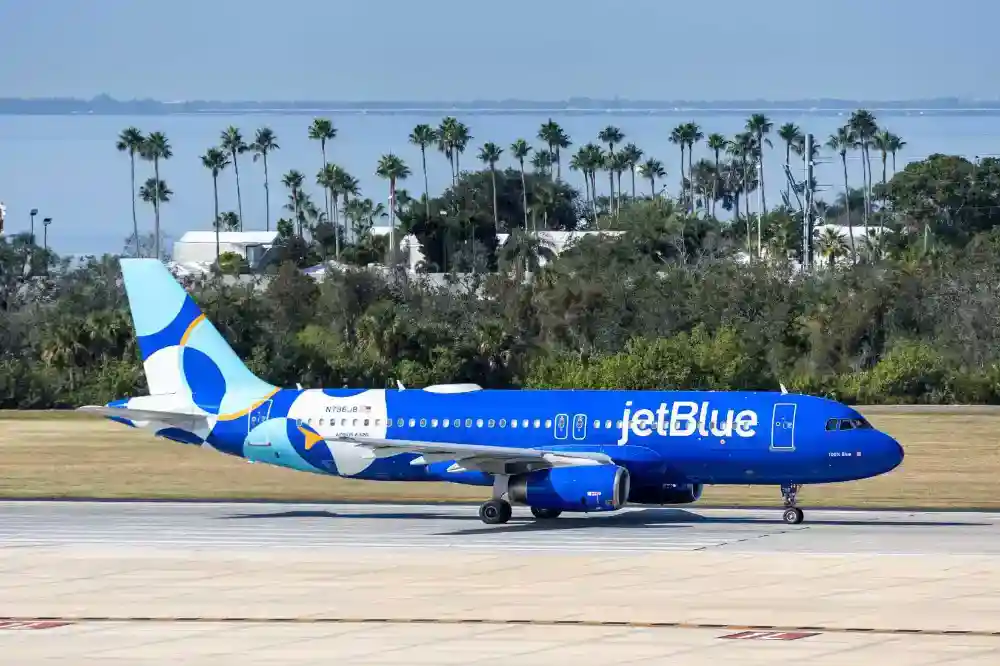
The aircraft involved, registered N506JB, has been part of the JetBlue fleet for nearly three decades. Officially identified as an Airbus A320-232, the aircraft completed its first flight in April 2000 before joining JetBlue in June of the same year. Known by the name Wild Blue Yonder, it currently features the airline’s Spotlight special livery, which was applied in September 2024. Powered by two IAE V2527-A5 turbofan engines, the aircraft is configured with 150 all-economy seats, making it one of the lower-density A320s still operating within JetBlue’s fleet.
JetBlue currently operates a small group of similarly configured A320 aircraft, although the airline has gradually begun reconfiguring these airplanes to a higher-density 162-seat layout. Despite its age of more than 26 years, N506JB continues to play an important role in domestic operations across the airline’s network.
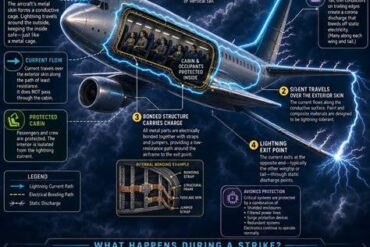
Although lightning striking an aircraft may sound alarming, modern commercial airplanes are specifically engineered to withstand these events. Aircraft effectively function as Faraday cages, allowing electrical current to travel along the conductive exterior of the fuselage before exiting through designated points such as the tail or wingtips. As a result, passengers inside the cabin are generally protected from the electrical energy, experiencing little more than a bright flash and a loud bang.
Traditional aluminum airframes naturally conduct electricity around the cabin, while newer composite aircraft incorporate embedded conductive materials, including copper mesh, to achieve the same protective effect. Extensive certification testing ensures that commercial aircraft can safely tolerate multiple lightning strikes throughout their operational lives without compromising structural integrity.
However, while the airframe itself typically remains unharmed, sensitive electronic systems can occasionally sustain damage. Weather radar antennas, avionics components, sensors, and communication equipment may require detailed inspections or replacement before an aircraft is cleared to fly again. That appears to have been the case for N506JB, whose damaged weather radar required maintenance before returning to passenger service.
Maintenance teams completed repairs the following day, restoring the aircraft’s weather detection capability and allowing JetBlue to return the airplane to scheduled operations. Flight tracking data showed the aircraft resumed normal service with flights linking Orlando, Ronald Reagan Washington National Airport, and Westchester, demonstrating that the issue had been fully resolved.
The incident highlights both the resilience of modern commercial aircraft and the effectiveness of airline safety procedures. While lightning strikes remain a regular occurrence for aircraft flying through active weather, serious system damage is comparatively rare. When it does occur, established operational protocols ensure crews have the training, airports have the capability, and maintenance teams have the expertise to safely inspect, repair, and return aircraft to service with minimal long-term disruption.