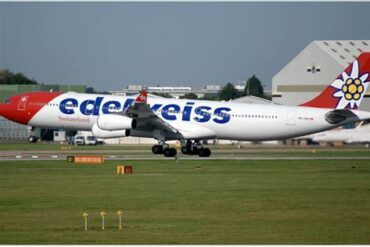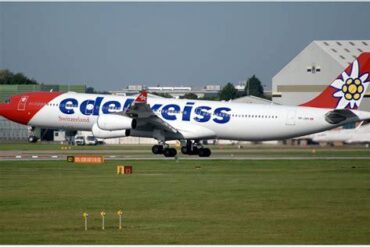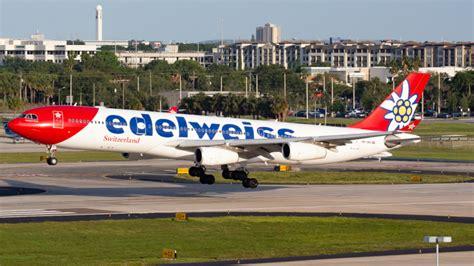
An Edelweiss Airbus A340-300 was swiftly returned to operational status after sustaining engine blade damage from a bird strike at Zurich Airport on December 1, 2025. The long-range quadjet, arriving as flight WK38 from Liberia Guanacaste International Airport, landed without complications, taxiing safely to its gate before maintenance teams later uncovered visible damage inside engine number four.
The post-flight inspection revealed that the aircraft, registered HB-JMC, had ingested birds into the outer right-wing CFM56 powerplant, resulting in blade deformation requiring immediate technical attention. Swift response from Edelweiss engineering teams enabled the aircraft to re-enter commercial service in just over a day, demonstrating the airline’s efficiency in rapid turnaround maintenance—an ability increasingly valuable in a world of constrained fleet capacity.
Records from Flightradar24 show the A340 returned to operational rotation on December 3, resuming long-haul service between Zurich (ZRH) and Cape Town (CPT). Despite the incident, passenger schedules remained largely unaffected, highlighting the resilience of both the aircraft and carrier.
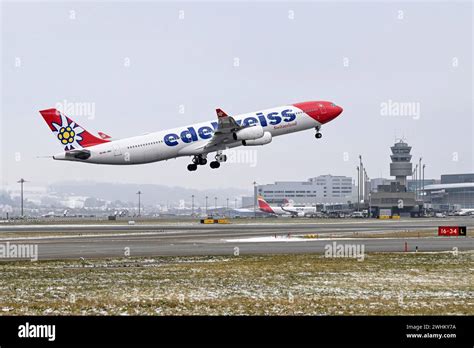
Edelweiss Maintenance Team Executes Rapid Repair Amid Engine Blade Damage
The aircraft remained grounded for approximately 25 hours, a remarkably short downtime for an event involving engine ingestion and component replacement. Technicians removed and inspected affected turbine blades, replaced damaged hardware, and completed a full diagnostics run before signing off the aircraft as flight-ready. This level of responsiveness speaks to Edelweiss’s heavy investment in technical capability, spare part availability, and structured A-check oversight.
The 22-year-old widebody, originally delivered to Swiss International Air Lines in 2002, transitioned to Edelweiss operations in April 2023. Configured for 300 passengers across two cabins—including 29 business class seats and 271 economy seats—the aircraft had accumulated 108,773 flight hours and 12,443 cycles by Q3 2025. While aging, the A340 remains a workhorse on high-demand vacation routes connecting Switzerland to seasonal long-haul destinations.
Aging Quadjet Fleet Nears Retirement As A350 Takes The Lead
The incident underscores the reality facing legacy four-engine airframes as global fleets continue their gradual exit from commercial service. Only 37 Airbus A340-300s remain active worldwide, operated by 12 carriers including Lufthansa, Mahan Air, Edelweiss, Swiss, and South African Airways. Both Swiss-based operators plan to phase out their A340 fleets entirely by mid-2027, shifting toward fuel-efficient twin-engine alternatives.
Modernization is already visible across Edelweiss’s long-haul strategy. The airline welcomed its first Airbus A350-900 earlier in 2025, now operating four of the type with two additional deliveries scheduled by end-2026. The next-generation A350 offers lower fuel burn, reduced emissions, extended range, and increased capacity—339 seats in a dual-class configuration versus 300 currently available aboard the A340.
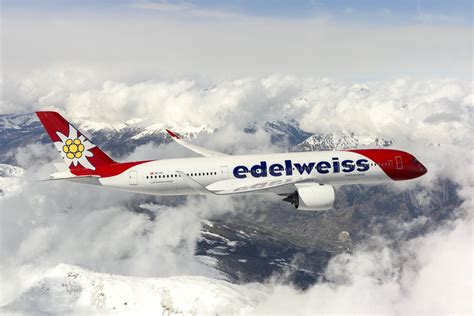
The Future Beyond The Bird Strike
The repaired A340 may have returned quickly, but the long-term trajectory is unmistakable: Edelweiss is preparing for a future built on efficiency, sustainability, and higher passenger throughput. The bird strike incident simply demonstrated that even aircraft approaching retirement remain deeply engineered and operationally capable when supported by skilled maintenance teams.
The A340-300 will continue operating long-haul leisure routes for the next two years—valuable predecessors bridging Edelweiss’s transition to a fully modernized A350-powered fleet. Long after its final takeoff, HB-JMC’s rapid return from engine damage will stand as an example of resilience at the twilight of an aviation era.
Fleet evolution continues to reshape the airline’s strategic footprint, and this quick repair ensures Edelweiss keeps flying forward while history’s four-engine giants complete their final chapters.