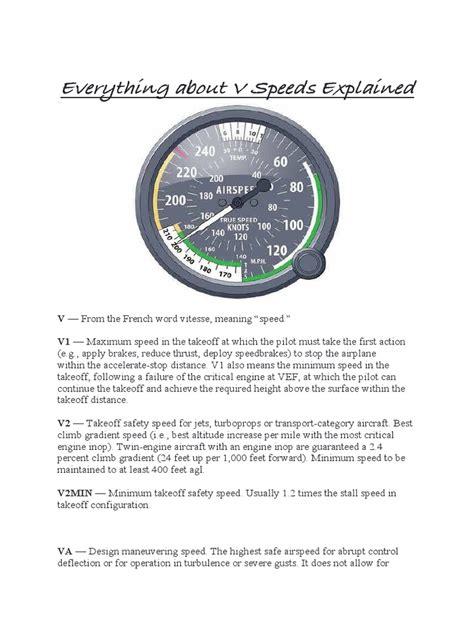
V-speeds, derived from the French word vitesse meaning “speed,” are critical references in aviation, standardized by the Federal Aviation Administration (FAA). These speeds govern the operational limits and procedures that pilots must rigorously adhere to for safe aircraft operation. Understanding each V-speed is vital not only for passing flight examinations but also for ensuring the highest level of safety in real-world flight operations. In this detailed guide, we explore everything about V speeds explained, demystifying each term and highlighting its practical application.
What Are V-Speeds?
V-speeds represent specific airspeeds crucial for different flight phases, including takeoff, climb, cruise, descent, and landing. These speeds, mandated in the aircraft’s Pilot Operating Handbook (POH) or the Aircraft Flight Manual (AFM), ensure that pilots can anticipate performance under standard and emergency conditions. Current regulations under the Federal Aviation Regulations (FARs) provide legal definitions and requirements for these speeds, demanding pilots stay updated with any changes.
V1 – Decision Speed
V1 is one of the most critical speeds during the takeoff phase. It defines the maximum speed at which a pilot must decide whether to abort the takeoff if a malfunction occurs. If an issue arises before reaching V1, the pilot must abort. If the problem surfaces after reaching V1, the takeoff must continue even with a failed engine, ensuring the aircraft can either stop within the available runway or safely lift off and climb out.
V2 – Takeoff Safety Speed
V2 guarantees that an aircraft achieves the necessary climb gradient (minimum 2.4% or 24 ft per 1,000 ft) with one engine inoperative. Pilots must maintain V2 until at least 400 feet above ground level (AGL) to ensure safe obstacle clearance and climb performance.
V2MIN is closely related, defined as 1.2 times the stall speed in the takeoff configuration.
VA – Design Maneuvering Speed
VA represents the maximum speed at which full, abrupt control movements can be safely made without risking structural damage. This speed decreases with aircraft weight and is critical when navigating through turbulence. The formula to adjust VA for different weights is:
[ VA₂ = VA × \sqrt{(Current Weight / Maximum Landing Weight)} ]

Other Crucial V-Speeds During Takeoff and Initial Climb
- VLOF (Liftoff Speed): The speed at which the aircraft becomes airborne.
- VR (Rotation Speed): The speed at which the pilot initiates nose-up attitude for liftoff, leading to VLOF.
- VMU (Minimum Unstick Speed): The slowest speed at which the aircraft can leave the ground, established through rigorous testing.
- VMCG (Minimum Ground Control Speed): The lowest speed at which directional control can be maintained on the ground after an engine failure.
- VEF (Critical Engine Failure Speed): The speed at which engine failure is assumed during takeoff performance calculations.
- VDEC (Decision Speed for Light Twin Aircraft): Similar to V1, specific to light twin-engine aircraft.
VFS and VFTO – Speeds Post-Takeoff with Engine Failure
VFS (Final Segment Speed) is the target speed after reaching 400 feet AGL in case of an engine failure, allowing continued safe climb-out.
VFTO (Final Takeoff Speed) is the required speed at the end of the takeoff path in the en route configuration with one engine inoperative.
Climb and Cruise Phase V-Speeds
- VENR (En Route Climb Speed): Once at 1,500 feet AGL, jets accelerate to VENR, ensuring optimal performance during single-engine climb.
- VAC (Missed Approach Climb Speed): Applied during go-around procedures with a critical engine inoperative, necessitating a 2.1% climb gradient.
- VY / VYSE (Best Rate of Climb Speeds): Maximum altitude gain per time unit. VY decreases with weight and altitude; VYSE refers to single-engine operations.
- VX / VXSE (Best Angle of Climb Speeds): Maximum altitude gain per distance unit. VX increases with altitude and weight.
Handling Turbulence and Gusts: VB and VC
VB (Turbulent Air Penetration Speed) is the design speed for encountering turbulent conditions, assuming gusts of 66 feet per second. VC (Design Cruising Speed) is the structural design speed for smoother air, accounting for 50 feet per second gusts.
Flying at or below VB during turbulence minimizes structural stress and risk of overstress damage.
Maximum Speeds for Structural Integrity
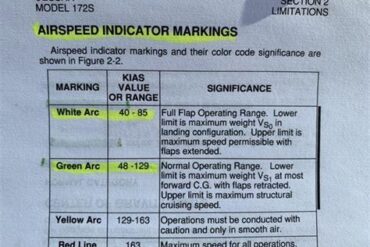
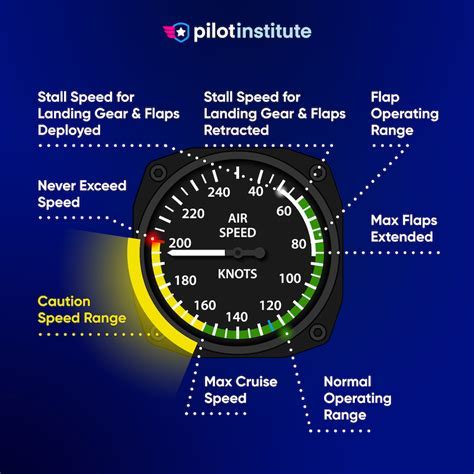
- VNO (Maximum Structural Cruising Speed): Upper limit for normal flight; speeds beyond this (yellow arc) only acceptable in smooth air.
- VNE (Never Exceed Speed): Absolute limit to prevent catastrophic structural failure, highlighted by the redline on airspeed indicators.
- VDF / MDF (Demonstrated Flight Diving Speed): Used when VD (Design Diving Speed) cannot be attained during testing.
- VFC / MFC (Maximum Speed Before Undesirable Flight Characteristics): Marks onset of conditions such as flutter or control reversal.
- VMO / MMO (Maximum Operating Limit Speed): Denotes the upper speed limit—expressed in knots at low altitude or as a Mach number at high altitude.
Flap and Gear Speed Limits
Managing flap and gear speeds ensures structural protection and system longevity:
- VFE (Maximum Flap Extended Speed): Top of the white arc; positive load limited to 2 Gs.
- VF (Design Flap Speed): Engineers target this speed to match VFE.
- VFR (Flap Retraction Speed): Optimal speed to retract flaps post-takeoff without aerodynamic issues.
- VLO (Landing Gear Operation Speed): Maximum speed for gear extension/retraction.
- VLE / VLLE / VLLO (Landing Gear Extended Limit Speeds): Maximum speed with gear down, including for operating landing lights.
Landing Approach and Go-Around Speeds
- VREF (Reference Landing Approach Speed): A target approach speed typically set at 1.3 times VSO (stall speed in landing configuration).
- VAP (Approach Speed Including Wind Factors): Adjusted from VREF by adding half the steady headwind and full gust factor, capped at +20 knots.
- VAC (Missed Approach Speed): Essential for single-engine missed approach maneuvers.
Correct calculation of VAP ensures a safe, stabilized approach, minimizing the risk of landing accidents.
Stall and Minimum Control Speeds
- VS (Stall Speed): Generic stall or minimum steady-flight speed.
- VS1 (Stall Speed Clean): Stall speed with gear and flaps retracted.
- VSO (Stall Speed Landing Configuration): Stall speed with full landing configuration—flaps and gear extended.
- VSSE (Safe Single Engine Speed): Critical for multiengine training cuts.
- VMCA (Minimum Controllable Airspeed): The minimum airspeed at which an aircraft remains controllable after a critical engine failure.
Maintaining proper margins above stall speeds ensures safe control authority and aerodynamic stability.
Unique Helicopter V-Speeds: VTOSS
VTOSS is specifically defined for Category A rotorcraft, representing the takeoff safety speed to ensure safe transition in the event of engine failure after liftoff.
Special and Utility Speeds
- VG (Best Glide Speed): Maximizes glide range during engine failure, essential in emergency planning.
- VH (Maximum Level Flight Speed): Top speed achievable in level flight at maximum continuous power; important for ultralight regulations.
- VWWO (Windshield Wiper Operating Speed): Ensures wiper function without mechanical failure under specific airspeeds.
Maintaining VG during emergencies can significantly enhance chances of a successful forced landing.
Conclusion: Mastery of V-Speeds Enhances Aviation Safety
Mastering V-speeds empowers pilots to execute precise, informed decisions throughout all flight phases. From takeoff to landing and through unexpected turbulence or emergency engine failures, these speeds form the blueprint for safe aircraft operation. Continual practice, review, and real-time application of these values not only elevate a pilot’s proficiency but also uphold the highest standards of aviation safety.