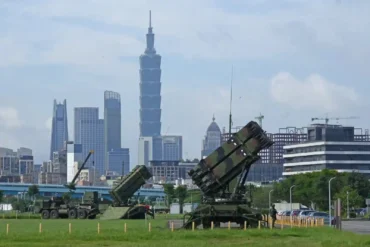
The tempo of Indo-Pacific defense planning has quickened. Washington is now accelerating long-delayed weapons deliveries to Taiwan, a shift driven by easing production bottlenecks and tightening processing pipelines for foreign military sales. The result is more than administrative momentum. It is a material reinforcement of Taiwan’s near-term warfighting capacity, focused on long-range strike, coastal denial, and persistent surveillance—three pillars central to deterring a cross-strait invasion scenario.
Taiwanese Defense Minister Wellington Koo confirmed that phased shipments scheduled for later this year will include M142 HIMARS rocket artillery, Harpoon coastal defense missile systems, MQ-9B unmanned aerial systems, and ongoing deliveries of Javelin anti-armor missiles. The acceleration comes amid sustained Chinese air and naval pressure around the island, with Taipei extending military exercises and expanding reservist readiness to match the evolving threat environment.
For Taiwan, these deliveries are not symbolic. They close operational gaps inside a defense construct designed around asymmetry—leveraging mobility, dispersion, and precision to offset China’s scale. Legislators in Taipei are simultaneously debating budgets tied to procurement schedules, underscoring how logistics, finance, and battlefield readiness are now tightly interwoven.
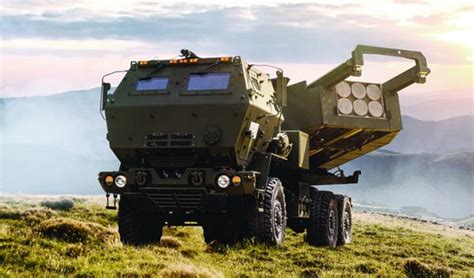
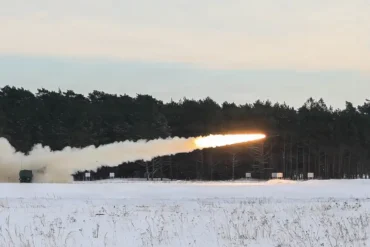
HIMARS: Mobile Precision Firepower Reshaping Taiwan’s Strike Depth
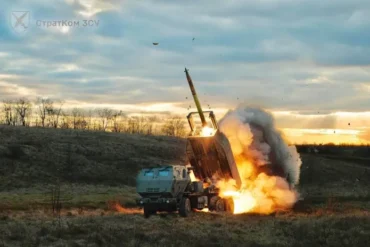
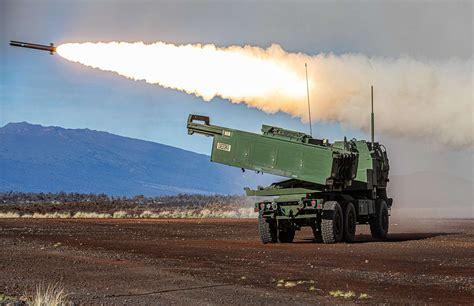
Among the incoming systems, High Mobility Artillery Rocket Systems (HIMARS) represent the most tactically flexible capability boost. Mounted on wheeled launchers, HIMARS combines road mobility with precision long-range fires—an ideal pairing for Taiwan’s dense infrastructure and mountainous terrain.
Each launcher carries a pod containing either six Guided Multiple Launch Rocket System (GMLRS) rockets or a single Army Tactical Missile System (ATACMS) missile. This modularity enables rapid shoot-and-scoot operations: firing from pre-surveyed points, relocating quickly, and rearming under concealment.
Range defines the deterrent value:
- GMLRS: Beyond 70 km, extended variants nearing 150 km
- ATACMS: Up to 300 km strike reach
This envelope allows Taiwan to target amphibious staging zones, logistics hubs, ports, and airfields along invasion corridors. In operational terms, it complicates Chinese planning cycles. Assault forces must now assume deep precision strikes against assembly areas before landings even begin.
Mobility also enhances survivability. Fixed artillery invites preemptive destruction; mobile launchers dissolve into road networks, tunnels, and urban cover. The system’s value lies as much in its elusiveness as in its firepower.
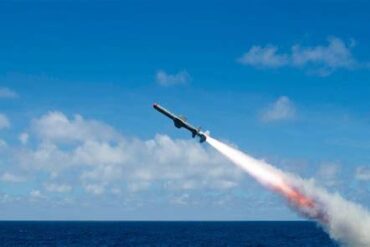
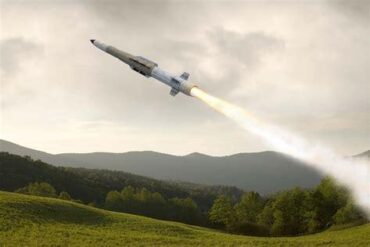
Harpoon Coastal Defense: Turning the Strait Into a Kill Zone
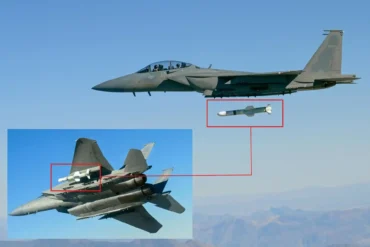
If HIMARS stretches Taiwan’s strike depth inland and across staging zones, Harpoon coastal defense systems weaponize the maritime approach itself—the most vulnerable phase of any amphibious invasion.
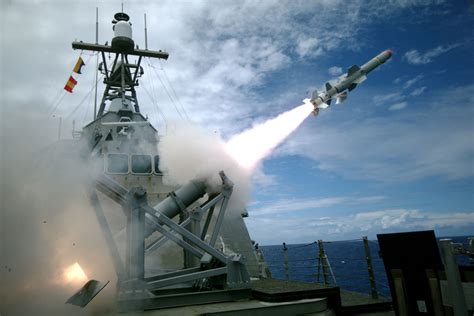
Taiwan’s configuration emphasizes mobility over fixed fortifications. Dispersed launch vehicles, radar trucks, and command nodes create a fluid targeting web that can relocate under threat. This architecture reduces susceptibility to missile preemption while preserving continuous coverage of littoral corridors.
The Harpoon Block II missile brings mature, combat-proven capabilities:
- Over-the-horizon targeting
- All-weather strike capacity
- Autonomous guidance systems
- Sea-skimming terminal flight
With ranges exceeding 120 km, Harpoon batteries force Chinese surface combatants and amphibious transports to operate under constant threat during sea transit and landing alignment. Salvo launches amplify lethality, saturating shipboard defenses through coordinated attack vectors.
Operational effectiveness, however, hinges on training cycles. Crews must rehearse displacement, targeting integration, and rapid reload under simulated combat pressure. Accelerated deliveries compress the timeline for achieving full deterrent maturity—but even initial deployments alter adversary risk calculations.
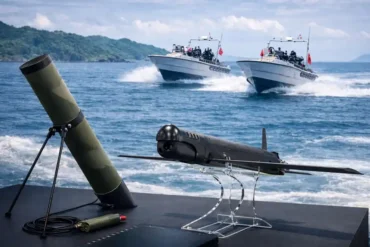
MQ-9B Drones: Persistent Eyes Over the Battlespace
Precision fires and coastal missiles rely on one indispensable ingredient—targeting intelligence. This is where the MQ-9B SkyGuardian enters Taiwan’s defense ecosystem.
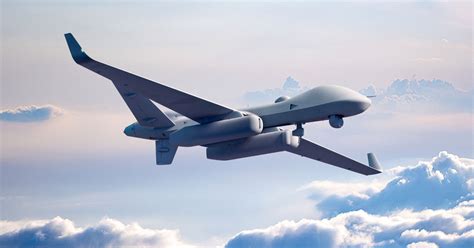
Taiwan’s acquisition centers on four weapons-capable aircraft supported by fixed and mobile ground control stations. Designed for maritime intelligence, surveillance, and reconnaissance (ISR), MQ-9B provides persistent wide-area coverage across sea lanes and air approaches.
Endurance is the system’s defining advantage. With flight times exceeding 40 hours and satellite command links enabling beyond-line-of-sight control, the drone sustains uninterrupted surveillance over invasion routes.
In contingency scenarios, this persistence becomes decisive:
- Detecting amphibious fleet concentrations early
- Monitoring blockade enforcement patterns
- Tracking surface action groups in real time
- Cueing missile and rocket units for precision strikes
In layered defense theory, ISR platforms act as connective tissue—linking sensors to shooters. Without them, missile systems operate blindly. With them, Taiwan gains a dynamic targeting grid capable of updating strike data continuously.
Javelin Missiles: Denial at the Point of Contact
Long-range fires shape the battlespace before landfall. FGM-148F Javelin missiles shape it after.
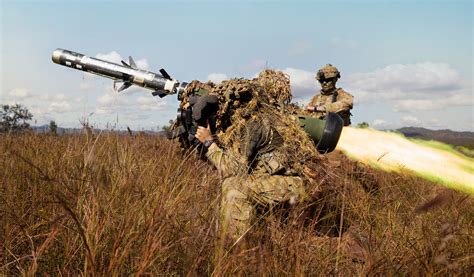
Taiwan’s deliveries include large stocks of missiles and lightweight launch units, reinforcing infantry anti-armor capacity across likely landing zones and urban chokepoints. The weapon’s fire-and-forget imaging infrared guidance allows operators to relocate immediately after launch—critical for survival in high-intensity combat.
Its top-attack trajectory targets armored vehicles at their weakest point: the turret roof. With an effective range around 2,500 meters—and proven lethality beyond—Javelin enables small units to ambush mechanized forces without prolonged exposure.
Invasion warfare rarely ends at the shoreline. Urban combat, valley advances, and infrastructure seizures follow. Javelin systems ensure that even successful landings devolve into slow, attritional fights—precisely the scenario Taiwan’s defense doctrine seeks to impose.
The “Porcupine Strategy” in Operational Form
These systems collectively animate Taiwan’s evolving “porcupine strategy.” The metaphor is deliberate: a smaller defender bristling with lethal, hard-to-neutralize capabilities that make conquest prohibitively costly.
Rather than pursuing symmetrical force parity with China, Taiwan emphasizes denial:
- Disrupt invasion logistics
- Fragment operational timelines
- Target transport and staging assets
- Stretch conflict duration
Geography amplifies this approach. Taiwan’s mountainous spine, dense urbanization, and limited landing beaches naturally constrain assault routes. Layered missile, drone, and rocket coverage converts those constraints into kill zones.
Accelerated U.S. deliveries therefore shape not just inventory levels, but battlespace geometry—altering where, when, and how conflict could unfold.
Production Bottlenecks and Strategic Timing
The acceleration follows years of procurement delays tied to manufacturing backlogs, pandemic-era supply chain disruptions, and competing global demand for munitions. As production capacity recovers, Washington has tightened processing timelines for Taiwan-bound systems.
This matters strategically. Deterrence is time-sensitive. Capabilities delivered after a crisis begins hold limited preventive value. Systems fielded beforehand reshape adversary planning assumptions.
Recent U.S. arms notifications suggest the pipeline is widening further, with follow-on packages designed to reinforce long-range fires, surveillance networks, and mobile missile forces. Taiwan, for its part, is working to clear legacy procurement backlogs while aligning budget approvals with accelerated delivery schedules.
Deterrence Through Battlespace Preparation
Minister Koo’s urgency reflects more than procurement optimism. Chinese air sorties and naval patrols around Taiwan have surged, compressing warning timelines and increasing gray-zone pressure.
Accelerated weapons deliveries serve a preparatory function. They allow Taiwan to:
- Train crews before crisis onset
- Integrate targeting networks
- Conduct joint operational rehearsals
- Harden dispersal and concealment infrastructure
Deterrence emerges not from possession alone, but from visible readiness. When missile batteries maneuver fluidly, drones patrol continuously, and rocket forces demonstrate rapid strike cycles, invasion calculus shifts.
Strategic Implications for Cross-Strait Stability
The cumulative effect of HIMARS, Harpoon, MQ-9B, and Javelin deployments is a defense architecture optimized for disruption. It cannot eliminate invasion risk outright—no system can—but it raises operational costs, extends conflict duration, and erodes the prospect of a rapid fait accompli.
From a strategic standpoint, the acceleration signals Washington’s intent to compress Taiwan’s vulnerability window. Each delivered launcher, missile battery, and drone sortie narrows the gap between procurement and operational readiness.
In deterrence theory, time is as decisive as firepower. Capabilities that arrive early shape decisions before the first shot. Capabilities that arrive late merely shape the aftermath.
Taiwan’s expanding layered defense—mobile rockets inland, anti-ship missiles along the coast, drones overhead, and infantry missiles at the shoreline—forms a denial web designed to fracture invasion sequencing at every phase.
The logic is stark but stabilizing: the harder the island is to seize quickly, the less likely a seizure attempt becomes.