A Disruptive Force in Very Light Jet Aviation
The Flaris LAR01 stands as a paradigm shift in very light jet (VLJ) innovation, marking a milestone not only in Polish aerospace engineering but also in the global narrative of personal aviation. Developed by Metal-Master, a company based in Jelenia Góra, Poland, this aircraft emerges from a vision by Sylwia and Rafał Ładzińscy to provide an accessible jet solution tailored for private owners, corporate use, and light commercial operations. Conceived outside the United States—unlike nearly every other VLJ—the LAR01 challenges long-held industry norms and proves that cutting-edge jet technology can originate beyond traditional aviation powerhouses.
Conceived with the ambition to provide an affordable upgrade path for piston and turboprop pilots, the Flaris LAR01 does more than just bridge performance gaps—it opens new horizons for low-cost jet travel on point-to-point short-haul routes.
Development Journey: A Polish Vision Takes Flight
The LAR01 project began as a collaboration between Metal-Master and multiple Polish technical institutions, including the Instytut Lotnictwa, military research agencies, and top engineering universities. The concept was to bring a next-generation jet to private pilots who historically relied on piston twins or turboprops. Spearheaded by Rafał Ładziński in research and development and Andrzej Frydrychewicz, known for his work on the PZL I-23 Manager, as chief designer, the program rapidly gained momentum.
Initial prototypes included a non-flying static test article in 2014, followed by a taxi-capable prototype in early 2015 powered by a Pratt & Whitney Canada PW610 engine. However, delays in final engine selection postponed the program. By 2016, the team committed to the Williams FJ33-5A turbofan, setting the stage for full integration testing.
Following extensive system verification and ground testing during 2017 and 2018, the prototype designated SP-YLE took its first flight on April 5, 2019. By February 2020, it had logged over 60 hours of flight time and secured approximately 50 pre-orders—a remarkable achievement for a newcomer in the jet aircraft space.

Engineering Elegance: Carbon Fiber and Modularity
Constructed primarily from carbon-fiber composites, the LAR01 demonstrates a strong commitment to weight efficiency and structural resilience. This material choice not only reduces overall airframe weight but also improves corrosion resistance and contributes to its high climb rate of 5,900 ft/min—superior in its category.
A defining feature is its removable elliptical wings and detachable tailplane, enabling owners to store the aircraft in standard-sized garages—a unique capability among jets. The cockpit layout, inspired more by automotive ergonomics than traditional aviation design, promotes ease of use for less experienced pilots. The fuselage-mounted fuel tank reduces complexity while enhancing safety.
Further emphasizing versatility, the LAR01 is capable of operating from unpaved runways and grass strips, expanding its operational base well beyond traditional airport infrastructure. Two ballistic recovery parachutes, positioned in the nose and tail, enhance survivability in emergency scenarios, while optional Garmin G600 TXi glass cockpits introduce world-class avionics to private aviators.
Performance Metrics: A Leader in Its Class
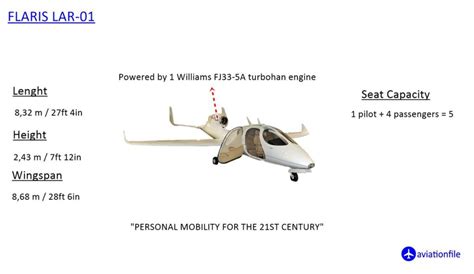
With an impressive maximum speed of Mach 0.72 (800 km/h) and a range of 1,900 nautical miles (3,519 km), the Flaris LAR01 offers capabilities that exceed many turboprops and light jets in its weight class. Designed to reach service ceilings of 31,000 feet (9,449 meters), it ensures efficient cruise operations above weather disturbances and commercial traffic.
Its stall speed of 62 knots (115 km/h) and a glide ratio of 18:1 reflect an aircraft designed for safety and controllability, even under abnormal flight conditions. These specifications, combined with a maximum takeoff weight (MTOW) of just 1,850 kg, make the LAR01 remarkably efficient and capable of short-field performance.
Specifications Summary
- Crew: 1 pilot + 4 passengers
- Length: 8.32 meters
- Wingspan: 8.68 meters
- Height: 2.43 meters
- Empty Weight: 900 kg
- MTOW: 1,850 kg
- Climb Rate: 5,900 ft/min
- Max Speed: Mach 0.72 / 800 km/h
- Range: 1,900 nmi / 3,519 km
- Service Ceiling: 9,449 m / 31,000 ft
- Stall Speed: 62 knots / 115 km/h
- Glide Ratio: 18:1

Market Position and Pricing
Priced at €1.8 million, the Flaris LAR01 offers an attractive entry point into jet ownership for pilots transitioning from high-performance piston aircraft or turboprops. Its operating cost of approximately $450 per hour compares favorably with older jet models and modern turboprops, positioning it as an economically viable option for business executives, charter operators, and aerial service providers.
Sales began in April 2024, with first deliveries slated for the United Arab Emirates—a region increasingly prioritizing private air mobility. Plans are already underway for CARGO and optionally piloted (OPV) variants, indicating that the LAR01 is merely the foundation of a larger family of small jets envisioned by Metal-Master.
Mission Flexibility and Future Potential
The LAR01 is built for multi-role adaptability. In addition to private ownership, it is ideal for air taxi operations, aerial medical transport, border patrol, aerial photography, and surveillance missions. Its low operational footprint and flexible mission configuration options make it a suitable platform for future autonomous UAV conversions—a direction already being explored by Metal-Master under the OPV program.
This kind of cross-functional airframe design ensures long-term relevance, offering an upgradeable platform as aerospace technology and regulatory frameworks evolve. Whether serving remote medical evacuation needs or connecting executives in underserved regions, the LAR01 is designed to scale across missions and industries.
Conclusion: A New Era in Light Jet Aviation
The Flaris LAR01 is far more than a technological achievement; it is a visionary response to the growing demand for personal and regional air mobility in the 21st century. Through a combination of Polish engineering ingenuity, modern composite structures, and market-focused design, the aircraft challenges established market leaders with a bold offering that is versatile, efficient, and affordable.
As production ramps up and certification milestones are finalized, the LAR01 will likely redefine the landscape for single-engine jets, proving that innovation, when coupled with purpose-driven design, can transform the way we approach air travel—whether for business, leisure, or life-saving missions.