In the storied history of naval warfare, some ships defy explanation — not because they were failures, but because they were bold, experimental attempts to rethink what a warship could be. While sleek destroyers and formidable aircraft carriers dominate popular imagination, a handful of unconventional warships emerged from the drawing board with designs so strange, they looked more like science fiction prototypes than tools of war. These vessels were not only built but, in many cases, also deployed. Their unusual designs often served a highly specific function or answered a technological question of their time. Here are five of the weirdest warships ever made, each pushing the boundaries of maritime engineering.
Tucumcari (PGH-2): The Hydrofoil Speed Demon
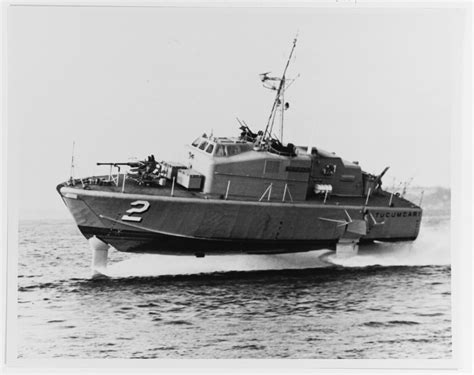
The Tucumcari (PGH-2) was one of the United States Navy’s boldest attempts at high-speed, high-efficiency littoral warfare. Constructed by Boeing in the late 1960s, this hydrofoil patrol boat didn’t look like a typical warship — and for good reason. Beneath its 72-foot-long aluminum hull lay a trio of underwater wings designed to lift the entire vessel above the ocean surface as it reached speed. By eliminating drag, this design gave the Tucumcari breathtaking velocity, topping out at speeds few traditional patrol boats could match.
The Tucumcari featured a canard-style hydrofoil layout, with one forward-mounted wing and two stern-mounted foils, all supported by jet propulsion rather than propellers. This engineering marvel pumped 120 tons of water per minute — double its own weight — to generate thrust. Armed with 40mm cannons and .50 caliber machine guns, the Tucumcari participated in several operational missions during the Vietnam War and was later used in NATO demonstrations across Europe.
Yet, despite its cutting-edge promise, hydrofoil technology proved unsustainable. High maintenance costs and limited utility in open seas eventually grounded these speedsters, with the Tucumcari’s career ending in 1972 after it ran aground off Puerto Rico.
Novgorod: The Floating Saucer Fortress
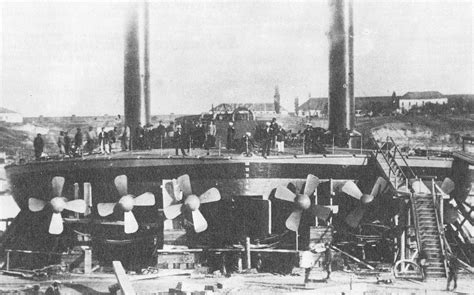
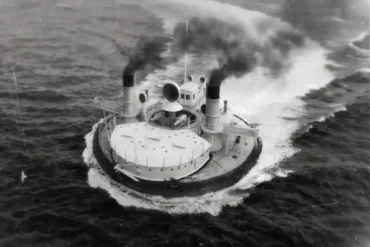
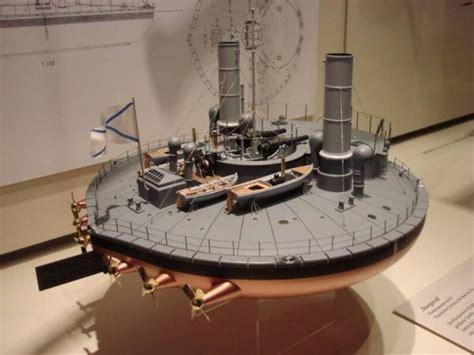
If the Tucumcari flirted with futuristic tech, the Russian Novgorod doubled down on bizarre geometry. Built in the 1870s during a period of intense naval experimentation, this warship was completely circular — 101 feet in diameter — and looked more like an alien spacecraft than a maritime vessel. Designed as a coastal defense monitor, it bristled with firepower, featuring a central rotating turret capable of delivering 11-inch shells in any direction.
Its rounded hull had one specific engineering goal: to support heavier guns without compromising stability. On conventional ships, large cannons could rock the vessel with their recoil. On the Novgorod, the wide beam countered this force effectively. But the circular design came at a steep price. The ship struggled to make headway due to poor hydrodynamics. It was slow, nearly impossible to steer, and occasionally spun in place when its guns fired.
Despite these drawbacks, the Novgorod and its sister ship, the Vice Admiral Popov, served for decades as stationary gun platforms protecting Russia’s southern coast, particularly around Sevastopol. While the circular warship never became a global standard, it remains one of the most iconic and unorthodox vessels in naval history.
Independence-Class: The Futuristic Trimaran of the U.S. Navy
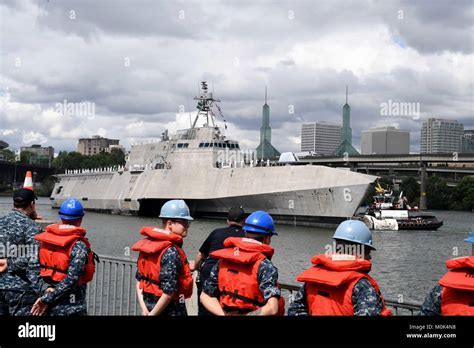
At first glance, the Independence-class Littoral Combat Ship (LCS) looks like something out of a futuristic naval simulation. Unlike most warships that rely on a singular hull, the Independence-class features a tri-hull (trimaran) configuration — a narrow central hull flanked by two sponsons. This design offers exceptional stability, large deck space, and impressive speed, reportedly exceeding 44 knots (50 mph).
Commissioned starting in 2010, ships like the USS Jackson (LCS-6) and USS Tulsa (LCS-16) were designed for shallow water (littoral) combat operations, such as anti-submarine warfare, mine detection, and fast patrol duties. Modular mission packages allow the ship to be configured for different tasks, from launching unmanned drones to deploying anti-ship missiles. Its lightweight aluminum construction further distinguishes it from traditional steel-hulled vessels.
Critics have pointed out some limitations, including structural vulnerabilities and limited combat durability. Nonetheless, the Independence-class remains an active part of the U.S. Navy’s coastal and forward-operating strategies. Its unique look and adaptability ensure its place among the most futuristic warships on the seas today.
Habakukk: The Ice Giant That Almost Was
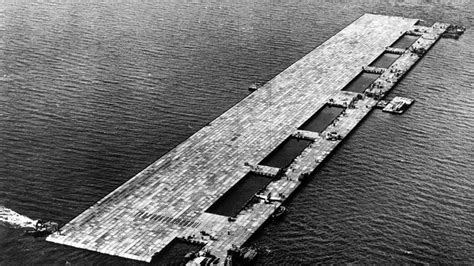
Perhaps no warship concept has ever been as outlandish — or as ambitious — as the British WWII-era Project Habakukk. Envisioned as a 2,000-foot-long aircraft carrier made of ice, this floating colossus was born from wartime desperation and unorthodox thinking. Its purpose? To serve as a mobile airbase in the North Atlantic, extending Allied air power against the growing menace of German U-boats.
The vessel was to be built not of steel, but of pykrete — a composite material made from ice and wood pulp. Stronger and slower to melt than ice alone, pykrete offered theoretical benefits: cost savings, ease of repair, and incredible resistance to torpedoes. A proof-of-concept was even constructed in Canada’s Lake Patricia, where a 60-foot prototype stayed frozen all summer with the help of refrigeration units.
Despite initial promise, the plan was ultimately shelved. Advances in conventional carrier technology and long-range aircraft made the enormous investment unnecessary. But Project Habakukk remains a testament to how wartime creativity and necessity can give rise to truly astonishing — if impractical — designs.
IRIS Shahid Mahdavi: Iran’s Drone-Era Warship
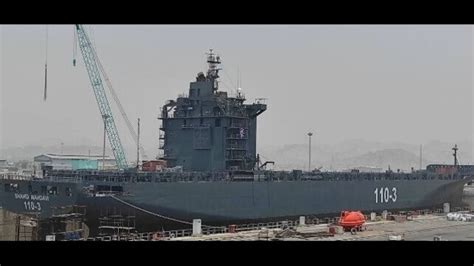
Launched quietly and without fanfare, the IRIS Shahid Mahdavi is one of the most mysterious and unconventional naval vessels operating today. Unlike traditional warships, it’s not a purpose-built hull — it’s a converted container ship, repurposed by Iran to function as a helicopter and drone carrier. This floating platform is part of a broader Iranian strategy to project power beyond the Persian Gulf, especially amid rising tensions with adversaries like Israel.
What makes the Shahid Mahdavi particularly strange is its origin and configuration. The superstructure has been modified to support rotary aircraft and unmanned aerial vehicles (UAVs), while maintaining a civilian façade reminiscent of WWII Q-ships — decoy vessels disguised as merchant ships. This allows Iran to deploy the Shahid Mahdavi in international waters with strategic ambiguity, supporting surveillance, electronic warfare, or even drone strikes while flying under the radar.
The vessel gained attention after the June 2025 escalation between Iran and Israel, where drone and missile exchanges raised the stakes across the region. Though much about the IRIS Shahid Mahdavi remains classified, its unconventional design and role in hybrid warfare ensure it will be watched closely by militaries and analysts alike.
Final Thoughts: Innovation at the Edge of Absurdity
Naval history is filled with conventional titans — battleships, cruisers, and destroyers that follow well-established blueprints. But on the fringes of design lie ships like the Tucumcari, Novgorod, and Shahid Mahdavi — strange and experimental vessels that dared to rewrite the rules. Whether born from desperation, ambition, or sheer ingenuity, these ships prove that sometimes, the path to innovation is paved with oddities.
While not all of them achieved lasting operational success, each of these weird warships contributed to the evolution of naval warfare. They tested the limits of what a warship could be — and in doing so, left behind legacies that are as fascinating as they are eccentric. As global tensions evolve and technology races forward, the next generation of naval vessels might look even stranger. And perhaps, in hindsight, these five ships will seem less weird — and more prophetic.