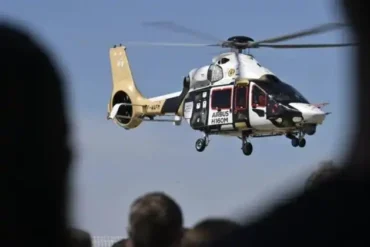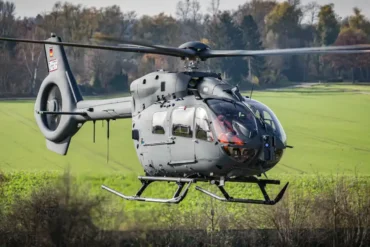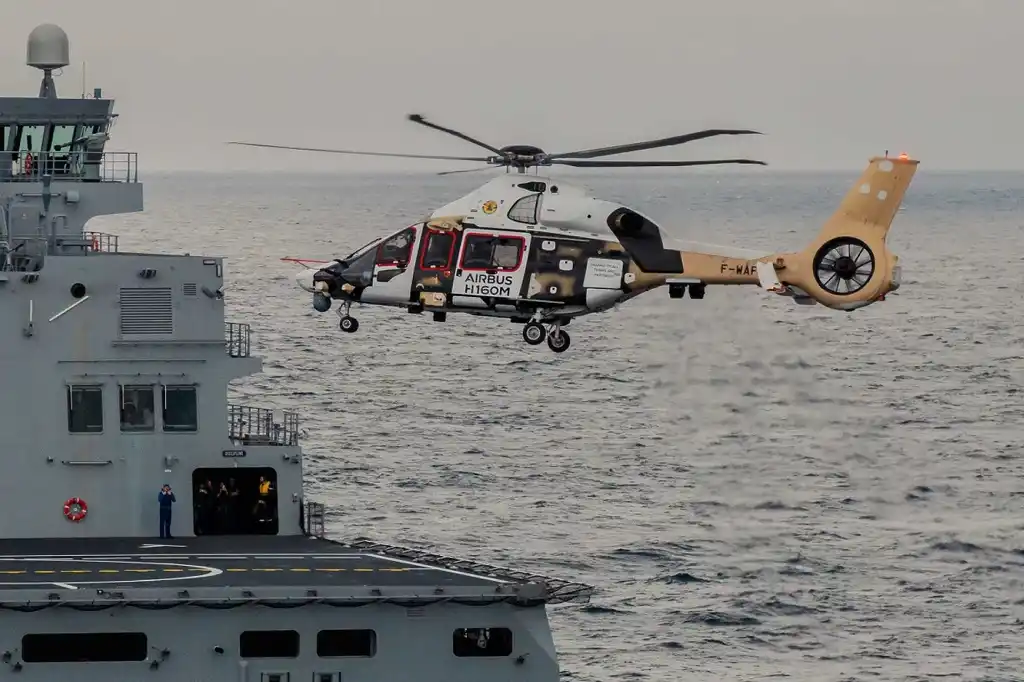
France’s H160M Guépard has quietly crossed a meaningful operational threshold. On January 16, 2026, the French Navy carried out the first close-range naval interaction between the new military helicopter prototype and a major surface combat support vessel, the fleet replenishment tanker BRF Jacques Stosskopf, during the ship’s departure from Toulon naval base. While no deck landing was attempted, the flight represented far more than a ceremonial milestone. It was a technically deliberate, sensor-focused exercise aimed at validating the helicopter’s behavior in the complex electromagnetic environment generated by a large naval ship.
This early-stage interaction is significant because it tests the Guépard not in isolation, but in the environment where it is expected to operate routinely. Large naval vessels produce strong magnetic fields, electromagnetic emissions, and electronic interference, all of which can influence navigation systems, mission sensors, and defensive avionics. Exposing the H160M to these effects at the prototype stage allows engineers to identify vulnerabilities early, rather than discovering them during frontline deployment.
The flight also signals the Navy’s intent to push the Guépard program forward methodically, integrating operational realism from the outset rather than treating maritime qualification as an afterthought.
A Purpose-Built Proximity Flight, Not a Landing Exercise
During the sortie, H160M prototype No. 1 operated in an armed configuration, deliberately flying close to the Jacques Stosskopf without landing on its deck. The absence of a landing was not a limitation but a conscious design choice. The primary objective was to observe how onboard systems responded when exposed to the magnetic and electromagnetic disturbances produced by a vessel of the tanker’s size.
Ships like the Jacques Stosskopf, displacing tens of thousands of tonnes, generate complex electromagnetic signatures from power generation, radar systems, and internal electrical networks. These effects can subtly degrade sensor accuracy or disrupt data fusion if not properly mitigated. For a helicopter expected to conduct maritime surveillance, force protection, logistics support, and medical evacuation, resilience in such conditions is non-negotiable.
This interaction took place as the tanker began a long-duration deployment, adding further realism to the test. Rather than a controlled harbor scenario, the Guépard encountered a ship configured and powered for extended operations, exposing it to the electromagnetic profile it would face in real missions.
From Civil Innovation to Military Baseline
The H160M Guépard traces its lineage to the Airbus H160, a helicopter that began life under the X4 program. The first prototype flew in June 2015, with European certification achieved in July 2020 and initial deliveries starting in December 2021. From the beginning, the H160 was designed as a digitally engineered, fully composite airframe, intended to reduce production time, lower lifecycle costs, and simplify maintenance.
Unlike earlier generations that evolved incrementally from previous designs, the H160 was conceived as a clean-sheet platform optimized for performance, payload, operating range, and acoustic discretion. It was targeted at demanding civil and parapublic missions such as offshore transport, search and rescue, medical evacuation, and government surveillance. This design philosophy made it an attractive foundation for a future military derivative.
The transition from civil to military was not cosmetic. The H160’s architecture was deliberately structured to accommodate growth in avionics, mission systems, and survivability features without compromising flight characteristics.
Aerodynamic and Structural Advances Over Legacy Platforms
Compared to the AS365 Dauphin, which it is set to replace, the H160 introduces a series of aerodynamic and structural refinements that collectively redefine its class. The most visible is the five-blade Blue Edge main rotor, engineered to reduce blade-vortex interaction noise while simultaneously increasing lift efficiency. This matters not only for acoustic discretion over populated areas, but also for shipboard operations where reduced vibration improves sensor stability.
At the tail, the helicopter employs a canted fenestron, enhancing low-speed stability and yaw authority during hover and deck approaches. The fuselage geometry has been optimized for lower drag and greater internal volume, supporting both higher cruise speeds and more flexible cabin layouts.
The adoption of electric landing gear and braking systems marks another departure from traditional hydraulic solutions. This shift reduces maintenance complexity and improves reliability, particularly in maritime environments where corrosion and fluid leaks are persistent challenges.
Proven Maritime Relevance Before the Guépard
Even before the H160M, the French Navy had already begun integrating the H160 into maritime service. It currently operates six H160 helicopters in a modified civil configuration, designated H160B, leased for a ten-year period. These aircraft feature 13 specific naval modifications, including the Euroflir 410S electro-optical system, armor protection, a dedicated operator console, a watertight cabin bin, and a medical wall for casualty evacuation.
This early adoption provided the Navy with invaluable operational feedback on the airframe’s suitability for shipboard use. It also allowed Airbus to refine corrosion protection, deck handling characteristics, and system integration long before the Guépard entered flight testing.
Powering both the civil and military variants are two Safran Arrano 1A turboshaft engines, each rated at 1,280 shp. The H160 family achieves a maximum takeoff weight of 6,050 kg, extendable to 6,250 kg in certain configurations, with a cruise speed of 255 km/h and a maximum speed of 272 km/h. A range of 880 km and endurance of 4 hours 30 minutes place it at the upper end of the medium helicopter category.
Digital Avionics as the Foundation
At the heart of the H160’s appeal is its digital avionics architecture. The civil variant introduced the Helionix suite, integrating flight management, automation, and system monitoring across large multifunction displays. Designed to reduce pilot workload, Helionix emphasizes automation, envelope protection, and intuitive human-machine interaction, enabling safe operations in complex environments.
This digital foundation was not discarded for the military version. Instead, it was expanded and hardened. The H160M Guépard adopts the Thales FlytX avionics system, providing centralized control of flight and mission functions from the cockpit. This continuity simplifies pilot training and allows crews to transition between variants with minimal friction.
The H160M Guépard and France’s Interservice Vision
The Guépard is the centerpiece of France’s Hélicoptère Interarmées Léger (HIL) program, which aims to replace five legacy helicopter types with a single, adaptable platform. The planned acquisition totals 169 helicopters: 80 for the Army, 49 for the Navy, 40 for the Air and Space Force, plus 10 for the Gendarmerie and one dedicated test aircraft.
Officially named Guépard in 2019, the program’s development and production contract was notified in December 2021. The first H160M prototype flew in July 2025, with deliveries scheduled to begin from late 2028.
Within naval aviation, the Guépard Marine will sequentially replace the Alouette III, Dauphin SPI, Dauphin Pedro, and eventually the AS565 Panther, consolidating roles that were previously spread across multiple aging platforms.
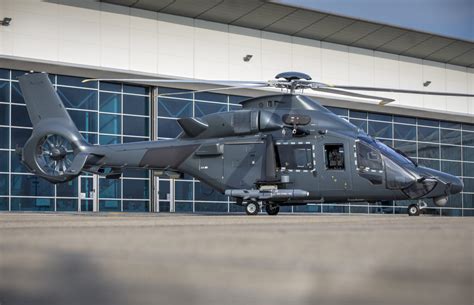
A True Military Helicopter, Not a Modified Civil One
Despite sharing an airframe, the H160M differs profoundly from its civil counterparts. It incorporates reinforced structures, selective ballistic protection, and mission systems purpose-built for combat operations. The sensor suite includes the Safran Euroflir 410 NG and the Thales AirMaster C AESA radar, enabling high-resolution maritime and overland surveillance.
Survivability is enhanced by a self-protection suite derived from Thales CATS 150, offering countermeasures across optical and electromagnetic domains. Secure communications and networked data links allow the Guépard to integrate seamlessly into joint air, land, and maritime operations.
Armament flexibility is another defining trait. The helicopter can be equipped with 7.62 mm and 12.7 mm machine guns, guided rocket systems, and precision shooter installations using the HForce modular weapon integration system. While the airframe is technically capable of carrying the ANL Sea Venom anti-ship missile and MU90 lightweight torpedo, these options are not funded in the initial standard.
Designed for the Future of Naval Warfare
One of the Guépard’s most forward-looking attributes is its native compatibility with unmanned systems. It is the first Airbus helicopter designed from inception to cooperate with drones, reflecting a shift toward manned-unmanned teaming in future operations. This capability positions the H160M not merely as a replacement platform, but as an enabler of new operational concepts.
The Navy’s contribution to testing, conducted through the HIL detachment of CEPA/10S at Istres, ensures that maritime requirements are embedded early. As additional prototypes become available, the scope and intensity of trials will expand, gradually transforming the Guépard from a promising prototype into a fully navalized combat system.
The January 2026 proximity flight near the Jacques Stosskopf may have looked understated from the outside, but it marked a decisive step. It demonstrated that the H160M Guépard is being shaped for the electromagnetic, sensor-dense reality of modern naval operations, not merely adapted to it.