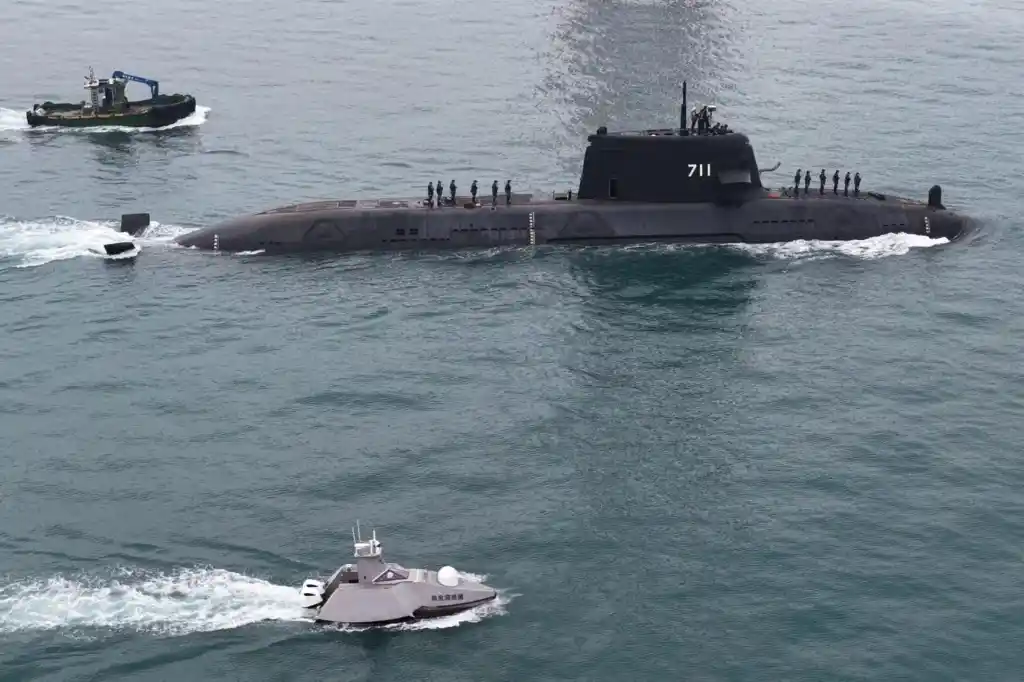
The Republic of China Navy has entered a decisive new phase in its undersea modernization drive with the start of controlled dive trials for Hai Kun, Taiwan’s first indigenous attack submarine. On January 26, 2026, the submarine, designated SS-711, departed Kaohsiung harbor and conducted its first submerged operations, transitioning from months of surface and harbor testing into the demanding environment beneath the waves. This moment represents far more than a routine technical milestone; it is the first tangible proof that Taiwan’s long-ambitious Indigenous Defense Submarine program is moving from concept into operational reality.
The initial dives follow a year of incremental progress throughout 2025, during which Hai Kun underwent floating tests, propulsion checks, and surface maneuvering trials. These preparatory steps were designed to confirm hull integrity, propulsion reliability, and command-and-control stability before risking submersion. According to Taiwanese media reporting, the January trials were conducted with additional test personnel aboard, underscoring the cautious and methodical approach taken for the submarine’s earliest underwater maneuvers. For any new submarine, the first dive is a defining moment: it validates not only engineering calculations but also the shipbuilder’s confidence in thousands of interconnected systems working in harmony.
Hai Kun is the product of CSBC Corporation, Taiwan’s state-owned shipbuilder, and stands as the first modern submarine designed and constructed entirely on Taiwanese soil. The achievement carries political and strategic weight, given decades of obstacles that limited Taiwan’s access to foreign submarine technology. By reaching the dive-testing stage, the program demonstrates that domestic industry can master complex disciplines such as pressure hull fabrication, ballast control, and underwater safety systems—areas traditionally dominated by a small group of experienced naval powers.
The path to this milestone has not been smooth. Hai Kun was launched in 2024 and began land-based testing at Kaohsiung later that year. Early sea trials encountered setbacks, including a reported main engine failure in September 2024 caused by ruptured internal piping. The incident forced a temporary halt and extensive repairs, pushing the program behind its original schedule. Rather than derailing the effort, these delays provided invaluable lessons for both the navy and shipyard, highlighting weaknesses in quality control and systems integration that could be corrected before deeper trials. By June 2025, the submarine returned to sea, eventually completing floating tests in November and clearing the way for submerged operations.
Technically, Hai Kun is understood to be a diesel-electric attack submarine, optimized for operations in the shallow, acoustically cluttered waters surrounding Taiwan. Open-source estimates suggest a submerged displacement between 2,500 and 3,000 tons and a hull length of roughly 80 meters, though official specifications remain undisclosed. Its propulsion architecture relies on diesel generators to charge large battery banks, allowing the submarine to operate silently on electric power while submerged. This design emphasizes stealth over endurance, favoring short, tactically timed patrols rather than prolonged deployments.
A central focus of the current test phase is the performance of Hai Kun’s onboard systems. Reports indicate that the submarine is equipped with an indigenous combat management system, linked to a sonar suite that includes bow-mounted arrays and flank sensors designed for passive detection. Earlier delays were reportedly tied to difficulties integrating these systems, particularly in ensuring stable data links between sensors and the platform management network. Taiwanese sources suggest that foreign technical assistance played a role in resolving these issues, although details remain deliberately vague due to the diplomatic sensitivities surrounding external involvement in the program.
Weapons integration is expected to proceed gradually as the submarine’s submerged handling characteristics are validated. Hai Kun is designed to deploy heavyweight torpedoes for both anti-submarine and anti-surface warfare, providing Taiwan with a credible undersea strike option. While the specific torpedo models have not been publicly confirmed, their effectiveness will depend less on headline specifications and more on sensor accuracy, crew training, and tactical doctrine. The dive trials are therefore as much about human factors as they are about machinery, allowing crews to gain familiarity with the submarine’s behavior under real operating conditions.
Strategically, Hai Kun is tailored to exploit the unique geography of the Taiwan Strait and nearby seas. Diesel-electric submarines operating on battery power can achieve extremely low acoustic signatures, particularly in littoral environments filled with background noise from commercial shipping and fishing vessels. In such conditions, even a single submarine can impose disproportionate demands on an adversary’s anti-submarine forces. Surface combatants, helicopters, and maritime patrol aircraft must devote significant resources to detection and tracking, complicating operational planning and increasing uncertainty during any crisis.
The start of dive testing also signals progress toward a much larger goal. Hai Kun is the lead boat in a planned class of eight indigenous submarines, which Taiwan aims to deliver by 2027. Building multiple hulls will test the scalability of Taiwan’s industrial base, from supply chain resilience to workforce expertise. Success would represent a structural shift in Taiwan’s defense posture, reducing reliance on foreign suppliers and embedding critical know-how within domestic industry.
Regionally, the trials are being closely watched as an indicator of Taiwan’s ability to sustain advanced military programs under sustained diplomatic and economic pressure. Submarine capabilities remain one of the most consequential variables in East Asian naval balances, offering stealth, persistence, and psychological deterrence out of proportion to fleet size. By moving Hai Kun into submerged trials, Taiwan adds a new and credible layer to its maritime defense strategy, reinforcing a doctrine centered on denial, survivability, and uncertainty rather than numerical parity.
As Hai Kun continues its test program through 2026, each successful dive will carry implications beyond the hull of SS-711. The submarine embodies a convergence of engineering ambition, strategic necessity, and political resolve. Its progress beneath the surface of the waters off Kaohsiung reflects a broader reality above it: Taiwan is no longer merely aspiring to an indigenous undersea capability—it is actively bringing one to life.