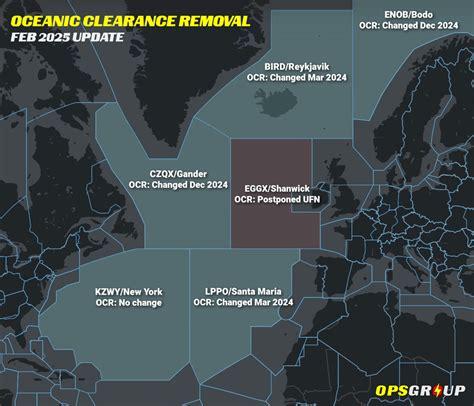
For more than half a century, transatlantic pilots approaching eastern Canada knew there was a very specific moment in the flight when the rules changed. At least 30 minutes before entering North Atlantic oceanic airspace, an eastbound crew would contact Gander Oceanic Control and receive a three-part clearance covering its route, speed, and altitude. The exchange was routine, predictable, and deeply embedded in airline operating procedures. Now, that familiar checkpoint has disappeared.
The change is the result of Oceanic Clearance Removal (OCR), introduced by NAV CANADA across the Gander Control Area on December 4, 2024. Rather than requiring aircraft to stop and obtain a separate oceanic clearance before crossing the boundary, the system allows the existing domestic flight plan and subsequent updates to continue into oceanic airspace. In principle, this creates a smoother transition between domestic and oceanic control. In practice, the first weeks exposed an important lesson: removing a procedure from an air traffic system does not immediately remove the habits built around it.
For pilots who had spent years being trained to expect an explicit clearance before crossing the Canadian coast, the absence of that final confirmation created an unusual psychological and operational gap. Crews knew they were supposed to continue, yet many instinctively wanted someone at Gander to tell them that they were cleared to do so. The result was a temporary increase in radio calls, navigational errors, and uncertainty precisely where the new system was intended to reduce workload.
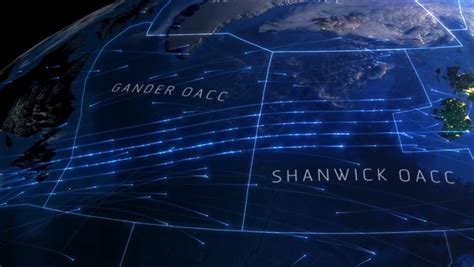
Why Gander Used a 30-Minute Oceanic Clearance
The old procedure existed because North Atlantic oceanic airspace is fundamentally different from the radar environment over land. Once aircraft leave the Canadian domestic system, controllers cannot depend on continuous conventional radar surveillance across the entire ocean. Instead, aircraft trajectories, separation standards, position reports, navigation systems, and communications have to work together with extraordinary precision.
Before OCR, aircraft operating at or above Flight Level 55, or 5,500 feet, were required to obtain a specific oceanic clearance before entering the relevant airspace. The clearance established three critical parameters: the aircraft’s lateral route, its longitudinal speed or Mach number, and its vertical flight level. These were not casual suggestions. They formed the operational framework that allowed Gander Oceanic Control to organize large numbers of aircraft crossing the Atlantic.
The timing was equally important. Crews were expected to make contact at least 30 minutes before reaching the oceanic entry point. If their estimated crossing time changed by three minutes or more, they were required to notify air traffic control. That requirement gave controllers a final opportunity to reconcile the aircraft’s actual trajectory with the planned traffic picture before the aircraft disappeared into the less forgiving oceanic environment.
For generations of crews, the procedure became second nature. The flight plan was filed, domestic controllers managed the aircraft toward the coast, and then the crew obtained the oceanic clearance that effectively served as the final green light. It was a small procedural moment inside a flight lasting seven, eight, or even fourteen hours, but it carried enormous operational significance.
NAV CANADA Replaced the Gate With a Continuous Flight Plan
OCR changed that philosophy. Instead of issuing an independent oceanic clearance immediately before entry, the domestic clearance became the master trajectory. An aircraft leaving Canadian domestic airspace no longer needed to pause for a separate three-element authorization.
The new arrangement also changed the role of the Request Clearance, or RCL, message. Under the revised process, an RCL is transmitted roughly 90 to 60 minutes before oceanic entry, but it functions primarily as a planning message rather than the traditional request for permission to cross the boundary. The aircraft does not wait for the old-style route, speed, and altitude handshake before continuing.
That distinction sounds straightforward on paper. For an airline pilot accustomed to decades of procedural training, however, it represented a major change in cockpit behavior.
The old system effectively created a hard procedural boundary. The new one creates a continuous digital trajectory. Instead of saying, in effect, “Here is your oceanic clearance; now proceed,” the system assumes that the aircraft’s authorized domestic flight plan continues naturally into the oceanic portion of its journey unless updated.
That removes thousands of routine radio and datalink exchanges from an extremely busy part of the North Atlantic system. It also reduces the possibility of aircraft waiting for clearances or entering holding patterns because of congestion at the boundary. But it transfers greater responsibility to the underlying information systems and to the controllers managing traffic while aircraft are still hundreds of miles from the coast.
The First Weeks Exposed a Human-Factors Problem
The early experience demonstrated why aviation procedures cannot be judged only by their technical architecture. Within the first 13 days after OCR began, Gander Oceanic Control and North Atlantic monitoring authorities recorded two significant height deviations and 15 Gross Navigational Errors, according to the reference material.
The issue was not simply that crews failed to understand the new rules. Many pilots understood them perfectly well but continued to behave according to the expectations built by years of training.
Some crews began calling domestic controllers to ask whether they were supposed to be waiting for a clearance. Others sought confirmation that no separate clearance would be issued. Some attempted to verify their routes point by point. What had previously been a short, standardized communication suddenly became a source of uncertainty.
This produced an ironic consequence. A system designed partly to reduce controller workload initially generated additional radio traffic. Domestic VHF frequencies became busier as pilots sought reassurance, while controllers had to spend time explaining a procedure that was specifically designed to eliminate the need for such conversations.
It was a classic human-factors problem. The technology had changed faster than the mental model.
CPDLC Created Another Layer of Confusion
The transition became more complicated when crews received amended oceanic routing through Controller-Pilot Data Link Communications (CPDLC).
One important message format used during the transition could resemble a straightforward instruction to proceed to a particular waypoint via a particular route. The problem was that pilots could interpret the wording differently from the way the system intended it to be understood.
A message formatted along the lines of “CLEARED TO [WAYPOINT] VIA [ROUTE]” could be interpreted by a crew as a direct clearance toward the named waypoint rather than as an instruction involving the complete amended route. That created the possibility that intermediate oceanic waypoints could be deleted from the flight management system or that the revised track might not be loaded correctly.
In an oceanic environment, that is not a trivial data-entry problem. The route programmed into an aircraft’s Flight Management System determines its navigation path, and even a seemingly small misunderstanding can produce a significant lateral deviation over hundreds of miles.
The response was therefore practical rather than theoretical. Gander Domestic FIR controllers began using VHF voice communications for certain pre-oceanic route amendments. Requiring crews to read back the revised waypoints verbally created another layer of confirmation and helped ensure that the correct route was entered before the aircraft crossed the coast.
The irony was hard to miss. A modernization program designed to eliminate a familiar radio exchange temporarily required aviation authorities to bring some of that voice communication back.
OCR Shifted More Responsibility Into Domestic Canadian Airspace
The most important consequence of OCR is not simply that pilots no longer receive the old clearance. It is that oceanic trajectory management begins farther inland.
Aircraft departing airports across eastern North America may be managed by several Canadian flight information regions before reaching the Atlantic. These include Moncton FIR, Montreal FIR, and Gander Domestic FIR. Under the older model, the oceanic center had a distinct opportunity to establish the final oceanic clearance. Under OCR, the domestic and oceanic systems must maintain a much more continuous picture of the aircraft.
This means a speed restriction, vector, altitude change, or other tactical adjustment made while the aircraft is still over land can influence its eventual oceanic trajectory.
The system therefore relies heavily on automated data exchange. Aircraft performance information, flight plans, trajectory updates, and controller instructions must remain synchronized. One particularly important parameter is the aircraft’s maximum flight level, which can change according to fuel weight, temperature, aircraft performance, and other operational factors.
If an aircraft cannot achieve the altitude expected in its flight plan, the system needs to identify the discrepancy early enough for controllers to adjust the aircraft’s profile. A large difference between the aircraft’s available performance and its assigned oceanic altitude can require intervention before the aircraft leaves reliable radar coverage.
That is the hidden infrastructure behind OCR. Passengers may never notice that the traditional clearance has disappeared, but the computers and controllers handling the flight must now communicate continuously to replace the old procedural checkpoint.
The North Atlantic Is Becoming One Connected Traffic System
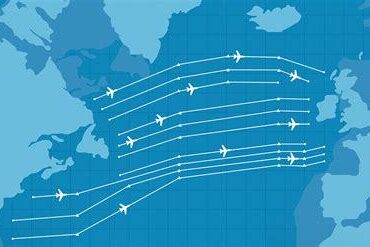
Gander’s change also fits into a much larger transformation in international air traffic management. The North Atlantic is one of the world’s most heavily traveled long-distance aviation corridors, with traffic volumes reaching roughly 2,000 flights per day during peak periods, according to NATS figures cited in the reference material.
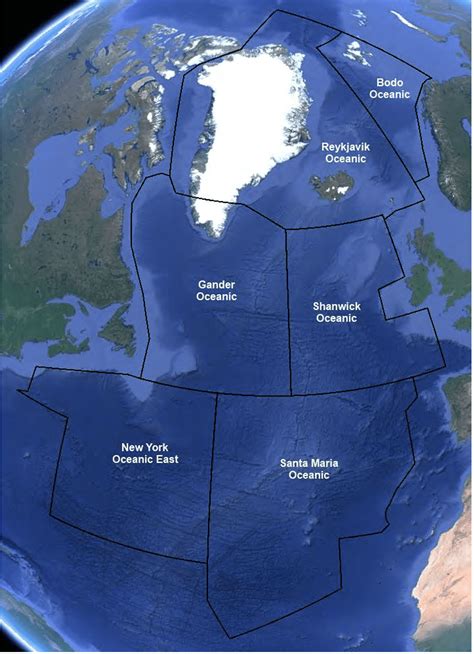
Aircraft crossing the ocean do not remain inside one control system. A flight from New York to London may pass through Canadian domestic airspace, Gander’s oceanic environment, the wider North Atlantic system, and eventually European-controlled airspace such as Shanwick.
Historically, each area could maintain its own procedures and handoff points. Increasingly, modern air traffic management is moving toward Trajectory-Based Operations, in which an aircraft’s entire planned path is treated as a continuously managed trajectory rather than a collection of separate segments.
That approach has obvious advantages. If aircraft trajectories can be exchanged digitally and updated continuously, controllers can make more efficient use of airspace. Airlines can potentially respond more effectively to changing winds, traffic levels, and aircraft performance. Instead of waiting for a fixed clearance point, the network can continuously calculate how aircraft should be separated and routed.
But the price is dependence on the network.
The old clearance system contained a very visible human checkpoint. OCR replaces part of that protection with software, datalink connectivity, synchronized databases, and automated trajectory calculations. If those systems work correctly, the transition can be nearly invisible. If they do not, there may be fewer obvious procedural barriers to catch an error.
Gander’s 2026 Procedures Added a Human Backup
The early problems did not cause NAV CANADA to abandon OCR. Instead, the system evolved.
Under AIP Canada Supplement 052/2026 and updated North Atlantic procedures effective March 19, 2026, Gander formalized additional voice-backup arrangements while continuing to develop the automated process. Gander Domestic FIR and Moncton FIR also resumed delivering loadable CPDLC reroute messages after message syntax and software validation procedures were refined.
This is an important distinction. The old clearance did not simply return. The fundamental OCR philosophy remained in place.
Instead, the system gained additional safeguards around the automated process. Voice communication could provide a reliable fallback when a route amendment required clarification, while validated CPDLC messages could return the efficiency of digital communication without relying on ambiguous wording.
In other words, aviation did what aviation often does best: it kept the modernization but reinforced the weak points exposed by real-world operations.
What the End of the 30-Minute Handshake Really Means
For passengers, almost nothing will look different. A Boeing 787, Airbus A350, Boeing 777, or other long-haul aircraft will still climb away from the North American coast, settle into cruise, and continue toward Europe. There will be no dramatic announcement when the aircraft crosses the old procedural boundary.
For pilots and air traffic controllers, however, the change is profound.
The disappearance of the traditional 30-minute Gander oceanic clearance represents a shift from a checkpoint-based system toward continuous trajectory management. It eliminates a familiar final handshake and replaces it with an assumption that the aircraft’s authorized flight plan remains valid as it crosses from domestic to oceanic airspace.
That makes the system faster and potentially more flexible, but it also demands much stronger synchronization between people, software, aircraft systems, and control centers.
The old method relied heavily on a simple principle: before an aircraft entered the ocean, someone explicitly confirmed its route, speed, and altitude. The new method relies on a more sophisticated principle: those parameters should already be known, synchronized, and continuously updated across the network.
That is why Gander’s quiet procedural change matters far beyond Newfoundland. It is a small but significant example of how aviation is replacing human-performed checkpoints with digitally connected trajectories.
For pilots trained for decades to wait for the final clearance, the hardest part was never learning the new rule. It was learning that there was no longer a green light to wait for. The green light had effectively become part of the system itself.
As transatlantic traffic grows and airspace becomes increasingly dependent on satellite surveillance, datalink communications, and automated trajectory management, the old 30-minute handshake will increasingly resemble an artifact from an earlier generation of aviation. The aircraft still crosses the same ocean, the controllers still protect the same airspace, and the pilots remain responsible for the same flight.
What has changed is where the safety barrier lives: not at the edge of the ocean, but inside the continuously connected system managing the flight long before the aircraft reaches the coast.