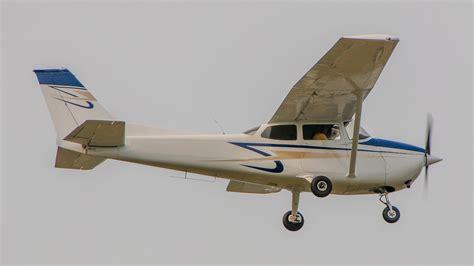
For seven decades, one small, high-wing airplane has defined what it means to learn to fly. The Cessna 172 is not the fastest, the most powerful, or the most glamorous aircraft ever built, yet more than 45,000 airframes have rolled out of Kansas factories, a total no military bomber or fighter has matched. Its story is one of quiet engineering pragmatism, relentless incremental refinement, and an almost perfect alignment with the demands of flight training. Understanding how a four-seat trainer outproduced the Ilyushin Il-2 Sturmovik and the Messerschmitt Bf 109 requires looking deep into Cessna’s corporate history, the design philosophy behind the Skyhawk, and the global aviation ecosystem that still depends on it today.
Cessna’s Early History and the Postwar Boom That Created the 172
Cessna Aircraft traces its origins to September 7, 1927, when founder Clyde Cessna partnered with aviation entrepreneur Victor Roos to form the Cessna-Roos Aircraft Company. The partnership proved short-lived, and the enterprise was soon renamed the Cessna Aircraft Corporation. Ownership changed hands several times across the following decades, with General Dynamics purchasing the company in 1985 and Textron Aviation Inc. acquiring it in 1992, a lineage that explains why the modern Skyhawk still carries the Cessna nameplate on the tail.
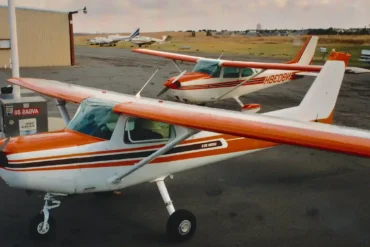
The immediate ancestor of the 172 was the Cessna 170, a conventional tailwheel aircraft that emerged during the light aircraft boom following World War II. As sales of the 170B began to slip, Cessna engineers set to work in near secrecy on a tricycle-gear variant built on the 170C foundation. Harry Clements, an aeronautical engineer involved in developing the 170, later recalled that “quickly, and secretly, work on a tri-gear version began,” and that the next thing he knew, the tri-gear version of the 170 had been introduced under the name 172. Its sales were so strong that the 170 line was essentially discontinued.
That shift coincided with a broader postwar appetite for recreational flying and personal aviation, as Americans sought new forms of leisure and mobility in the air. The 172’s high-wing configuration offered occupants an unobstructed view of the landscape below, a quality that appealed to tourists and sightseers as much as to students, while its practical layout and easy handling made it accessible to pilots of modest experience. From the very beginning, the aircraft was designed to be forgiving rather than demanding.
Longevity Through Adaptability and Seven Decades of Evolution
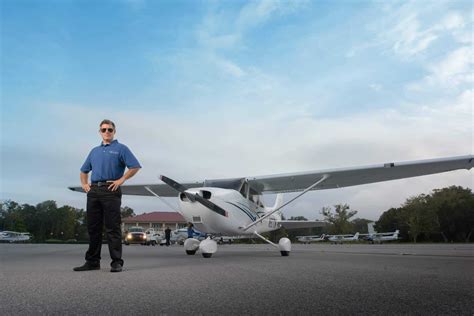
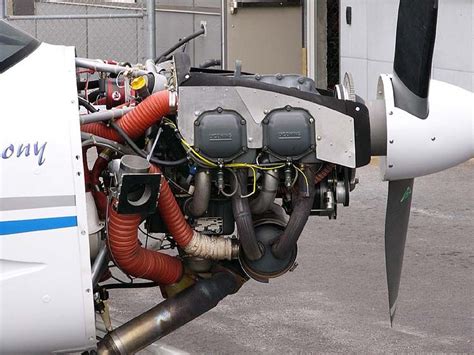
Perhaps the single greatest reason the Cessna 172 has retained its place in private aviation is that Cessna never allowed the design to stagnate. Throughout the 1960s, the 172A through 172I models introduced a swept-back tail, a streamlined cowling, an autopilot, electric flaps, and the Lycoming O-320 engine, which became the standard powerplant for future Skyhawks. Each change was modest on its own, but together they transformed the aircraft from a simple trainer into a genuinely capable cross-country machine.
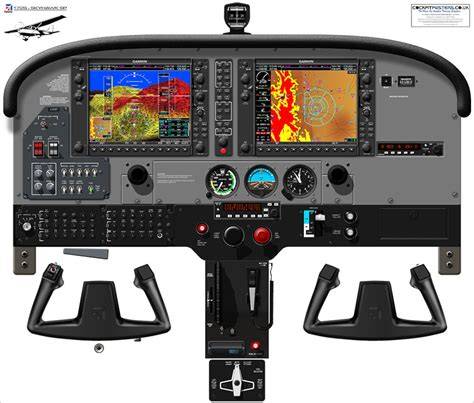
The 1970s brought structural refinements in the 172L through 172N models, including a tubular landing gear strut and the Lycoming O-320-H2AD engine, improvements aimed squarely at durability and maintenance economics in high-cycle training environments. During the 1980s, Cessna installed the Lycoming O-320-D2J engine on 172P models, producing 160 horsepower, before production paused later in the decade and resumed under Textron ownership in the 1990s. From that decade into the early 21st century, the 172R through 172S NAV III introduced further engine and avionics upgrades, most notably the Garmin G1000 glass cockpit, GPS, and advanced autopilot systems.
That compounding evolution explains the staggering production figure. Textron states that 45,000 Skyhawks have been delivered to customers around the world, more than any other aircraft in the industry. The closest competitor by total airframes is the Soviet Ilyushin Il-2 Sturmovik, with 36,183 built during World War II, followed by the Messerschmitt Bf 109 at 34,852. The 172’s margin over those wartime legends was achieved not through mass mobilization but through sustained commercial demand across generations of pilots.
Why the Skyhawk Became the Backbone of Pilot Training
The global airline industry depends on a vast, continuously replenished pool of qualified aviators. According to Airports Council International, some 9.8 billion passengers traveled the globe in 2025, a rise of 3.7 percent over 2024 and 6.5 percent over 2019 levels, drawn from 2,817 airports across more than 180 countries and territories. Airbus expects passenger traffic to grow at an average of 3.6 percent per year through 2044, while Boeing forecasts a requirement for 660,000 new pilots over the 20 years to 2044. Every one of those future captains must begin somewhere.
In the United States, entry to the airline ranks requires an Airline Transport Pilot (ATP) certificate, generally carrying 1,500 hours of flight experience according to the Government Accountability Office. The intake pipeline feeding that requirement has expanded dramatically: the Federal Aviation Administration’s Aerospace Forecast 2026–2046 records that student pilot numbers surged from 128,501 in 2016 to 370,286 by the end of 2025. A very large share of those nearly 400,000 student pilots have sat at the controls of a Cessna 172, and for good reason.
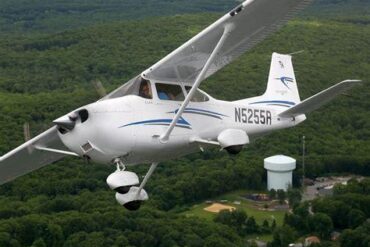
The aircraft’s defining virtues in the training role are structural. Its high-wing configuration grants excellent forward and downward visibility in the traffic pattern, while stable slow-flight performance and responsive handling give students honest feedback without punishing small mistakes. Predictable landing characteristics and a fixed tricycle landing gear eliminate the tailwheel directional-control challenge and retractable-gear distractions that complicate early training. Those same traits reduce stress in the cockpit, letting students build confidence while mastering the fundamentals of flight.
What the Skyhawk Looks Like at 70 and What It Costs Today
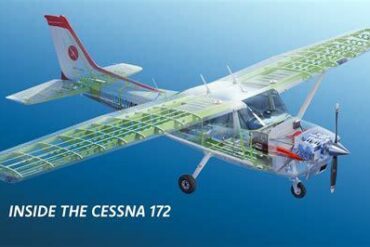
The current production model, the 172S, remains one of the most common aircraft seen at flight schools, universities, and flying clubs worldwide. Its cockpit centers on the Garmin G1000 or G1000 NXi integrated glass avionics suite, making it an ideal classroom for pilots transitioning toward turboprops and business jets that use similar operating concepts. The airframe measures 27 feet 2 inches in length with a wingspan of 36 feet 1 inch and a wing area of 174 square feet, seating up to four occupants with a 120-pound baggage allowance.
Performance figures remain emblematic of the type. The 172S has a maximum takeoff weight of 2,550 pounds, a maximum payload of 870 pounds, and 318 pounds of usable fuel, powered by a Lycoming IO-360-L2A developing 180 horsepower. It cruises at 124 knots true airspeed, reaches a maximum range of 640 nautical miles, climbs at 730 feet per minute, and operates to a service ceiling of 14,000 feet with a maximum limit speed of 163 knots indicated. The cabin uses durable Luxor 2-type seating built to withstand constant training use, alongside large wraparound windows, power headset jacks, and USB outlets for charging electronic flight bags.
Ownership economics have shifted with the aircraft’s reputation. A new 172 typically costs between $450,000 and $550,000 (roughly £337,000 to £412,000), while older models range from $300,000 to $400,000 (about £225,000 to £300,000) depending on condition and equipment. Earning a Private Pilot Certificate generally requires 50 to 70 flight hours spread across three to 12 months. Behind the aircraft sits a support network stocking 140,000 parts, offering a 12-month warranty, and reporting a 99 percent same-day shipping rate on in-stock components.
The Enduring Legacy and Continuing Market Relevance of the Cessna 172
Textron operates a 500,000-square-foot production facility in Independence, Kansas, where nearly 500 full-time Cessna employees worked as of 2013, building the 172 Skyhawk alongside the 182 Skylane and 206 Stationair. That dedicated industrial base, combined with the aircraft’s ubiquity, keeps the type economically viable in a sector where many designs have vanished. In the first half of 2026, Textron Aviation reported $3.03 billion in revenue, up 11 percent year over year, with segment profit rising 9 percent to $319 million.
The 172 has also embedded itself in aviation lore. In 1987, Mathias Rust, an 18-year-old from West Germany, penetrated Soviet air defenses and landed a Cessna 172 near Moscow’s Red Square, a stunt that humiliated the Soviet military and earned him worldwide fame alongside a 14-month prison sentence. Such episodes underline how far a simple, reliable light aircraft can carry a pilot, literally and culturally.
Seventy years after the type’s first flight in 1955, the Skyhawk remains in continuous production, a rare achievement for any machine of the postwar era. Its durability, visibility, predictable handling, and vast parts ecosystem keep it at the center of general aviation and the global pilot-training pipeline. For new students and seasoned owners alike, the Cessna 172 is less a relic of aviation history than a living standard against which every other trainer is measured, and that is precisely how an unassuming four-seater became the most-produced aircraft in history.