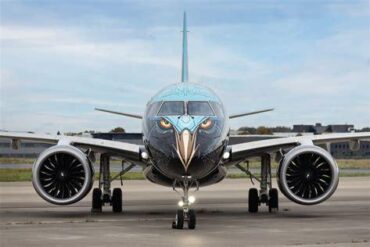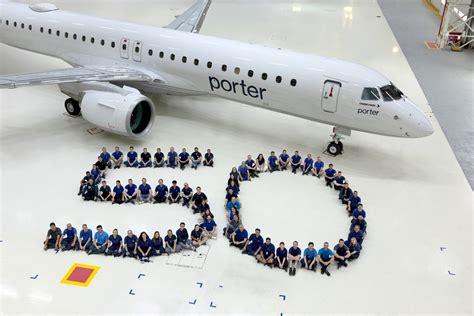
The Embraer E195-E2 was never supposed to become one of the most interesting aircraft for long-distance leisure flying. Born from the E-Jet family and developed primarily around the regional market, it was designed to give airlines a smaller alternative to conventional narrowbody aircraft. Yet the aviation market has a habit of finding new uses for aircraft that engineers originally designed for something else. Today, the E2 is increasingly being used on routes approaching or exceeding 2,000 nautical miles, opening nonstop markets that previously looked too small for a larger Airbus or Boeing jet.
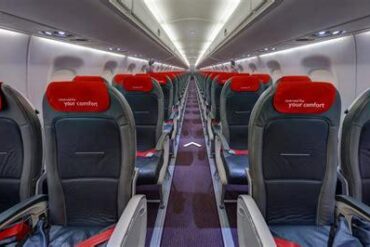
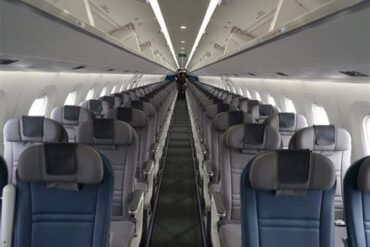
That transformation is particularly important because leisure routes are not always built around enormous passenger volumes. A destination may attract plenty of travelers during holidays, summer vacations, or seasonal peaks without generating enough year-round demand to justify an aircraft carrying 180, 200, or more passengers. The E195-E2 occupies an unusually useful space in that equation. With a capacity of roughly 124 passengers in the configuration highlighted here, it can provide long-range connectivity without forcing an airline to sell hundreds of seats simply to make a route work.
The result is a quiet shift in how airlines think about network planning. Instead of asking whether a market can support a traditional narrowbody, carriers can ask whether it can support a much smaller aircraft with the range to fly directly. That distinction is allowing the E2 family to appear on long and thin routes across Africa, Asia, Europe, and North America, with leisure markets providing some of the most eye-catching examples.
Why the Embraer E195-E2 Is So Well Suited to 2,000-Mile Routes
The fundamental advantage of the E2 is not simply that it can fly far. Plenty of aircraft can cover 2,000 miles. The more important question is whether an aircraft can cover that distance economically with the right amount of capacity.
The E195-E2 combines a relatively small passenger cabin with modern engines, an updated wing, and extensive technological improvements over the original E-Jet family. This gives airlines a tool that sits between traditional regional jets and larger single-aisle aircraft. It does not need the passenger volume of an Airbus A320 or Boeing 737 to make a long route viable, yet it can travel far beyond the distances commonly associated with older regional aircraft.
That creates an especially powerful proposition for airlines pursuing long and thin routes. A market might have enough demand for 100 to 130 passengers but struggle to fill a 180-seat aircraft consistently. Operating the larger aircraft could require aggressive discounting, which damages yields and makes the route harder to sustain. The E195-E2 allows an airline to offer fewer seats while protecting the economics of the service.
There is another advantage: airlines can experiment. Launching a new international route is inherently risky because demand forecasts are never perfect. A smaller aircraft reduces the financial exposure associated with entering an unproven market. If demand grows, frequencies can potentially increase. If demand remains seasonal, the aircraft can move to another route during weaker periods.
This flexibility is helping turn routes that once looked like pipe dreams into realistic network opportunities.
Africa Shows How the E2 Can Challenge Larger Aircraft
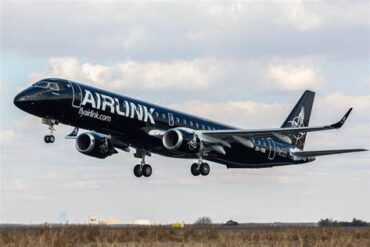
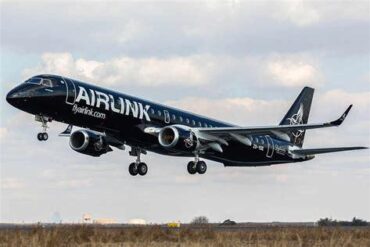
One of the clearest demonstrations of this strategy is emerging in Africa, where Airlink is preparing to launch service between Cape Town International Airport and Sir Seewoosagur Ramgoolam International Airport in Mauritius on October 2, 2026.
The route covers approximately 2,226 nautical miles, or about 4,122 kilometers. That is a substantial distance for an aircraft that originated in the regional-jet category. More importantly, Airlink will enter a market where established airlines already operate larger aircraft. South African Airways uses an Airbus A320, while Air Mauritius operates an Airbus A330.
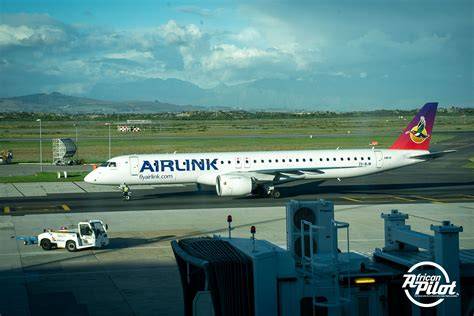
At first glance, putting a 124-seat aircraft against an A330 might seem like a disadvantage. In reality, the difference in capacity can be the central reason the smaller aircraft makes sense. Airlink does not need to replicate the amount of capacity offered by a widebody aircraft. It needs to capture enough passengers at sustainable fares to make its own operation profitable.
That is where the E195-E2 becomes strategically interesting. Low operating costs and modest capacity can allow a smaller carrier to enter markets dominated by much larger competitors without accepting the same level of financial exposure.
The aircraft has already demonstrated its ability to handle demanding long sectors in Africa. Air Peace previously operated the E195-E2 between Lagos and Johannesburg, a route that became notable for its distance as well as the challenging conditions at Johannesburg O.R. Tambo International Airport. Johannesburg’s combination of high elevation and potentially hot temperatures creates additional performance challenges for aircraft.
Although Air Peace no longer operates that route, its historical operation demonstrated that the E2 could handle a demanding mission well beyond the short regional sectors traditionally associated with the E-Jet concept.
Hunnu Air Turns the E2 Into a Long-Distance Leisure Tool in Asia
If Africa demonstrates the E2’s ability to challenge larger aircraft, Hunnu Air provides an especially fascinating example of how the aircraft can support seasonal leisure flying.
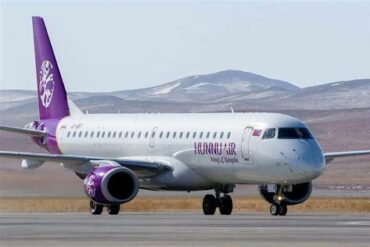
The Mongolian carrier operates from Ulaanbaatar Chinggis Khan International Airport with a small fleet consisting of one ATR 42, two Embraer E190s, and two E195-E2s. Its regular network includes destinations in China, Russia, Japan, Kazakhstan, and Mongolia, but its seasonal charter operations reveal another side of the E2’s capabilities.
Among its most interesting services are seasonal flights to Phu Quoc International Airport in Vietnam. The great-circle distance between Ulaanbaatar and Phu Quoc is approximately 2,245 nautical miles, or 4,157 kilometers.
That distance is remarkable because it puts the flight in territory commonly associated with much larger narrowbody aircraft. The route is roughly comparable in length to some transcontinental services in the United States. Yet an aircraft with a regional-jet heritage and a cabin of only around 124 seats can serve the market directly.

The economics are particularly important for a seasonal leisure route. A charter does not necessarily need the same daily, year-round demand as a major scheduled trunk route. Instead, an airline can deploy capacity when travelers actually want to fly. The E195-E2’s smaller cabin therefore becomes an advantage rather than a limitation.
An A320-family aircraft could provide considerably more seats, but that extra capacity is useful only if the market can absorb it. Otherwise, the airline is paying to transport empty seats. The E2 provides a much closer match between available capacity and actual demand, which is precisely what thin leisure markets need.
Widerøe Proved the Concept in Europe
The E2’s role in long-distance flying is not limited to emerging markets. In Europe, Widerøe has shown how a regional carrier can use the aircraft to expand beyond its traditional geographic boundaries.
Widerøe was the launch operator for the E2 family and remains one of the few airlines operating the smaller E190-E2. The airline has historically focused heavily on short regional services connecting smaller communities in Norway, with turboprops forming the majority of its fleet.
Yet the E190-E2 has allowed Widerøe to stretch that model. The airline previously operated the aircraft between Bergen and Lanzarote in the Canary Islands, a route that lasted around five hours and represented Widerøe’s longest flight.
That operation is significant because the airline did not need to transform itself into a conventional mainline carrier to offer such a service. It could retain its regional identity while using a relatively small jet to connect Norwegian passengers with a major leisure destination.
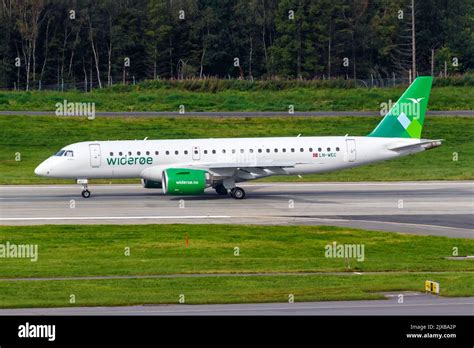
Although the Lanzarote route is no longer operating, the underlying concept remains relevant. Widerøe continues to use its E2 aircraft for international services to destinations including France, Germany, and Ireland. The strategy connects communities that might otherwise require a connection through a much larger European hub.
For passengers, that means less connecting and more nonstop flying. For Widerøe, it means the E2 can serve as a bridge between its traditional regional network and international markets without requiring the airline to operate a fleet of much larger narrowbodies.
Porter’s E195-E2 Strategy Is Changing Canadian Network Planning
North America offers perhaps the most dramatic example of how the E195-E2 can change an airline’s identity.
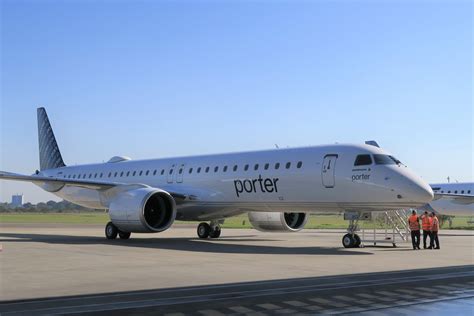
Porter Airlines traditionally built its business around turboprops and short-haul services from Billy Bishop Toronto City Airport. Its downtown Toronto location provided a major competitive advantage, but the airport’s restrictions on jet operations limited Porter’s ability to expand its network using conventional aircraft.
The airline responded by ordering 75 E195-E2s and using the aircraft to pursue a much broader national strategy.
Porter’s current longest route is between Montreal-Trudeau International Airport and Vancouver International Airport, covering approximately 1,994 nautical miles, or 3,693 kilometers. The market is heavily contested, with Air Canada offering multiple daily services and Flair Airlines also competing for passengers.
Yet Porter does not need to match the capacity of its larger rivals to compete effectively. The E195-E2 allows the airline to provide nonstop service while carrying substantially fewer passengers per flight.
This matters because airline profitability is not simply a contest over who can put the most seats into the sky. If an airline operates too many seats for the available demand, fares can fall as carriers compete to fill their cabins. A smaller aircraft can protect yield integrity by limiting the amount of capacity placed into the market.
Porter’s E195-E2 therefore gives the airline a useful combination of range and capacity. It can compete on long domestic routes without necessarily accepting the economics of a much larger narrowbody. Even when a route is strategically valuable before it becomes highly profitable, the smaller aircraft can reduce the cost of maintaining that market presence.
Embraer E2 vs. Airbus A220: The Real Battle Is About Mission
The E195-E2 is frequently compared with the Airbus A220, and there is good reason for that. Both aircraft offer long range, modern technology, relatively low operating costs, and the ability to serve markets that fall below the natural size of traditional narrowbodies.
However, treating them as direct substitutes in every situation misses an important part of the story.
The A220 family has accumulated more than 1,100 orders in the reference material, with approximately 998 orders for the A220-300 and 108 for the A220-100. Embraer’s E2 family has accumulated 532 orders, including 464 for the E195-E2 and 68 for the E190-E2.
The numbers suggest that Airbus has won the broader sales battle. But they also show why headline order totals can be misleading. Around 90% of A220 orders are for the A220-300, which is considerably larger than the E195-E2 and competes more directly with aircraft such as the Airbus A319neo and Boeing 737 MAX 7.
The E195-E2 occupies a particularly interesting position because its smaller capacity makes it useful for missions where a larger aircraft may simply be too much airplane. The E190-E2 goes smaller still, allowing operators such as Widerøe to serve markets where even the E195-E2 would provide more capacity than necessary.
In other words, the competition is not merely about which aircraft has the best specifications. It is about matching the aircraft to the route.
Why Long-Haul Leisure Routes Are Becoming More Important
The growth of E2 operations on 2,000-mile leisure routes reflects a broader change in airline economics. Travelers increasingly value nonstop service, even between cities that previously relied on connections through major hubs.
That creates opportunities for airlines to identify underserved city pairs and connect them directly. Leisure travelers are particularly valuable in this respect because demand can be highly seasonal. A destination may have intense demand during school holidays or peak vacation periods while producing much weaker traffic during other months.
A 124-seat aircraft can respond to that pattern far more effectively than a 200-seat narrowbody. Airlines can schedule fewer seats, preserve fares, and potentially shift aircraft between markets as demand changes.
The E195-E2 is therefore becoming more than a regional jet. It is evolving into a network-development tool, allowing carriers to test markets, add international destinations, and build passenger demand without making the enormous capacity commitment associated with a conventional narrowbody.
The Quiet Expansion of the E2 May Be Its Biggest Strength
The most remarkable aspect of the Embraer E2’s rise is that it does not require a dramatic revolution in airline operations. It simply solves a very specific problem extremely well.
There are thousands of potential city pairs around the world where demand is too small for a large narrowbody but too distant for many traditional regional aircraft. These routes exist in the gap between regional aviation and mainline aviation. The E2 fits into that gap with unusual precision.
From Cape Town to Mauritius, Ulaanbaatar to Phu Quoc, Bergen’s former service to Lanzarote, and Porter’s Montreal-Vancouver operation, the pattern is increasingly clear. Airlines are using the aircraft to stretch regional connectivity across distances once considered the territory of larger jets.
That does not mean the E195-E2 will replace the A320, 737, or A220. Larger aircraft remain essential where demand is strong. Instead, the E2 is expanding the number of routes that airlines can consider in the first place.
Its real achievement may therefore be less about flying 2,000 miles and more about making 2,000-mile routes economically possible with only about 124 seats. Across four continents, that capability is quietly reshaping the definition of what a regional jet can do.