In an age where drone technology has become commonplace in everything from photography to warfare, a Japanese innovation is turning heads for its singular, surprising purpose. The BB102 drone, developed by NTT e-Drone Technology, isn’t here to deliver packages or spy on adversaries. It’s not even designed to treat disease. Instead, its mission is to prevent a deadly agricultural epidemic before it ever reaches the coop: Avian Influenza.
Avian Flu: A Persistent Threat to Japan’s Livestock Industry
Avian Influenza, more commonly known as bird flu, continues to devastate livestock populations around the globe. In early 2025, Japan’s Chiba prefecture alone saw over 3 million chickens infected, with the total count reaching nearly 5 million within months. The virus not only wipes out poultry populations but also poses a serious threat to humans—particularly farmers working in close quarters with infected birds.
While vaccines and biosecurity measures exist, the speed and scope of Avian Flu outbreaks demand more proactive prevention. That’s where the BB102 drone enters the picture—not with syringes or medicine, but with high-tech lights and strategic flight paths.
The Singular Purpose: Scare Off the Carriers Before the Virus Arrives
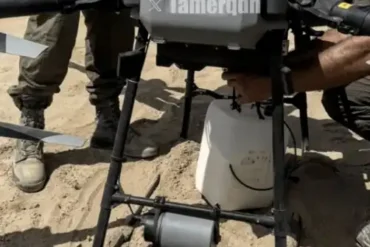
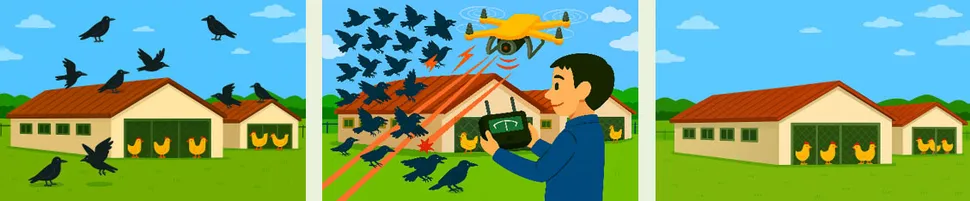
Unlike conventional agricultural drones designed for crop spraying or imaging, the BB102 has one job: to patrol farms and scare away birds that carry the Avian Flu virus. These include pigeons, crows, and various waterfowl, all of which can introduce the virus to otherwise healthy livestock.
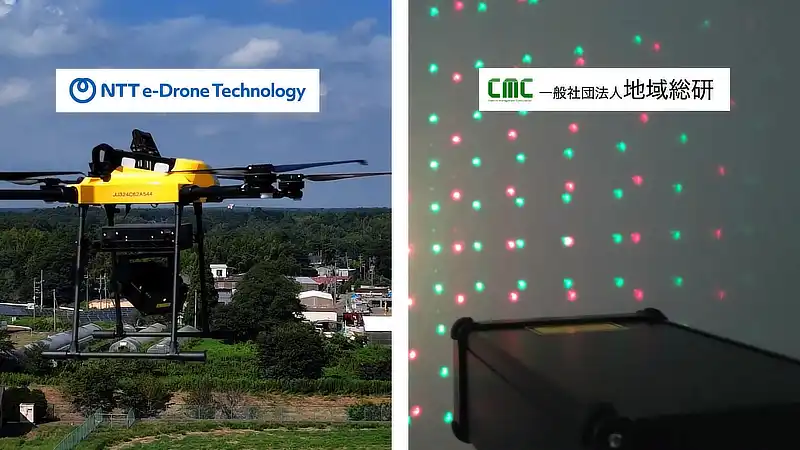
But this drone doesn’t use sound cannons or nets. Instead, it harnesses a highly specialized laser array system to create a visual deterrent. When unwanted birds enter the drone’s patrol zone, the BB102 unleashes a brilliant light display of red and green lasers, pulsing in randomized patterns that disorient and frighten off intruders.
The method isn’t just a gimmick. Studies have shown that red and green light frequencies are particularly disturbing to many bird species, triggering flight responses without causing them harm. This allows the BB102 to protect the health of animals and farmers alike, all while operating autonomously.
Behind the Tech: What Makes the BB102 Unique
At the heart of the BB102 is its autonomous flight AI combined with bird-detection sensors. It’s designed to continuously patrol a defined perimeter around a farm, scanning the skies for aerial activity. Once a potential threat is spotted, the drone targets the zone with a pre-programmed laser deterrent sequence, sending flashing red and green beams across the area.
Key features include:
- Fully autonomous patrol capability, with customizable geofencing
- Multi-angle laser projection system, optimized for visibility at various altitudes
- Rechargeable power system with solar-assisted docking station
- Quiet propulsion mechanisms to reduce noise disturbance
This isn’t a generic drone retrofitted with lights. The BB102 was built from the ground up for this specific mission. Every design element—from its hover stability to battery longevity—was engineered to maximize its avian deterrent capacity.
From Research to Real-World Deployment: Government-Backed Protection
The drone’s origin story lies not in a lab, but in the urgent demand of Japanese poultry farmers suffering catastrophic losses. NTT e-Drone Technology responded by collaborating with agricultural experts, disease researchers, and robotics engineers to conceptualize and test a model that could provide real-world relief.
As news of its success spread, local governments in Japan began offering subsidies to encourage farm-wide adoption of the BB102. Municipal support has been critical, as not every farm can shoulder the upfront cost of high-tech protection. With financial assistance, even small to mid-sized farms can now implement an automated avian defense system.
This government-backed push serves a dual purpose: it helps protect the national poultry supply chain, and it mitigates the risk of zoonotic disease transfer to humans—something health authorities increasingly monitor in the post-COVID era.
A Sustainable and Humane Approach to Disease Control
Traditional bird control methods often rely on netting, sound cannons, or chemical repellents. These approaches can be harmful, expensive, or ineffective over long periods. Netting is restrictive and prone to wear. Cannons disturb other wildlife and communities. Chemicals raise ethical and environmental concerns.
The BB102 sidesteps these pitfalls. It’s a non-lethal, non-invasive, and environmentally sustainable approach. By leveraging light and motion—a natural deterrent—the system aligns with evolving values around ethical agriculture and humane pest control.
Moreover, because it operates autonomously, it minimizes the need for farmer intervention, reducing labor costs and human exposure to potential disease vectors.
Scalability and the Future of Agricultural Drones in Asia
Although the BB102 is currently most prominent in Japan, its implications ripple across all of Asia. Countries like South Korea, Vietnam, and Thailand, which also grapple with seasonal Avian Flu outbreaks, are closely monitoring the BB102’s performance.
If successful at scale, the BB102 could become a blueprint for disease prevention drones across agriculture—not just for poultry, but for swine flu prevention, cattle virus containment, and even orchard pest control. The modular design of the drone means future iterations could be tailored to different species and environments.
NTT e-Drone Technology has hinted at future models incorporating thermal imaging, UV disinfection, and automated reporting tools for farmers to assess real-time threat levels.
Challenges and Limitations: It’s Not a Silver Bullet
Despite its innovation, the BB102 is not a complete solution to the Avian Flu crisis. For one, it cannot detect infected birds already within a flock. Its role is preventive, not curative. Additionally, drones require regular maintenance, software updates, and trained personnel for optimal operation.
Another limitation lies in coverage area. A single drone can only monitor a finite zone, so large farms may require multiple units. This brings up cost, deployment logistics, and synchronization across devices.
Finally, while red and green lasers are proven deterrents, birds can adapt over time. To counteract this, the BB102 uses randomized strobe patterns and variable timing, but long-term studies are still in progress to gauge the effectiveness over multiple seasons.
Conclusion: A High-Tech Guardian of the Coop
The BB102 represents a paradigm shift in disease prevention in modern agriculture. It’s a rare example of technology serving a singular, yet critically important function—defending livestock and human health from one of the most persistent viral threats in the farming industry.
With the support of local governments, the backing of agricultural science, and the ingenuity of Japanese engineering, the BB102 is setting a precedent that may soon become standard operating procedure across global farms.
As climate change accelerates the mutation and spread of zoonotic diseases, solutions like the BB102 may very well determine how well-prepared humanity is for the next agricultural epidemic.