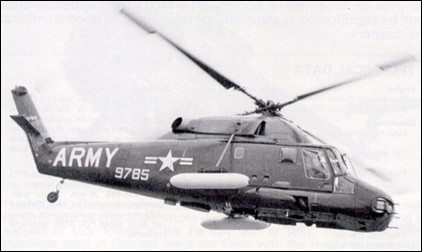
The Kaman H-2 “Tomahawk” remains one of the most compelling and often overlooked rotary-wing innovations of the Vietnam era—a project born from urgency, marked by ingenuity, and ultimately abandoned not for performance, but politics. Conceived as a low-cost interim gunship, the Tomahawk was a response to the United States Army’s need for a reliable armed helicopter while purpose-built attack aircraft were still under development.
Origins of the Kaman H-2 Tomahawk: The Tactical Gap
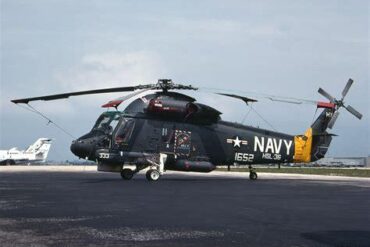
In the early 1960s, the U.S. Army faced a critical tactical shortfall. The Bell UH-1 “Iroquois” was already in service, yet its limitations in payload, survivability, and integrated firepower made it inadequate for the intensifying conflicts in Southeast Asia. Meanwhile, development delays plagued advanced attack helicopters like the AH-56 Cheyenne. In this vacuum, Kaman Aircraft Corporation seized the opportunity to repurpose its Navy UH-2A Seasprite into a capable armed platform suitable for land warfare.
The concept of the H-2 “Tomahawk” took shape swiftly. By October 1963, a prototype was already under evaluation by the Army Aviation Test Board. While not a bespoke attack helicopter, it was cleverly optimized for its role, acting as a bridge between aging utility platforms and future air cavalry assets.

Design Innovations: Weaponizing the Seasprite
Where the standard UH-2A served as a maritime utility craft, the Tomahawk was aggressively reimagined for combat. Its reconfiguration focused on firepower, protection, and modular adaptability:
- Chin-Mounted Gun Turrets: The Tomahawk featured twin 7.62mm machine guns in chin turrets. These could be operated independently or linked to engage the same target simultaneously, a feature uncommon for the period.
- Door Gunner Armament: A single M60 machine gun manned by a crew member in the side door allowed suppression of threats during troop insertion or extraction.
- Rocket Pods: Short stub wings extended from the fuselage, supporting up to four 7-tube launchers for 2.75-inch rockets—offering considerable strike capacity for ground support.
- Enhanced Armor: Combat survivability was addressed with armor plating around the cockpit, engine, transmission, and fuel tanks, reinforcing critical areas against small arms fire.
- Modern Avionics: Army-standard navigation and communication systems replaced naval configurations, ensuring compatibility with ground units.
These upgrades transformed the UH-2’s original role from a maritime workhorse to a rugged battlefield enabler.
Flight Performance and Technical Data
Despite its reconfiguration, the Tomahawk retained impressive flight dynamics, thanks to the robust UH-2 airframe and its General Electric T58-GE-8 turboshaft engine, delivering 930kW of power.
- Max Speed: 260 km/h
- Cruising Speed: 245 km/h
- Range: 1070 km
- Service Ceiling: 5300 m
- Empty Weight: 2886 kg
- Max Take-off Weight: 4060 kg
- Rotor Diameter: 13.41 m
- Fuselage Length: 11.15 m
- Height: 4.11 m
- Crew: 3
These figures placed the H-2 Tomahawk ahead of the UH-1 in several key performance metrics, especially in range and altitude capabilities.
Army Evaluation: High Marks, Unrealized Potential
The Tomahawk underwent extensive testing in late 1963. Evaluators from the Army Aviation Test Board found the aircraft’s performance to be exceptional, especially given its rapid development cycle and cost-effectiveness. They concluded that it would serve well in combat scenarios, fulfilling the immediate requirement for a stop-gap attack platform.
Encouraged by the trials, the U.S. Army obtained Congressional approval to purchase 220 aircraft. For a brief moment, Kaman’s helicopter appeared destined to play a central role in America’s evolving airmobile doctrine. But history would take a different turn.
The Political Kill Switch: End of the Tomahawk Program
In a twist emblematic of Cold War-era defense procurement, the Tomahawk program was abruptly terminated in the wake of President John F. Kennedy’s assassination in November 1963. With Lyndon B. Johnson assuming the presidency, a distinct shift in priorities unfolded.
The UH-2-based Tomahawk—produced by Connecticut-based Kaman—was soon abandoned in favor of continuing procurement of the Texas-manufactured Bell UH-1, a move widely viewed as politically motivated. The Iroquois, although less advanced in some respects, had a more established production line and field history. It was the safer bet in a time of national uncertainty.
Legacy of Innovation: What the Tomahawk Left Behind
Though it never saw mass production or combat deployment, the H-2 Tomahawk’s influence resonated across multiple facets of military aviation. Its modular architecture and emphasis on survivability, adaptability, and rapid conversion foreshadowed design principles later seen in helicopters like the AH-64 Apache and UH-60 Black Hawk.
More specifically, the Tomahawk contributed to the following:
- Advancement in Modular Weapon Mounts: The stub-wing hardpoints provided a template for modern modular pylons.
- Crew-Centric Defensive Systems: Placing the door gunner in a suppressive fire role became a mainstay in tactical helicopter design.
- Cost-Balanced Innovation: Demonstrated that effective armed platforms could be derived from existing airframes with limited resources.
- Combat System Integration: Proved that integrating Army-standard equipment into Navy-derived airframes was both feasible and effective.
Comparative Context: The Tomahawk vs. the Huey
While the Tomahawk offered superior firepower customization and defensive enhancements, the Bell UH-1 enjoyed logistic advantages that no amount of innovation could overcome. The Huey had:
- A proven battlefield record, especially by 1964.
- Established maintenance networks.
- A broader base of trained personnel.
- Political backing tied to industrial geography and post-assassination national stability.
In this context, the H-2 Tomahawk became a victim of timing and strategy, not technical deficiency.
Conclusion: The Ghost in the Rotor Wash
The Kaman H-2 “Tomahawk” serves as a reminder of the delicate balance between innovation and political expediency in military procurement. Developed swiftly, equipped with forward-thinking systems, and backed by positive evaluations, it had every hallmark of a platform destined for relevance.
Yet in the swirling complexities of Vietnam-era defense strategies and political reshuffling, the Tomahawk was grounded—a prototype consigned to history before it could leave its mark in combat. Still, its brief existence was not in vain. It stood as a proof of concept, influencing the future of helicopter gunship development and highlighting the role of adaptability in aerospace engineering.