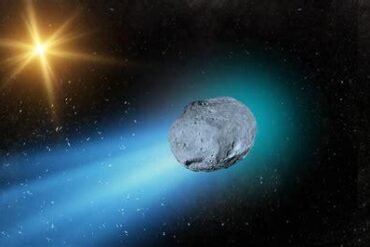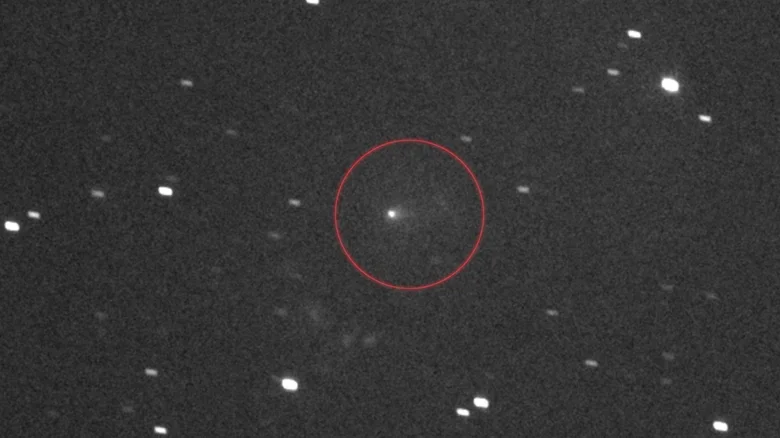
The newly released NASA imagery of interstellar comet 3I/ATLAS offers the most refined look yet at a cosmic object that has crossed unimaginable distances to drift through our neighborhood. As the third confirmed interstellar visitor in recorded history, 3I/ATLAS presents a rare opportunity to examine material that likely predates the formation of our own solar system. The latest photographs, captured from late September through mid-October, expand the scientific archive with striking clarity, enabling detailed assessments of the comet’s structure, composition, and trajectory.
High-Resolution Imaging From Multiple NASA Platforms
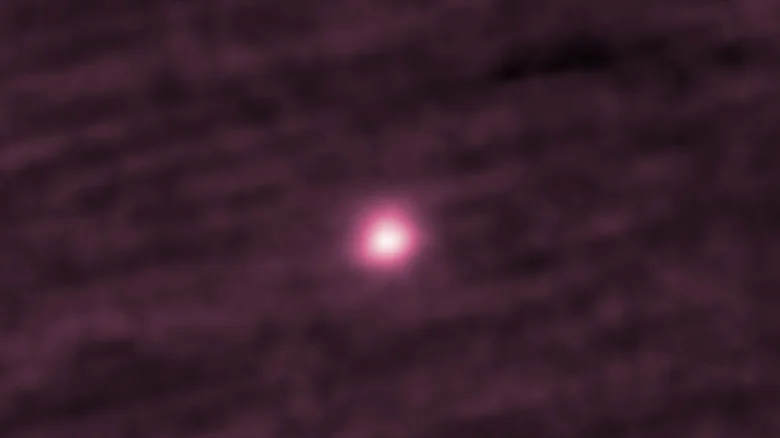
The new visuals come from an array of NASA assets positioned across the solar system, each offering a distinct vantage point. The PUNCH sun-observing satellites traced the comet’s shimmering silhouette as it cut across heliospheric light. The Solar and Heliospheric Observatory captured subtle changes in brightness that hint at evolving outgassing patterns. MAVEN, orbiting Mars, provided colorized data on reflected solar radiation, while the Perseverance rover delivered surface-level perspective from the Red Planet itself, photographing 3I/ATLAS against the thin Martian sky. These complementary angles enrich the dataset and elevate the scientific value of every frame.
International Observatories Join the Effort
New contributions have also emerged beyond U.S. borders. The ESA and Roscosmos ExoMars Trace Gas Orbiter captured refined contrast images that reveal a faint, elongated smudge extending behind the comet—a delicate but unmistakable tail sculpted by solar wind. These multi-agency visuals deepen the global effort to monitor 3I/ATLAS as it moves through the inner solar system.
At present, the comet is too close to the sun to be observed with ground-based telescopes, but that visibility gap will close soon. When 3I/ATLAS sweeps past Earth on December 19, it will be observable once more through advanced instruments including the James Webb Space Telescope and the W.M. Keck Observatory. Researchers anticipate unprecedented insights as the comet brightens and comes into optimal range.
Interstellar Visitors Are Incredibly Rare
Although speculation continues to swirl about possible extraterrestrial origins or technologies, NASA officials have made the nature of 3I/ATLAS abundantly clear. According to Nicky Fox, associate administrator of NASA’s Science Mission Directorate, there is no evidence of artificial signatures. Every measurement so far is consistent with a naturally occurring comet. Even so, the scientific intrigue remains powerful, because 3I/ATLAS represents raw material forged outside our solar system—potentially remnants of long-disrupted planets or early protoplanetary disks in distant star systems.
Its appearance marks only the third time astronomers have confirmed the arrival of an object from another star. The first—1I/’Oumuamua in 2017—helped reveal the existence of a family of dark comets. The second, 2I/Borisov, dazzled observers with a textbook cometary tail. Now, 3I/ATLAS continues this pattern of revelation, delivering new insights with each passing milestone.
Upcoming Flyby Promises Extensive Scientific Discovery
Researchers expect the upcoming Earth flyby to unlock detailed measurements of the comet’s chemical profile, surface reflectivity, velocity fluctuations, and possibly its original star system. Already, astronomers have detected significant carbon dioxide within its coma—an ingredient that reveals much about the comet’s temperature history and formation environment. Early studies also suggest that its acceleration may not be solely gravitational, raising questions about sublimation processes and the internal structure of its nucleus.
Despite its dramatic arrival, 3I/ATLAS poses no danger to Earth. Its trajectory keeps it a comfortable 170 million miles from our planet—a safe distance by cosmic standards. Scientists view this pass as a rare scientific gift, one that will help contextualize how our solar system fits within the broader galactic ecosystem.
As the mid-December window approaches, expectations continue to build for a wave of new findings. With each observation, the comet enriches our understanding of the forces that sculpt worlds—both near and unimaginably far.