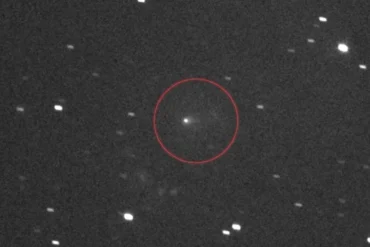
The sudden arrival of Comet 3I/ATLAS triggered a wave of fascination that spread far beyond astronomy circles. Its extreme speed, unusual trajectory, and subtle but measurable deviations from expected motion invited speculation that bordered on science fiction. For a brief moment, the idea that humanity had intercepted evidence of alien technology felt plausible to some observers, especially when prominent scientists entertained the question publicly. Yet new research has shifted the conversation decisively back toward physics, chemistry, and the well-documented behavior of comets.
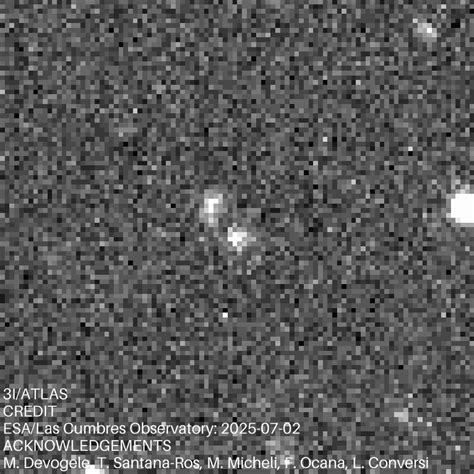
Discovered in mid-2025 by the Asteroid Terrestrial-impact Last Alert System (ATLAS) telescope in Chile, 3I/ATLAS immediately stood out. Its hyperbolic orbit proved it originated outside our solar system, making it only the third confirmed interstellar object ever observed passing through the Sun’s gravitational domain. That rarity alone guaranteed attention, but its motion raised deeper questions. Unlike typical comets, 3I/ATLAS displayed slight accelerations that could not be fully explained by gravity alone, reigniting memories of earlier cosmic enigmas.
The debate intensified when these anomalies echoed the strange behavior of ʻOumuamua, the interstellar object detected in 2017. Then, as now, unconventional explanations gained traction, partly because the data challenged standard assumptions. What separates 3I/ATLAS from its predecessor, however, is the unprecedented level of observational precision achieved during its passage, enabling scientists to test exotic hypotheses against hard measurements rather than conjecture.
Why 3I/ATLAS Looked Suspicious at First
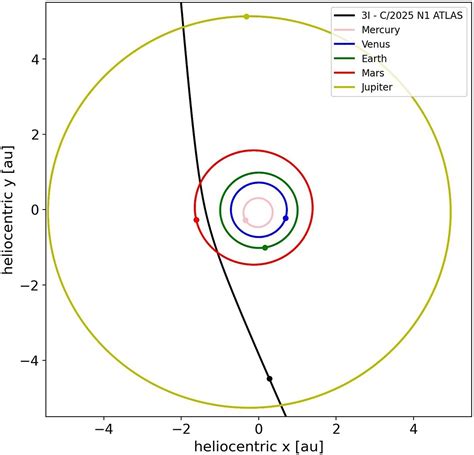
From the start, 3I/ATLAS seemed to defy expectations. Its path through the solar system was retrograde, cutting against the plane in which most planets orbit. Even more intriguing was the statistical unlikelihood of its route, which passed unusually close to Venus, Mars, and Jupiter. Some calculations suggested that such an alignment would occur only a tiny fraction of the time, lending apparent weight to arguments that the object’s motion might be intentional rather than natural.
Physical characteristics also fueled speculation. Estimates placed the comet’s nucleus anywhere from 1,400 feet to several miles in diameter, wrapped in a luminous coma of dust and gas. As it accelerated to speeds exceeding 150,000 miles per hour, observers detected small but persistent deviations from purely gravitational motion. To critics of conventional explanations, these deviations resembled controlled maneuvers rather than passive responses to solar forces.
The situation escalated when a faint radio signal was detected emanating from the object in late 2025. Although later analysis suggested natural origins, the timing was enough to ignite online theories and media headlines. For those inclined to see intention where uncertainty exists, 3I/ATLAS appeared to be whispering secrets from another civilization.
The Harvard Hypothesis and the Alien Technology Debate
Few figures shaped the public narrative more than Avi Loeb, a Harvard astrophysicist known for challenging orthodox interpretations of cosmic anomalies. In a theoretical paper and subsequent media appearances, Loeb explored whether 3I/ATLAS could represent non-human technology, framing the idea as a speculative exercise rather than a firm conclusion. He pointed to the improbability of the comet’s orbital parameters and its conveniently obscured perihelion as circumstantial evidence worth examining.
Loeb’s arguments drew on the “Dark Forest” theory, which proposes that advanced civilizations remain silent to avoid detection by potential threats. Within this framework, a stealthy interstellar probe passing quietly through another star system would make strategic sense. While the hypothesis captivated audiences, many researchers cautioned that improbability alone does not imply artificial origin, especially when dealing with limited samples of rare phenomena.
Measuring the Motion That Settled the Question
The decisive shift came with a study led by T. Marshall Eubanks and an international team of astronomers, submitted to Research Notes of the AAS. Using data from the European Space Agency’s Mars Trace Gas Orbiter and NASA’s Psyche spacecraft, the researchers achieved something previously thought impractical: direct measurement of the comet’s non-gravitational acceleration without observing multiple orbital passes.
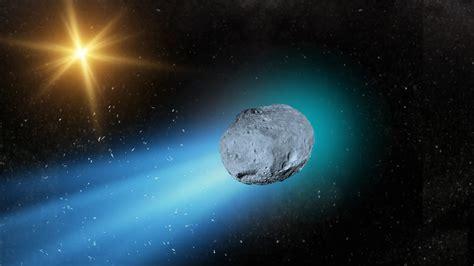
These measurements revealed accelerations amounting to mere hundred-millionths of Earth’s gravity, subtle yet unmistakable. Crucially, the magnitude and direction of these forces matched patterns long observed in ordinary comets. The culprit was outgassing, a process in which volatile ices vaporize under solar heating, ejecting jets of gas that act like tiny thrusters. Far from being evidence of propulsion systems, the data aligned perfectly with natural cometary physics.
Outgassing: A Mundane Explanation With Profound Implications
Outgassing may sound anticlimactic compared to alien probes, but its explanatory power is immense. As a comet approaches the Sun, uneven heating causes localized eruptions across its surface. These jets alter rotation, speed, and trajectory in ways that can appear erratic without detailed modeling. In the case of 3I/ATLAS, the observed deviations were not only expected but typical, according to the study’s authors.
Eubanks himself dismissed sensational interpretations, noting that nothing about the data broke known records or required extraordinary explanations. Instead, the findings reinforced confidence in long-standing models of comet behavior, even when applied to objects born around distant stars. What once seemed mysterious now reads as a textbook example of physics operating under unfamiliar conditions.
What 3I/ATLAS Really Teaches Us About the Cosmos
While the alien hypothesis has largely been laid to rest, 3I/ATLAS remains scientifically invaluable. As an interstellar visitor, it offers a rare sample of material formed around another star, carrying chemical clues about environments far beyond our reach. Studying its composition and behavior helps astronomers refine theories of planetary formation across the galaxy.
The comet’s legacy, then, is not disappointment but insight. It demonstrates how quickly speculation can arise when data are scarce, and how decisively careful measurement can resolve even the most tantalizing questions. As 3I/ATLAS continues its journey, with a close pass by Jupiter expected in March 2026, it stands as a reminder that the universe is often more subtle, and more fascinating, than our boldest fantasies.