Nondestructive Testing (NDT) plays a vital role in aviation safety and maintenance. As a method to inspect components without causing damage, it ensures aircraft integrity while minimizing downtime. The process of NDT certification in aviation is complex, regulated, and essential for professionals who wish to specialize in aircraft maintenance and inspection. In this article, we explore in detail how technicians can pursue certification, what standards apply, and the levels of qualification available.
What Is NDT and Why It Matters in Aviation
Nondestructive Testing refers to a series of methods used to evaluate the condition of aircraft parts without altering their physical structure or performance capabilities. As defined in FAA Advisory Circular 65-31A, it encompasses any tests or evaluations performed to determine integrity, composition, or properties—electrical, thermal, or dimensional—without causing permanent changes to the part.
In the aviation industry, where safety is paramount, NDT ensures that critical components are inspected regularly and accurately, helping prevent mechanical failures and maintaining compliance with strict airworthiness standards.

Key Standards for NDT Certification in Aviation
To pursue NDT certification, technicians must adhere to internationally recognized standards and guidelines. Among the most authoritative references are:
- FAA Advisory Circular 65-31A – Offers guidance for training and certifying NDI personnel in aviation.
- AIA NAS 410 – Issued by the Aerospace Industries Association, this is a primary standard for NDT personnel certification in aerospace applications.
- ATA Specification 105 – Published by the Air Transport Association, outlining qualification guidelines.
- ISO 9712 – The International Organization for Standardization’s benchmark for global NDT personnel qualification.
- CAN/CGSB-48.9712 – A Canadian national standard equivalent to ISO 9712.
- ASNT SNT-TC-1A – A recommended practice from the American Society for Nondestructive Testing.
These standards serve as the foundation for training programs and internal company practices. While some organizations develop their own written practices, alignment with one or more of these standards is critical for FAA acceptance.
Is FAA Certification Required to Perform NDT?
A common misconception among Airframe and Powerplant (A&P) mechanics is that their license inherently allows them to conduct all forms of NDT. However, Federal Aviation Regulation 65.81(a) makes it clear that unless the mechanic has previously performed the specific NDT task, they must demonstrate proficiency under supervision.
Thus, being an A&P alone does not qualify one to perform NDT independently. Skill, training, and procedural compliance are mandatory. Interpreting NDT results requires experience that goes beyond one-time performance under supervision.
NDT Testing Methods Used in Aviation
Aviation applications primarily use five nondestructive testing methods:
- Radiographic Testing (RT) – Uses X-rays or gamma rays to inspect internal structures.
- Magnetic Particle Testing (MT) – Detects surface and near-surface discontinuities in ferromagnetic materials.
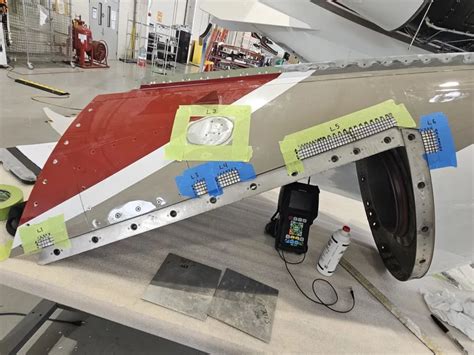
- Ultrasonic Testing (UT) – Uses high-frequency sound waves to detect internal flaws.
- Liquid Penetrant Testing (PT) – Identifies surface-breaking defects using dye solutions.
- Eddy Current Testing (ET) – Uses electromagnetic induction to locate surface and near-surface flaws.
Each method requires its own specialized training and certification. Technicians must become proficient in the setup, calibration, performance, and interpretation associated with the chosen method.
Understanding NDT Certification Levels: From Entry to Expert
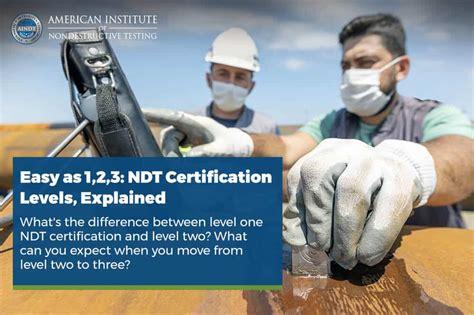
Most NDT certification frameworks, regardless of standard, classify proficiency into three main levels:
Level I
This is the entry point, where personnel can:
- Follow procedures to perform specific tests.
- Calibrate equipment and record results.
- Receive supervision from Level II or III personnel.
Level I may also include a “Special” category for task-specific duties under controlled conditions.
Level II
Technicians at this level:
- Set up and standardize testing equipment.
- Conduct tests and interpret results.
- Provide training and supervision to Level I personnel.
- Understand the limitations of the testing methods they use.
Level III
The highest level of qualification, Level III professionals are responsible for:
- Interpreting regulatory codes and standards.
- Designing inspection procedures and selecting appropriate methods.
- Evaluating new techniques and validating equipment.
- Overseeing the training and qualification of all NDT personnel within their organization.
How to Get Certified: Training Pathways and Providers
For aspiring NDT professionals, training and certification are achievable through multiple routes. Options include:
- In-house training: Offered by larger aviation companies with structured programs aligned to NAS 410 or ASNT.
- Independent training centers: Third-party providers offering classroom instruction, hands-on practice, and proctored exams.
- Equipment manufacturers: Often provide method-specific certification training for their tools.
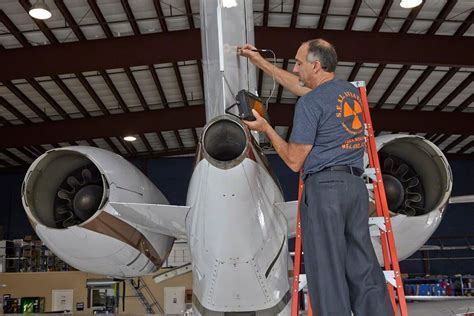
Training programs typically include classroom theory, practical hands-on training, and on-the-job training (OJT). Most standards specify minimum training hours and required OJT experience to progress through each level.
Cross-Training and Multi-Discipline Certification
Technicians often pursue multiple NDT certifications to increase versatility and career value. For example, a Level II in Magnetic Particle Testing might also hold a Level I in Eddy Current Testing.
Standards allow for some overlap in training hours, making it more efficient to pursue additional disciplines once a foundation is established.
Why NDT Certification Enhances Aviation Careers
The demand for certified NDT professionals in aviation is growing. With the increase in fleet sizes, aging aircraft, and stricter safety regulations, airlines and maintenance providers actively seek technicians who can perform high-level inspections and ensure regulatory compliance.
Benefits of certification include:
- Expanded career opportunities across MROs (Maintenance, Repair, and Overhaul), OEMs, and airlines.
- Higher earning potential due to specialized skillsets.
- Recognition by global aviation authorities, opening doors to international work.

Regulatory Oversight and FAA Considerations
While the FAA does not issue NDT-specific licenses, it mandates that all inspections be conducted by qualified personnel, as defined in FARs and supported by industry-recognized standards. Employers must demonstrate that personnel performing NDT are properly trained and certified under acceptable written practices.
Inspectors conducting NDT that impacts airworthiness must work under an FAA-approved system or quality program that outlines qualification, supervision, and ongoing competency verification.
Conclusion: Mastering the NDT Certification Path in Aviation
Becoming certified in NDT for aviation is not just a regulatory formality—it is a critical professional investment. Through structured training, discipline-specific expertise, and adherence to international standards, technicians position themselves as indispensable assets to aviation safety and operational reliability.
Whether entering the field at Level I or striving for Level III mastery, the journey to certification offers a clear path to career advancement, job security, and professional recognition. With global standards, industry demand, and technical evolution aligning in favor of certified professionals, now is the time to invest in an NDT certification and elevate your aviation career.