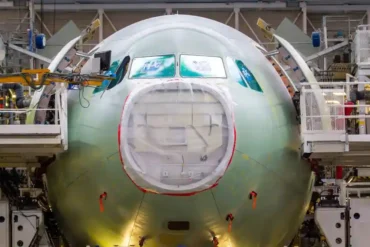
Airbus faces another setback just as it was emerging from a high-profile software challenge that disrupted thousands of A320-family aircraft worldwide. A newly discovered fuselage panel quality issue is now exerting fresh pressure on the world’s largest commercial aircraft manufacturer, casting uncertainty over its already-ambitious delivery goals and prompting a notable reaction in financial markets.
Reports from industry insiders indicate that several dozen Airbus A320-family jets are affected by a manufacturing flaw involving the aircraft’s fuselage panels. This issue is separate from the recent software directive and is believed to originate from the production process itself. While precise technical details remain closely guarded, the core of the problem appears to lie in panel integrity and compliance with Airbus’ stringent structural standards.
The upside for airlines is that this issue is not expected to affect in-service aircraft, offering Airbus a narrower and more manageable scope than the large-scale software update that temporarily grounded jets across the world in late November. Instead, the brunt of the disruption will fall on the delivery pipeline, where even small production irregularities ripple downstream.
Sources familiar with the matter told Reuters that the flaw was discovered early enough to prevent widespread operational consequences. Still, assembly lines are sensitive ecosystems, and even isolated defects can disrupt workflow timing, aircraft certification sequencing, and customer delivery slots.
Delivery Slowdowns Already Taking Shape
Industry sources confirm that Airbus has already begun adjusting delivery plans due to the fuselage issue, though the scale of delays remains uncertain. Several dozen aircraft are reportedly undergoing inspection or rework, and internal planning teams are reassessing December output forecasts.
The timing is difficult for the manufacturer. After October, Airbus was 235 aircraft short of its target of roughly 820 deliveries in 2025. With another 72 jets handed over in November, the gap narrowed but remained significant—163 aircraft still needed before year-end. That would require Airbus to surpass its all-time monthly delivery record of 138 aircraft in December 2019, a feat complicated by supply-chain fatigue and the fresh fuselage setback.
While partners like Pratt & Whitney reportedly produced enough engines for Airbus to feasibly reach the target, the broader aerospace supply chain remains fragile. Every additional bottleneck—from cabin suppliers to avionics to structural components—creates compounding pressure.
Market Reaction: Shares Slide as Investors Digest the News
News of the fuselage flaw sent Airbus shares down 5.3%, according to CNBC. Investors, already cautious due to the earlier software challenge, reacted swiftly to the indication that another quality problem could hamper momentum during the industry’s most time-critical delivery window.
Even so, there were signs of reassurance. Reuters sources suggested that the issue has been identified, contained, and isolated, giving Airbus a fighting chance to control the narrative and mitigate further disruption. Yet large manufacturers seldom escape market scrutiny when production defects arise—particularly when the company is racing toward a high-visibility annual output milestone.
A320 Software Crisis Nearly Resolved—but Still Fresh in Memory
The fuselage issue lands just as Airbus is finally closing the chapter on a far more dramatic scenario: the EASA-mandated software update affecting more than 6,000 A320-family aircraft. That directive followed an incident in which a JetBlue A320 abruptly lost altitude, prompting regulators to require immediate overnight updates to flight-control systems.
The software fix caused brief but widespread operational disruptions, even affecting high-profile missions such as the ITA Airways aircraft scheduled to transport the Pope from Istanbul to Beirut. By early December, Airbus confirmed that fewer than 100 aircraft were still grounded, signaling that the industry-wide scramble was nearly complete.
The proximity of these two issues—one digital, one structural—heightens the sense of pressure around Airbus’ year-end performance, especially as airlines lean heavily on new deliveries to stabilize schedules and support post-pandemic network expansion.
What This Means for Airbus Heading Into 2025
The fuselage panel defect adds another layer of complexity to Airbus’ already intensive production roadmap. While not as disruptive as an in-service defect, it threatens the company’s ability to close out the year with strong delivery numbers—an indicator closely watched by investors, airlines, and suppliers.
If delays spill into early 2026, backlogs may grow even larger, tightening airline fleet-planning flexibility at a time when both low-cost and full-service carriers are aggressively upgauging and expanding narrowbody operations. Airbus maintains a dominant position in this segment, but continued quality issues could give competitors opportunities to exploit.
The coming weeks will determine whether Airbus can contain the fuselage flaw without sacrificing December’s delivery tempo. Whether or not it hits its 820-aircraft target, the manufacturer heads into the next year with heightened scrutiny on its supply chain resilience, quality controls, and industrial stability.
The industry will now watch closely as Airbus works to maintain momentum under the weight of another critical—yet hopefully short-lived—manufacturing challenge.